
The best biostimulator UK for you may not be the one with the most compelling online claims. Sculptra, Radiesse, Profhilo and polynucleotides differ in their ingredients and intended effects, so the right option depends on your skin, goals and suitability, not a universal ranking.
It’s understandable if the names and mechanisms feel difficult to compare, especially when advertised results can sound predictable. Biostimulators aren’t interchangeable, and they can’t guarantee a particular outcome. A qualified medical practitioner can explain what each option may or may not address, discuss potential risks and help you decide whether treatment is appropriate.
In this guide, we’ll compare how these treatments are discussed, the kinds of concerns they may be considered for and why results and timelines can vary. We’ll also cover practical questions to ask about a practitioner’s qualifications, the treatment plan and aftercare. Vie Aesthetics offers a doctor-led, personalised approach, with treatment options discussed in consultation. The aim is to help you make an informed, unpressured decision based on individual suitability.
There isn’t one best biostimulator UK treatment for everyone. Suitability depends on your goals, medical history and an assessment by a qualified practitioner. If you’re comparing options to find the best biostimulator UK choice for you, it helps to understand that the term describes a broad category, not one product or a guarantee of a particular result.
In aesthetic medicine, a biostimulator is a treatment intended to encourage or support a biological response, such as collagen production. Collagen is a protein that helps provide structure to the skin and other tissues. Products vary in their ingredients and intended effects, so the term doesn’t mean they all work in the same way. For context, Sculptra (poly-L-lactic acid) is one example of a named product within this broader conversation, not a synonym for every biostimulator.
For an overview of two other treatment terms, watch this video. It can help you prepare questions, but it can’t determine personal suitability.
Think of “biostimulator” as an umbrella term. It groups different treatments discussed for their potential to stimulate collagen or support skin quality, while each product has its own formulation and clinical considerations. The word alone doesn’t tell you where a treatment may be used, whether it suits you, or what changes to expect. You can read more about polynucleotide treatments as one distinct category.
A simple guide to the terms
Myth: All collagen-stimulating treatments work identically, so a universal ranking can identify the best choice.
Reality: Treatments differ, and suitability depends on your aims, circumstances and practitioner assessment. Ask what a proposed option is intended to address, what it may not do, and what uncertainties or risks apply. Visible changes and individual responses can vary.
Key takeaways
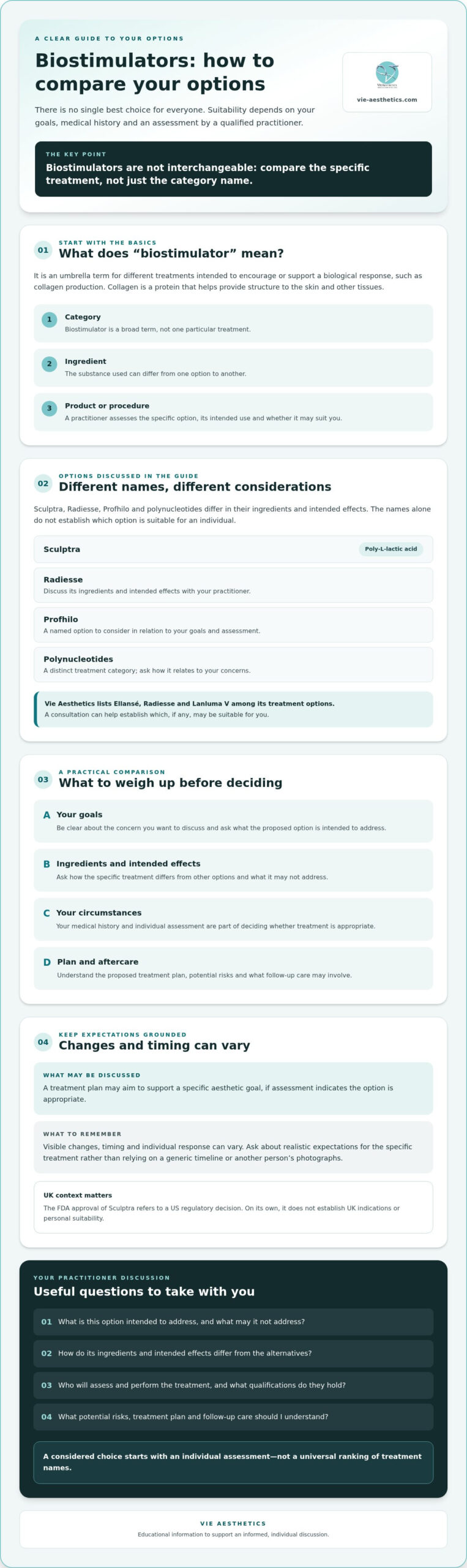
Some aesthetic treatments are intended to encourage the body’s own collagen production. Collagen is a protein that contributes to the skin’s structure, but this broad description doesn’t mean every product triggers the same response or is used for the same purpose. Ask the practitioner to explain the specific option being considered, including its intended use, suitable treatment area and potential benefits.
A practitioner may discuss a treatment with the aim of supporting changes in skin quality or structure over time. That’s different from assuming an immediate, predictable increase in volume: any early appearance and later changes depend on the treatment, the individual and their response. Avoid relying on a generic timeline or another person’s photographs as a forecast for your own results.
Product claims also need to be understood in context. The FDA approval of Sculptra refers to a US regulatory decision and does not, by itself, establish UK indications or suitability. Ask your practitioner which information applies to the proposed treatment and your circumstances.
It may: be considered as part of a plan to support a specific aesthetic goal, if assessment indicates that the treatment is appropriate.
It won’t: guarantee a particular appearance, work identically for everyone or necessarily address every concern. A consultation can clarify potential benefits and alternatives, but it can’t promise an outcome.
For example, Vie Aesthetics lists Ellansé treatment as an option. Its relevance depends on an individual assessment, rather than its position in an online ranking or a general label such as “collagen-stimulating”.
If you’d like to discuss your goals and available options, you can view the consultation booking page.
A useful comparison starts with the concern you want to discuss, not a league table of treatments. The options below are prompts for a consultation, not a recommendation. A qualified practitioner needs to confirm what each treatment involves, whether it’s suitable for you and what alternatives may be appropriate.
Ask the practitioner to summarise your goal and explain why they’re suggesting a particular option. Find out what the treatment is intended to address and what it may not do. You can also ask what risks and aftercare to consider, how the option compares with alternatives, and whether another approach or no treatment may be more appropriate. Polynucleotide treatment information can help you recognise this as a separate category to discuss, rather than assuming it’s interchangeable with other options.
Use this table to organise your questions. Vie Aesthetics lists Ellansé, Radiesse and Lanluma V as treatment options. Other names shown are included for general comparison only and shouldn’t be taken as confirmation that Vie Aesthetics offers them.
| Option to discuss | Questions for your practitioner | Details to confirm |
|---|---|---|
| Ellansé | Could it be relevant to my stated goal? | Intended use, suitability, risks and aftercare. |
| Radiesse | Why might this be considered over an alternative? | Product-specific approach, suitable areas and limitations. |
| Lanluma V | Is it appropriate for the concern and area I’m asking about? | Intended use, suitability criteria and treatment plan. |
| Polynucleotides | How does this category relate to my priorities? | Specific product, intended use and evidence for the recommendation. |
| Profhilo or Sculptra | Are these relevant alternatives for my circumstances? | Availability, product information, suitability and any differences from the proposed option. |
Don’t infer a treatment’s formulation, suitability or expected effect from its name alone. Ask the practitioner to explain the product details and how they relate to your goal. Individual suitability, response and outcomes vary, so the table can guide a discussion but can’t decide which option is right for you. Vie Aesthetics’ procedures are performed only by doctors and qualified medical practitioners, with personalised treatment planning.
There’s no single answer to “best biostimulator UK” that applies to everyone. A careful consultation should help you understand whether a treatment fits your goals, what alternatives exist and what uncertainties to consider, without pressure to proceed.
Bring a clear description of what you hope to discuss. Then use these questions to assess the recommendation and the person proposing it:
Vie Aesthetics states that its procedures are performed only by doctors and qualified medical practitioners. You can review the Vie Aesthetics practitioner team for background, then raise any further questions directly during a consultation.
Take time to consider your priorities and note down anything you’d like clarified. A consultation is an opportunity to discuss your goals, suitability and available options; it doesn’t commit you to having treatment. You should feel comfortable asking for time to consider the information before making a decision.
Vie Aesthetics’ personalised approach is intended to support an individual discussion rather than a one-size-fits-all recommendation. No practitioner can promise a particular appearance, so make sure you understand the proposed plan, risks and follow-up before deciding.
The best biostimulator UK option isn’t a universal winner. Treatments differ, and the right discussion starts with your goals, individual suitability and a clear understanding of what a treatment may or may not achieve. Visible changes and responses vary, so an online ranking or another person’s experience can’t predict your own outcome.
Before deciding, ask why a treatment is being recommended, what alternatives may be appropriate, and what risks, aftercare and expectations to consider. Take time to reflect on the answers. A consultation is a chance to explore your options, not an obligation to proceed.
At Vie Aesthetics, procedures are performed only by doctors and qualified medical practitioners, with treatment planning tailored to the individual. The practice received the Global Best Aesthetic Practice of the Year award at the MyFaceMyBody Awards 2020/21. These details may help inform your choice of provider, alongside asking about the practitioner who would assess and treat you.
With the right information and a considered conversation, you can take the next step at a pace that feels comfortable for you.
There isn’t one best biostimulator in the UK for everyone. Treatments differ in their ingredients, intended use and clinical considerations, so the right option depends on your goals, medical history and an assessment by a qualified practitioner. Ask why a particular treatment is being considered, what it may and may not achieve, and which alternatives could suit you. An online ranking can’t determine individual suitability or predict your result.
Not exactly. “Biostimulator” describes a broad category of treatments discussed for their potential to stimulate or support collagen production, while “dermal filler” describes a type of injectable treatment. Some products may be described as collagen-stimulating fillers, so the terms can overlap. They don’t mean every product works in the same way. Ask your practitioner to explain the specific product, its intended purpose and how it differs from alternatives.
There isn’t one timeline that applies to every biostimulator or every person. The type of treatment, the plan and your individual response can all influence when changes may become noticeable and how they develop. A practitioner should explain what to expect for the specific option being discussed, when your progress may be reviewed and what follow-up involves. Don’t assume another person’s experience or photographs predict your own results.
Some treatment plans may consider more than one aesthetic treatment, but combining them isn’t suitable for everyone and shouldn’t be assumed to improve results. A qualified practitioner can assess your goals, medical history, treatment timing and potential risks before recommending whether a combined or staged approach is appropriate. Ask why each treatment is proposed, what each is intended to address and whether a simpler plan or an alternative would be more suitable.
If a practitioner considers a biostimulator unsuitable, they should explain why and discuss appropriate alternatives, which may include another treatment or no treatment. Suitability can depend on your goals, health and individual circumstances. You can ask for the reasoning, potential risks and expected limitations to be clarified, and take time to consider the advice. A consultation is for informed discussion; it doesn’t mean you have to proceed with any treatment.
There isn’t one reliable UK price for biostimulator treatment. The amount quoted may depend on the specific treatment and individual plan, so broad online figures may not reflect what a practitioner recommends for you. Ask the clinic for a clear, personalised quote before deciding, and check exactly which treatment and appointments it covers. Vie Aesthetics can discuss available options and suitability during a consultation; no treatment price is quoted here.

The best biostimulator UK for you may not be the one with the most compelling online claims. Sculptra, Radiesse, Profhilo and polynucleotides differ in their ingredients and intended effects, so the right option depends on your skin, goals and suitability, not a universal ranking.
It’s understandable if the names and mechanisms feel difficult to compare, especially when advertised results can sound predictable. Biostimulators aren’t interchangeable, and they can’t guarantee a particular outcome. A qualified medical practitioner can explain what each option may or may not address, discuss potential risks and help you decide whether treatment is appropriate.
In this guide, we’ll compare how these treatments are discussed, the kinds of concerns they may be considered for and why results and timelines can vary. We’ll also cover practical questions to ask about a practitioner’s qualifications, the treatment plan and aftercare. Vie Aesthetics offers a doctor-led, personalised approach, with treatment options discussed in consultation. The aim is to help you make an informed, unpressured decision based on individual suitability.
There isn’t one best biostimulator UK treatment for everyone. Suitability depends on your goals, medical history and an assessment by a qualified practitioner. If you’re comparing options to find the best biostimulator UK choice for you, it helps to understand that the term describes a broad category, not one product or a guarantee of a particular result.
In aesthetic medicine, a biostimulator is a treatment intended to encourage or support a biological response, such as collagen production. Collagen is a protein that helps provide structure to the skin and other tissues. Products vary in their ingredients and intended effects, so the term doesn’t mean they all work in the same way. For context, Sculptra (poly-L-lactic acid) is one example of a named product within this broader conversation, not a synonym for every biostimulator.
For an overview of two other treatment terms, watch this video. It can help you prepare questions, but it can’t determine personal suitability.
Think of “biostimulator” as an umbrella term. It groups different treatments discussed for their potential to stimulate collagen or support skin quality, while each product has its own formulation and clinical considerations. The word alone doesn’t tell you where a treatment may be used, whether it suits you, or what changes to expect. You can read more about polynucleotide treatments as one distinct category.
A simple guide to the terms
Myth: All collagen-stimulating treatments work identically, so a universal ranking can identify the best choice.
Reality: Treatments differ, and suitability depends on your aims, circumstances and practitioner assessment. Ask what a proposed option is intended to address, what it may not do, and what uncertainties or risks apply. Visible changes and individual responses can vary.
Key takeaways
Some aesthetic treatments are intended to encourage the body’s own collagen production. Collagen is a protein that contributes to the skin’s structure, but this broad description doesn’t mean every product triggers the same response or is used for the same purpose. Ask the practitioner to explain the specific option being considered, including its intended use, suitable treatment area and potential benefits.
A practitioner may discuss a treatment with the aim of supporting changes in skin quality or structure over time. That’s different from assuming an immediate, predictable increase in volume: any early appearance and later changes depend on the treatment, the individual and their response. Avoid relying on a generic timeline or another person’s photographs as a forecast for your own results.
Product claims also need to be understood in context. The FDA approval of Sculptra refers to a US regulatory decision and does not, by itself, establish UK indications or suitability. Ask your practitioner which information applies to the proposed treatment and your circumstances.
It may: be considered as part of a plan to support a specific aesthetic goal, if assessment indicates that the treatment is appropriate.
It won’t: guarantee a particular appearance, work identically for everyone or necessarily address every concern. A consultation can clarify potential benefits and alternatives, but it can’t promise an outcome.
For example, Vie Aesthetics lists Ellansé treatment as an option. Its relevance depends on an individual assessment, rather than its position in an online ranking or a general label such as “collagen-stimulating”.
If you’d like to discuss your goals and available options, you can view the consultation booking page.
A useful comparison starts with the concern you want to discuss, not a league table of treatments. The options below are prompts for a consultation, not a recommendation. A qualified practitioner needs to confirm what each treatment involves, whether it’s suitable for you and what alternatives may be appropriate.
Ask the practitioner to summarise your goal and explain why they’re suggesting a particular option. Find out what the treatment is intended to address and what it may not do. You can also ask what risks and aftercare to consider, how the option compares with alternatives, and whether another approach or no treatment may be more appropriate. Polynucleotide treatment information can help you recognise this as a separate category to discuss, rather than assuming it’s interchangeable with other options.
Use this table to organise your questions. Vie Aesthetics lists Ellansé, Radiesse and Lanluma V as treatment options. Other names shown are included for general comparison only and shouldn’t be taken as confirmation that Vie Aesthetics offers them.
| Option to discuss | Questions for your practitioner | Details to confirm |
|---|---|---|
| Ellansé | Could it be relevant to my stated goal? | Intended use, suitability, risks and aftercare. |
| Radiesse | Why might this be considered over an alternative? | Product-specific approach, suitable areas and limitations. |
| Lanluma V | Is it appropriate for the concern and area I’m asking about? | Intended use, suitability criteria and treatment plan. |
| Polynucleotides | How does this category relate to my priorities? | Specific product, intended use and evidence for the recommendation. |
| Profhilo or Sculptra | Are these relevant alternatives for my circumstances? | Availability, product information, suitability and any differences from the proposed option. |
Don’t infer a treatment’s formulation, suitability or expected effect from its name alone. Ask the practitioner to explain the product details and how they relate to your goal. Individual suitability, response and outcomes vary, so the table can guide a discussion but can’t decide which option is right for you. Vie Aesthetics’ procedures are performed only by doctors and qualified medical practitioners, with personalised treatment planning.
There’s no single answer to “best biostimulator UK” that applies to everyone. A careful consultation should help you understand whether a treatment fits your goals, what alternatives exist and what uncertainties to consider, without pressure to proceed.
Bring a clear description of what you hope to discuss. Then use these questions to assess the recommendation and the person proposing it:
Vie Aesthetics states that its procedures are performed only by doctors and qualified medical practitioners. You can review the Vie Aesthetics practitioner team for background, then raise any further questions directly during a consultation.
Take time to consider your priorities and note down anything you’d like clarified. A consultation is an opportunity to discuss your goals, suitability and available options; it doesn’t commit you to having treatment. You should feel comfortable asking for time to consider the information before making a decision.
Vie Aesthetics’ personalised approach is intended to support an individual discussion rather than a one-size-fits-all recommendation. No practitioner can promise a particular appearance, so make sure you understand the proposed plan, risks and follow-up before deciding.
The best biostimulator UK option isn’t a universal winner. Treatments differ, and the right discussion starts with your goals, individual suitability and a clear understanding of what a treatment may or may not achieve. Visible changes and responses vary, so an online ranking or another person’s experience can’t predict your own outcome.
Before deciding, ask why a treatment is being recommended, what alternatives may be appropriate, and what risks, aftercare and expectations to consider. Take time to reflect on the answers. A consultation is a chance to explore your options, not an obligation to proceed.
At Vie Aesthetics, procedures are performed only by doctors and qualified medical practitioners, with treatment planning tailored to the individual. The practice received the Global Best Aesthetic Practice of the Year award at the MyFaceMyBody Awards 2020/21. These details may help inform your choice of provider, alongside asking about the practitioner who would assess and treat you.
With the right information and a considered conversation, you can take the next step at a pace that feels comfortable for you.
There isn’t one best biostimulator in the UK for everyone. Treatments differ in their ingredients, intended use and clinical considerations, so the right option depends on your goals, medical history and an assessment by a qualified practitioner. Ask why a particular treatment is being considered, what it may and may not achieve, and which alternatives could suit you. An online ranking can’t determine individual suitability or predict your result.
Not exactly. “Biostimulator” describes a broad category of treatments discussed for their potential to stimulate or support collagen production, while “dermal filler” describes a type of injectable treatment. Some products may be described as collagen-stimulating fillers, so the terms can overlap. They don’t mean every product works in the same way. Ask your practitioner to explain the specific product, its intended purpose and how it differs from alternatives.
There isn’t one timeline that applies to every biostimulator or every person. The type of treatment, the plan and your individual response can all influence when changes may become noticeable and how they develop. A practitioner should explain what to expect for the specific option being discussed, when your progress may be reviewed and what follow-up involves. Don’t assume another person’s experience or photographs predict your own results.
Some treatment plans may consider more than one aesthetic treatment, but combining them isn’t suitable for everyone and shouldn’t be assumed to improve results. A qualified practitioner can assess your goals, medical history, treatment timing and potential risks before recommending whether a combined or staged approach is appropriate. Ask why each treatment is proposed, what each is intended to address and whether a simpler plan or an alternative would be more suitable.
If a practitioner considers a biostimulator unsuitable, they should explain why and discuss appropriate alternatives, which may include another treatment or no treatment. Suitability can depend on your goals, health and individual circumstances. You can ask for the reasoning, potential risks and expected limitations to be clarified, and take time to consider the advice. A consultation is for informed discussion; it doesn’t mean you have to proceed with any treatment.
There isn’t one reliable UK price for biostimulator treatment. The amount quoted may depend on the specific treatment and individual plan, so broad online figures may not reflect what a practitioner recommends for you. Ask the clinic for a clear, personalised quote before deciding, and check exactly which treatment and appointments it covers. Vie Aesthetics can discuss available options and suitability during a consultation; no treatment price is quoted here.