

Facial Volume Loss After Weight Loss: What Helps?
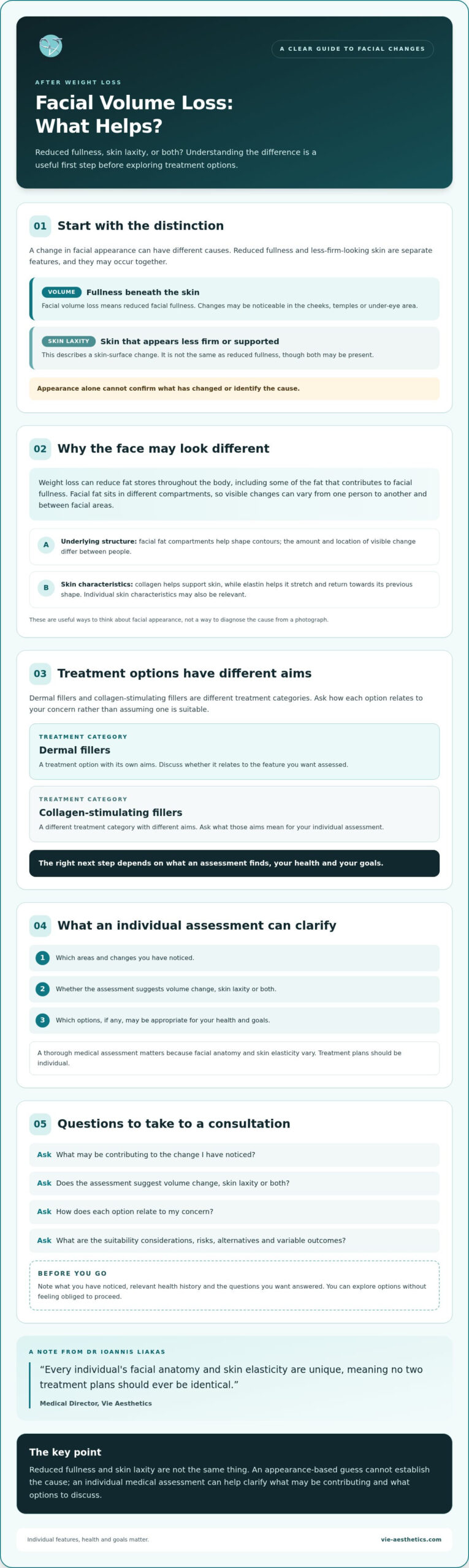
Facial volume loss after weight loss happens when some of the fat that supports your facial contours becomes smaller. Your face may simply look slimmer, but you may also notice hollow cheeks or temples, deeper folds, more visible under-eye shadows, jowling or looser skin around the jawline and neck. These changes are not unique to weight-loss injections. They can follow any substantial or rapid weight loss, including lifestyle-led weight loss and bariatric surgery. The informal term ‘Ozempic face’ describes an appearance, not a medical diagnosis or a side effect exclusive to one medicine.
There is no single best treatment. A doctor first needs to identify whether the main issue is lost volume, skin laxity, reduced skin quality or a combination. Targeted dermal filler may replace selected volume; collagen-stimulating injectables may support gradual tissue remodelling; skin-tightening procedures may address laxity; and some people need a carefully staged combination. Treatment is always optional.
“Significant weight loss can bring important health benefits, yet the facial changes can feel unexpected. The safest plan starts with anatomy: we assess what has changed, where support has been lost and whether laxity, volume or skin quality is the main concern. We then treat conservatively, if treatment is appropriate at all.” Dr Ioannis Liakas, Medical Director at Vie Aesthetics
The short answer
Facial fat loss can make the cheeks, temples and under-eye area look hollow and may make lines or folds more visible.
- Loose skin and volume loss are different problems, although they often occur together.
- Weight-loss medicines do not create a separate facial condition; the amount and pace of weight loss are relevant factors.
- Skincare can support hydration and surface quality, but it cannot replace deeper facial volume.
- The most suitable option depends on your anatomy, medical history, weight trajectory and goals.
Why does your face change after weight loss?
Your face contains several superficial and deeper fat compartments. These contribute to the curves of the cheeks and temples and help support the skin above them. When body weight decreases, some facial fat may also reduce. The pattern is individual: one person may mainly notice slimmer cheeks, while another sees more change around the temples, eyes or lower face.
Reduced facial volume
Volume loss means less fullness beneath the skin. It may show as flatter cheeks, hollow temples, more pronounced tear troughs or a sharper transition between facial areas. Existing lines can look deeper because the tissue beneath them offers less support.
Skin laxity
Skin laxity means the skin and supporting tissues look less firm or do not contract fully around the face’s new contours. You may notice jowling, softer definition along the jawline or loose skin on the neck. Skin laxity is not the same as volume loss, and adding volume does not automatically correct it.
Skin quality
Weight loss does not directly diagnose a skin-quality problem, but age, sun exposure, smoking, hormones, genetics and general health all influence collagen, elasticity, hydration and texture. Dryness, fine lines or crepiness may therefore become more noticeable at the same time as the face loses fullness.
The pace and extent of weight loss
Large or rapid changes can make the contrast more visible because the skin and supporting tissues must adapt to a different facial shape. This does not mean everyone who loses weight will develop a hollow or lax appearance. Age, starting weight, facial anatomy and individual fat distribution all affect the result.
What can facial volume loss after weight loss look like
Common changes include the following. A photograph cannot confirm their cause, so treat this as a guide rather than a self-diagnosis.
| Area | What you may notice | What may contribute |
| Cheeks | Less projection or fullness; the mid-face may look flatter | Volume loss, laxity or both |
| Temples | Hollowing at the sides of the forehead | Reduced soft-tissue volume |
| Under-eyes | More visible hollows or shadows | Volume change, skin quality and anatomy |
| Nasolabial folds | Lines from the nose towards the mouth may look deeper | Reduced mid-face support and tissue movement |
| Jawline | Less definition or more visible jowling | Laxity, tissue descent and changes in support |
| Neck | Loose or crepey-looking skin | Skin laxity and skin quality |
Is ‘Ozempic face’ different from ordinary weight loss?
No. ‘Ozempic face’ is a popular, non-medical term for facial hollowing, lines and laxity noticed after weight loss associated with medicines such as semaglutide or tirzepatide. The same changes can happen after other forms of weight loss. It is more accurate to discuss facial volume loss after weight loss rather than attribute the appearance to one brand.
If you take a prescribed weight-management medicine, do not stop it, change the dose or slow your treatment solely for cosmetic reasons without speaking to your prescriber. Your wider health comes first. An aesthetic practitioner should understand your medication, progress and relevant medical history before advising on treatment.
Will facial volume return when your weight stabilises?
Your appearance may continue to settle once your weight is stable, but there is no reliable timetable and no guarantee that lost fullness will return. Skin contraction and facial fat distribution vary widely. Regaining weight purely to change your face is not a predictable solution and may conflict with your health goals.
If you are still losing weight quickly, a doctor may advise monitoring the changes before committing to a larger treatment plan. Smaller, staged decisions can reduce the risk of treating a moving target.
What treatments may help facial changes after weight loss?
The right option depends on the concern identified during assessment. No treatment recreates your former face exactly, and every procedure has limitations and risks. A conservative plan should restore balance rather than simply add as much volume as possible.
| Assessment finding | Options a doctor may discuss | Primary aim | What it does not automatically fix |
| Mainly volume loss | Hyaluronic acid dermal filler; selected collagen-stimulating injectables | Restore targeted support or encourage gradual collagen production | Loose skin, surface texture or every area at once |
| Mainly skin laxity | Endolift or another carefully selected tightening procedure | Improve firmness and contour in suitable areas | Replace lost facial volume |
| Tissue descent | Thread lift in appropriately selected patients | Reposition selected tissues and support contour | Create true volume or replace surgery where laxity is marked |
| Skin quality | Skin boosters, polynucleotides, PRP or other regenerative treatments | Support hydration, texture or regenerative processes | Replace deep structural volume |
| Mixed concerns | A staged combination plan such as VIElift, where suitable | Address separate concerns with different treatment categories | Guarantee a result or remove the need for careful sequencing |
Hyaluronic acid dermal fillers
A doctor may use hyaluronic acid filler to restore selected areas of support, such as the cheeks or temples, depending on your anatomy. Results are usually visible promptly, although swelling can temporarily affect the appearance. The aim should be proportion and structure, not indiscriminate filling. Fillers can cause swelling, tenderness, bruising, lumps, asymmetry or infection. Rare but serious complications include vascular occlusion, which can damage skin and, in very rare cases, affect vision. Ask which product will be used, why it suits the area, how complications are managed and whether the clinic has an emergency protocol. Read more about dermal filler treatments at Vie Aesthetics.
Collagen stimulating injectables
Collagen-stimulating injectables work differently from a conventional hyaluronic acid filler. Depending on the product, they may provide some immediate structure and encourage a gradual collagen response over the following months. Results are not identical between products, and not every formulation is suitable for every facial area. Some collagen stimulators are not readily reversible. This makes product choice, placement and practitioner experience particularly important. Your doctor should explain the expected timeline, longevity, risks and alternatives before treatment. Explore Vie Aesthetics’ collagen stimulant options.
Endolift and skin tightening
Endolift is a minimally invasive laser treatment used to address selected areas of skin laxity and contour. It does not replace lost volume. Because the treatment can also affect small, localised fat deposits, a volume-depleted face requires particularly careful patient selection, treatment planning and control of the areas treated. A doctor may consider Endolift where laxity is the dominant concern, or combine it with a separate volume-restoring treatment when both issues are present. The order and timing matter. More treatment is not necessarily better. Read the clinic’s full Endolift treatment information.
Thread lifting
A thread lift may be discussed when tissue position and mild to moderate laxity contribute to the concern. Threads are intended to support or reposition tissue; they do not recreate lost fat. They also carry risks, including bruising, swelling, asymmetry, infection, visible or palpable threads and temporary discomfort.
Skin boosters and regenerative treatments
Skin boosters, polynucleotides, platelet-rich plasma and related treatments may support hydration, texture or regenerative processes in suitable patients. They can complement a plan when the skin looks dry, crepey or less resilient. They should not be described as replacements for deeper facial volume.
Combination treatment
Post-weight-loss facial changes often affect more than one tissue layer. A staged plan may therefore combine conservative volume support, tissue tightening, skin-quality treatment or threads. Vie Aesthetics’ VIElift is one example of a personalised combination approach, but the specific components should follow assessment rather than a fixed package. See how a tailored VIElift treatment plan may combine different treatment aims.
When surgery may be the more honest option
Non-surgical treatment has limits. If laxity is marked, a surgical opinion may be more appropriate than repeated filler, threads or energy-based procedures. A responsible clinician should say when a non-surgical plan is unlikely to meet your goals and should be willing to recommend no treatment or an independent surgical assessment.
When should you consider treatment after weight loss?
There is no universal waiting period. Timing depends on whether your weight is still changing, your general health, your medication plan, your nutritional status, the treatment under consideration and how much the facial appearance is still evolving. A doctor may suggest waiting until your weight trend is steadier before making a major correction. This does not mean every person must wait a fixed number of months. It means the plan should account for the likelihood of further change. Before booking, consider the following:
- Is your weight still changing quickly?
- Are you taking a GLP-1 or another prescription medicine that your aesthetic practitioner needs to know about?
- Have you had recent blood tests or been advised about nutrition by your prescribing or primary-care clinician?
- Are you seeking a subtle improvement, or expecting treatment to restore your exact pre-weight-loss appearance?
- Do you have an important event soon, and have you allowed for swelling, bruising and recovery?
What happens at a post weight loss facial assessment?
At Vie Aesthetics, the consultation should establish what has changed before discussing a procedure. Your practitioner may assess:
- Your medical history, medicines, allergies and previous aesthetic treatment
- The amount and pace of weight change and whether it is continuing
- Facial proportions, asymmetry and the pattern of volume loss
- Skin thickness, elasticity, texture and degree of laxity
- The cheeks, temples, under-eyes, lower face, jawline and neck as one connected structure
- Your priorities, expectations and tolerance for downtime, maintenance and risk
Bring older photographs if you are comfortable doing so. They can help explain what has changed, but they should guide discussion rather than create an obligation to reproduce a former appearance.
Questions to ask before you decide
- What do you think is the main issue: volume loss, laxity, skin quality or a combination?
- Why is this treatment appropriate for my anatomy and current weight trajectory?
- What will it improve, and what will it not improve?
- What are the common and serious risks?
- What product or device will you use, and who will perform the procedure?
- What happens if I have a complication or dislike the result?
- Could a staged approach, no treatment or a surgical opinion be more appropriate?
- What maintenance, recovery and total cost should I expect?
A considered next step
Facial volume loss after weight loss is not one problem with one solution. Hollowing, laxity and skin quality need separate assessment, even when they appear together. The safest plan is specific, conservative and honest about what treatment can and cannot achieve. Vie Aesthetics offers doctor-led consultations at its CQC-registered clinics in Holborn, London and Rayleigh, Essex. You can discuss your facial changes, medical history and goals without any obligation to proceed.
Book a personalised consultation or contact the clinic team if you would like help choosing the correct appointment.
Frequently asked questions
Is facial volume loss after weight loss normal?
It is common, but it does not happen to everyone or affect every face in the same way. Cheeks, temples and the under-eye area may lose fullness, while skin laxity can become more visible around the jawline and neck. A consultation can distinguish these changes.
Is Ozempic face caused by the medicine itself?
‘Ozempic face’ is not a medical diagnosis and is not unique to Ozempic. It describes facial hollowing, lines or laxity noticed after weight loss. Similar changes can follow other GLP-1 medicines, bariatric surgery or lifestyle-led weight loss.
Can facial volume return naturally?
Your appearance may settle after your weight stabilises, but there is no reliable way to predict whether lost fullness will return. Facial fat distribution and skin contraction vary. If treatment interests you, a staged plan may be sensible while changes are still evolving.
Can skincare restore lost facial volume?
No cream or serum can replace deeper fat or structural volume. A suitable routine can improve hydration, barrier function, pigmentation and surface texture. Daily broad-spectrum SPF also helps protect collagen, but skincare and volume-restoring procedures have different aims.
Are dermal fillers or Endolift better after weight loss?
They address different concerns. Dermal filler may restore selected volume, while Endolift is used for suitable areas of laxity and contour. If both concerns are present, a doctor may discuss a staged combination. Neither option is automatically right for everyone.
Can Endolift make facial volume loss worse?
Endolift can affect small localised fat deposits as well as laxity, so a volume-depleted face needs careful assessment and precise treatment planning. It should not be treated as a universal solution for post-weight-loss changes or used to replace lost volume.
How much filler is needed after significant weight loss?
There is no standard amount. The appropriate volume depends on facial anatomy, the areas affected, the product used and the intended result. A conservative practitioner may treat in stages and review the balance before adding more.
Should I wait until my weight is stable?
Often, a steadier weight makes planning easier because further loss may change the result. There is no fixed waiting period that suits everyone. Your practitioner should consider your weight trend, health, medication and the proposed treatment.
What if I am still taking a GLP-1 medicine?
Tell both your prescriber and aesthetic practitioner. Do not alter a prescribed medicine for cosmetic reasons without medical advice. The practitioner should consider your ongoing weight trajectory, health history and treatment timing before recommending an aesthetic procedure.
What are the risks of treating facial volume loss?
Risks depend on the procedure. They can include swelling, bruising, infection, asymmetry, lumps, unwanted contour changes or dissatisfaction. Injectable fillers also carry rare but serious vascular risks. Ask how the clinic prevents, recognises and manages complications.
Medical and treatment disclaimer
This article provides general information and does not replace an individual medical assessment. Suitability, risks, recovery and results vary. Do not start, stop or change prescription medication without advice from the clinician responsible for your care.