The best aesthetic clinic isn’t necessarily the one with the longest treatment menu. When choosing an aesthetic clinic, look at who will assess you, how carefully they discuss your needs and whether you have space to consider your options. These same questions can help you compare any aesthetic clinic with other providers.
It’s understandable to find clinics difficult to compare when websites list different treatments and credentials. A useful consultation should give you time to discuss your goals, relevant history, possible options and their limitations before you decide whether to proceed.
This guide explains what to check, from practitioner qualifications and treatment suitability to reviews and aftercare. It also offers practical questions to help you assess whether a clinic’s information is clear and its recommendations are tailored to your circumstances.
Vie Aesthetics states that its procedures are performed only by doctors and qualified medical practitioners, and describes its treatment planning as personalised. Use the guidance ahead to make an informed choice at your own pace.
Assess practitioner qualifications, the quality of the consultation, whether a proposed treatment suits your needs and what follow-up is explained. A polished website or extensive treatment menu can help you understand what a clinic offers, but neither shows whether a particular procedure is appropriate for you.
Use this checklist when comparing providers:
The term Aesthetic medicine covers a range of procedures, so the relevant experience will depend on what you’re considering. Ask the practitioner to explain their experience with that procedure in plain language, and how they assess whether it may suit your needs. If you’re comparing an aesthetic clinic Holborn with other providers, apply the same questions consistently rather than relying on the treatment list alone.
Ask directly who will carry out the assessment and who would perform the proposed procedure. Check the practitioner’s name and professional details against the relevant official register, using the register itself rather than relying only on a clinic profile.
A practitioner should be able to describe their relevant experience in clear, accessible language. You can also ask what happens if they decide the treatment isn’t suitable; a useful answer should explain the reasoning without making you feel obliged to proceed.
Look for a balanced explanation of potential benefits, limitations and how outcomes can vary between individuals. The clinic should also make it clear how you can ask questions, raise concerns and find out about follow-up care.
Separate information you can verify, such as a practitioner’s registered details, from promotional claims. Reviews can offer insight into other people’s experiences, while photographs show selected examples; neither establishes what your own outcome will be.
A patient-first aesthetic clinic makes practitioner details checkable, explains suitability and limitations, and clearly describes how questions and follow-up are handled. For clinic-specific information, you can review Vie Aesthetics consultation booking details.
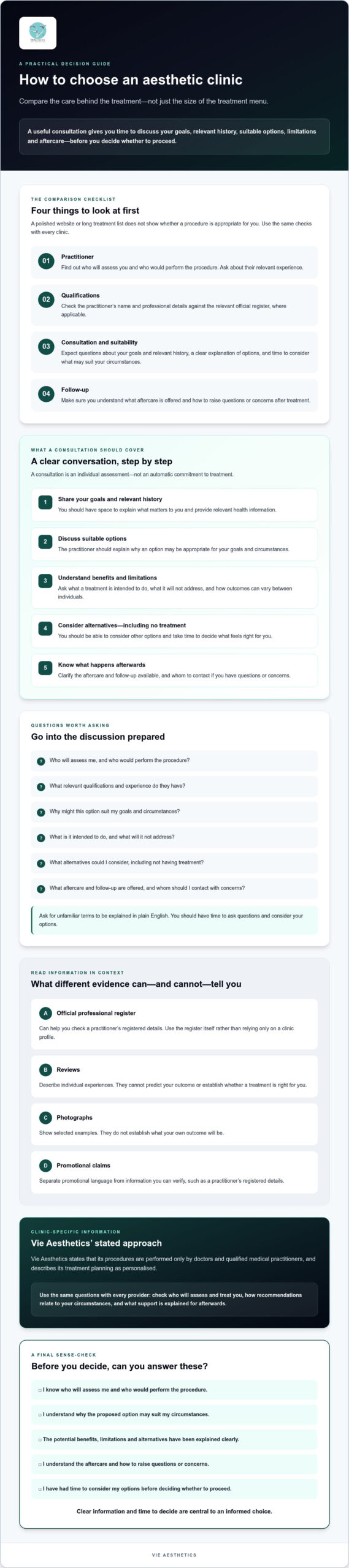
A consultation should be a discussion and individual assessment, not an automatic commitment to treatment. You should be able to explain your goals, share relevant health information, hear suitable options and their limitations, and ask questions before deciding what to do.
If you’re searching for an aesthetic clinic Holborn, use the consultation to find out how a recommendation relates to your own circumstances. A practitioner should explain why an option may be appropriate for you, while making clear that treatment recommendations and outcomes aren’t universal.
Prepare a few questions so you can leave with a clear understanding of the proposal. For example, ask:
Ask for unfamiliar terms to be explained in plain English. The Royal College of Surgeons of England’s Professional Standards for Cosmetic Surgery relates to cosmetic surgery, so don’t assume it sets requirements for every non-surgical aesthetic procedure. Its guidance can still help you reflect on the importance of clear communication and informed decisions.
A helpful explanation describes the intended aim without promising a particular result. It should also make clear that responses and outcomes vary between individuals, and explain relevant limitations and aftercare in terms you understand.
If you’re comparing an aesthetic clinic Holborn with other providers, notice whether the conversation gives you time to consider this information. A rushed, unclear or pressurised discussion is a reason to pause, ask for clarification and decide in your own time.
If you’d like to discuss your goals with Vie Aesthetics, you can arrange a consultation. Booking a discussion doesn’t mean you have to proceed with a procedure.
Use reviews as one part of your assessment, then check treatment information and aftercare directly with the clinic. Look for specific comments about communication, care and follow-up, and check where reviews are published and whether the information is current.
Reviews can help you understand other patients’ experiences, but they can’t predict your outcome or replace a personalised consultation. Testimonials describe individual experiences, not a standard result. Treat promotional language and before-and-after images as context to discuss, rather than proof that a particular treatment will suit you.
| Evidence to look for | Question to ask | What remains unverified |
|---|---|---|
| Recent reviews on an identifiable platform, with detail about communication and follow-up | Where can I see current reviews, and how are concerns handled? | Whether another patient’s experience predicts your own |
| Clear treatment information describing aims, suitability and limitations | Why might this option be suitable for me, and what might it not do? | Whether the treatment is appropriate for your circumstances |
| Accessible aftercare guidance and an explanation of how to raise concerns | What aftercare is advised, and whom should I contact with questions? | Whether the information covers your individual needs |
Give more weight to specific descriptions of the consultation, how clearly information was explained and whether follow-up was discussed than to broad praise or outcome claims alone. Check the review source and current live information; don’t rely on old screenshots or a score without knowing where it came from.
The GMC guidance on cosmetic procedures offers relevant guidance for doctors. Reviews and testimonials remain personal accounts, not evidence that a result is assured.
Look for a plain explanation of the treatment’s intended aim, how suitability is assessed, possible limitations and how outcomes can vary between people. Information should also cover aftercare and how to raise a concern. If these details aren’t clear, ask the clinic before making a decision.
For a broader introduction to available options, read this guide to non-surgical aesthetic treatments.
Vie Aesthetics describes its approach as personalised and states that its procedures are performed only by doctors and qualified medical practitioners. These are useful points to consider when comparing providers, but they don’t determine whether a particular treatment is right for you. That depends on an individual assessment and a discussion of your goals and circumstances.
A considered conversation should help you understand the options relevant to your concerns, why a practitioner may suggest them and what their limitations are. You can ask questions, reflect on the information and decide whether you want to take things further. There’s no need to treat a recommendation as an obligation to proceed.
Bring up what you hope to achieve and ask which options may be relevant to those aims. A practitioner can discuss the considerations that apply to you, explain possible limitations and help you understand what further information you may need before making a decision.
For background on the people at the practice, you can meet the clinical team. Use that information as a starting point for asking who would assess you and who would perform any proposed procedure. The consultation itself is where you can explore how an option relates to your needs.
Personalised care doesn’t mean that every treatment will be suitable, or that outcomes will be the same for everyone. It means the discussion should take your individual circumstances into account and give you room to make an informed choice.
A little preparation can make your conversation more useful. Note your goals, any relevant health history you’re comfortable sharing, and the questions you want answered. You might include what you hope a treatment will do, what you’re unsure about and what you’d like to know about aftercare.
Booking a consultation is a way to discuss your options, not an agreement to have treatment. Take the time you need to consider what you’ve been told, and ask for anything unclear to be explained again.
If you’re ready to discuss your goals and ask questions, you can book a consultation with Vie Aesthetics.
Choosing an aesthetic clinic Holborn means looking beyond a polished website or long treatment menu. Check who will assess and perform a procedure, whether the consultation explores your individual needs, and how the clinic explains suitability, limitations and aftercare.
Reviews can offer a glimpse of other patients’ experiences, but they can’t predict your own. Use them alongside clear treatment information and a direct conversation with a practitioner, so you can weigh up your options without feeling rushed.
Vie Aesthetics states that its procedures are performed only by doctors and qualified medical practitioners, and describes its treatment planning as personalised. A consultation gives you the opportunity to discuss your goals and questions, while an individual assessment helps determine which options, if any, may be suitable for you.
Take your time, ask what you need to know and choose the next step that feels right for you.
Check who will assess you and perform the procedure, their relevant qualifications, how your suitability will be discussed and what aftercare information the clinic provides. For doctors, you can check professional details on the General Medical Council’s register. A long treatment menu or positive reviews can’t confirm that a specific procedure is suitable for you, so use them alongside a consultation that considers your individual circumstances.
Yes. A consultation should let you discuss your goals and relevant history, hear about options and limitations, and ask questions before deciding. These are distinct parts of an informed treatment discussion, not a requirement to book a procedure. If you feel rushed, ask for more explanation or take time to consider what you’ve heard. You should be able to make your decision without pressure.
Ask for the practitioner’s name and confirm who will assess you and who would perform the procedure. Request details of their relevant qualifications and experience, then check their professional status through the appropriate register where applicable. For a doctor, the General Medical Council provides a public register. Don’t assume the person you speak to when arranging an appointment will also carry out your treatment.
No. A review records one person’s experience; it can’t assess your goals, relevant history or suitability for treatment. Look for specific comments about communication, care and follow-up, and check the review source and current information. Treat testimonials and before-and-after images as individual examples to discuss with a practitioner, not as evidence that you’ll have the same experience or outcome.
Before you decide, ask the clinic to explain the treatment’s intended aim, why it may be suitable for you and what it may not achieve. The discussion should also cover limitations, individual variation, alternatives and aftercare. You should know how to raise questions or concerns. If any part is unclear, ask the practitioner to explain it in plain language before making your decision.
No. Booking a consultation is an opportunity to discuss your goals, hear about relevant options and ask questions; it isn’t agreement to have a procedure. Vie Aesthetics states that its procedures are performed only by doctors and qualified medical practitioners, but that fact doesn’t establish that a particular treatment is suitable for every person. An individual assessment and discussion can help you decide whether to proceed.

The best aesthetic clinic isn’t necessarily the one with the longest treatment menu. When choosing an aesthetic clinic, look at who will assess you, how carefully they discuss your needs and whether you have space to consider your options. These same questions can help you compare any aesthetic clinic with other providers.
It’s understandable to find clinics difficult to compare when websites list different treatments and credentials. A useful consultation should give you time to discuss your goals, relevant history, possible options and their limitations before you decide whether to proceed.
This guide explains what to check, from practitioner qualifications and treatment suitability to reviews and aftercare. It also offers practical questions to help you assess whether a clinic’s information is clear and its recommendations are tailored to your circumstances.
Vie Aesthetics states that its procedures are performed only by doctors and qualified medical practitioners, and describes its treatment planning as personalised. Use the guidance ahead to make an informed choice at your own pace.
Assess practitioner qualifications, the quality of the consultation, whether a proposed treatment suits your needs and what follow-up is explained. A polished website or extensive treatment menu can help you understand what a clinic offers, but neither shows whether a particular procedure is appropriate for you.
Use this checklist when comparing providers:
The term Aesthetic medicine covers a range of procedures, so the relevant experience will depend on what you’re considering. Ask the practitioner to explain their experience with that procedure in plain language, and how they assess whether it may suit your needs. If you’re comparing an aesthetic clinic Holborn with other providers, apply the same questions consistently rather than relying on the treatment list alone.
Ask directly who will carry out the assessment and who would perform the proposed procedure. Check the practitioner’s name and professional details against the relevant official register, using the register itself rather than relying only on a clinic profile.
A practitioner should be able to describe their relevant experience in clear, accessible language. You can also ask what happens if they decide the treatment isn’t suitable; a useful answer should explain the reasoning without making you feel obliged to proceed.
Look for a balanced explanation of potential benefits, limitations and how outcomes can vary between individuals. The clinic should also make it clear how you can ask questions, raise concerns and find out about follow-up care.
Separate information you can verify, such as a practitioner’s registered details, from promotional claims. Reviews can offer insight into other people’s experiences, while photographs show selected examples; neither establishes what your own outcome will be.
A patient-first aesthetic clinic makes practitioner details checkable, explains suitability and limitations, and clearly describes how questions and follow-up are handled. For clinic-specific information, you can review Vie Aesthetics consultation booking details.
A consultation should be a discussion and individual assessment, not an automatic commitment to treatment. You should be able to explain your goals, share relevant health information, hear suitable options and their limitations, and ask questions before deciding what to do.
If you’re searching for an aesthetic clinic Holborn, use the consultation to find out how a recommendation relates to your own circumstances. A practitioner should explain why an option may be appropriate for you, while making clear that treatment recommendations and outcomes aren’t universal.
Prepare a few questions so you can leave with a clear understanding of the proposal. For example, ask:
Ask for unfamiliar terms to be explained in plain English. The Royal College of Surgeons of England’s Professional Standards for Cosmetic Surgery relates to cosmetic surgery, so don’t assume it sets requirements for every non-surgical aesthetic procedure. Its guidance can still help you reflect on the importance of clear communication and informed decisions.
A helpful explanation describes the intended aim without promising a particular result. It should also make clear that responses and outcomes vary between individuals, and explain relevant limitations and aftercare in terms you understand.
If you’re comparing an aesthetic clinic Holborn with other providers, notice whether the conversation gives you time to consider this information. A rushed, unclear or pressurised discussion is a reason to pause, ask for clarification and decide in your own time.
If you’d like to discuss your goals with Vie Aesthetics, you can arrange a consultation. Booking a discussion doesn’t mean you have to proceed with a procedure.
Use reviews as one part of your assessment, then check treatment information and aftercare directly with the clinic. Look for specific comments about communication, care and follow-up, and check where reviews are published and whether the information is current.
Reviews can help you understand other patients’ experiences, but they can’t predict your outcome or replace a personalised consultation. Testimonials describe individual experiences, not a standard result. Treat promotional language and before-and-after images as context to discuss, rather than proof that a particular treatment will suit you.
| Evidence to look for | Question to ask | What remains unverified |
|---|---|---|
| Recent reviews on an identifiable platform, with detail about communication and follow-up | Where can I see current reviews, and how are concerns handled? | Whether another patient’s experience predicts your own |
| Clear treatment information describing aims, suitability and limitations | Why might this option be suitable for me, and what might it not do? | Whether the treatment is appropriate for your circumstances |
| Accessible aftercare guidance and an explanation of how to raise concerns | What aftercare is advised, and whom should I contact with questions? | Whether the information covers your individual needs |
Give more weight to specific descriptions of the consultation, how clearly information was explained and whether follow-up was discussed than to broad praise or outcome claims alone. Check the review source and current live information; don’t rely on old screenshots or a score without knowing where it came from.
The GMC guidance on cosmetic procedures offers relevant guidance for doctors. Reviews and testimonials remain personal accounts, not evidence that a result is assured.
Look for a plain explanation of the treatment’s intended aim, how suitability is assessed, possible limitations and how outcomes can vary between people. Information should also cover aftercare and how to raise a concern. If these details aren’t clear, ask the clinic before making a decision.
For a broader introduction to available options, read this guide to non-surgical aesthetic treatments.
Vie Aesthetics describes its approach as personalised and states that its procedures are performed only by doctors and qualified medical practitioners. These are useful points to consider when comparing providers, but they don’t determine whether a particular treatment is right for you. That depends on an individual assessment and a discussion of your goals and circumstances.
A considered conversation should help you understand the options relevant to your concerns, why a practitioner may suggest them and what their limitations are. You can ask questions, reflect on the information and decide whether you want to take things further. There’s no need to treat a recommendation as an obligation to proceed.
Bring up what you hope to achieve and ask which options may be relevant to those aims. A practitioner can discuss the considerations that apply to you, explain possible limitations and help you understand what further information you may need before making a decision.
For background on the people at the practice, you can meet the clinical team. Use that information as a starting point for asking who would assess you and who would perform any proposed procedure. The consultation itself is where you can explore how an option relates to your needs.
Personalised care doesn’t mean that every treatment will be suitable, or that outcomes will be the same for everyone. It means the discussion should take your individual circumstances into account and give you room to make an informed choice.
A little preparation can make your conversation more useful. Note your goals, any relevant health history you’re comfortable sharing, and the questions you want answered. You might include what you hope a treatment will do, what you’re unsure about and what you’d like to know about aftercare.
Booking a consultation is a way to discuss your options, not an agreement to have treatment. Take the time you need to consider what you’ve been told, and ask for anything unclear to be explained again.
If you’re ready to discuss your goals and ask questions, you can book a consultation with Vie Aesthetics.
Choosing an aesthetic clinic Holborn means looking beyond a polished website or long treatment menu. Check who will assess and perform a procedure, whether the consultation explores your individual needs, and how the clinic explains suitability, limitations and aftercare.
Reviews can offer a glimpse of other patients’ experiences, but they can’t predict your own. Use them alongside clear treatment information and a direct conversation with a practitioner, so you can weigh up your options without feeling rushed.
Vie Aesthetics states that its procedures are performed only by doctors and qualified medical practitioners, and describes its treatment planning as personalised. A consultation gives you the opportunity to discuss your goals and questions, while an individual assessment helps determine which options, if any, may be suitable for you.
Take your time, ask what you need to know and choose the next step that feels right for you.
Check who will assess you and perform the procedure, their relevant qualifications, how your suitability will be discussed and what aftercare information the clinic provides. For doctors, you can check professional details on the General Medical Council’s register. A long treatment menu or positive reviews can’t confirm that a specific procedure is suitable for you, so use them alongside a consultation that considers your individual circumstances.
Yes. A consultation should let you discuss your goals and relevant history, hear about options and limitations, and ask questions before deciding. These are distinct parts of an informed treatment discussion, not a requirement to book a procedure. If you feel rushed, ask for more explanation or take time to consider what you’ve heard. You should be able to make your decision without pressure.
Ask for the practitioner’s name and confirm who will assess you and who would perform the procedure. Request details of their relevant qualifications and experience, then check their professional status through the appropriate register where applicable. For a doctor, the General Medical Council provides a public register. Don’t assume the person you speak to when arranging an appointment will also carry out your treatment.
No. A review records one person’s experience; it can’t assess your goals, relevant history or suitability for treatment. Look for specific comments about communication, care and follow-up, and check the review source and current information. Treat testimonials and before-and-after images as individual examples to discuss with a practitioner, not as evidence that you’ll have the same experience or outcome.
Before you decide, ask the clinic to explain the treatment’s intended aim, why it may be suitable for you and what it may not achieve. The discussion should also cover limitations, individual variation, alternatives and aftercare. You should know how to raise questions or concerns. If any part is unclear, ask the practitioner to explain it in plain language before making your decision.
No. Booking a consultation is an opportunity to discuss your goals, hear about relevant options and ask questions; it isn’t agreement to have a procedure. Vie Aesthetics states that its procedures are performed only by doctors and qualified medical practitioners, but that fact doesn’t establish that a particular treatment is suitable for every person. An individual assessment and discussion can help you decide whether to proceed.