What if treating skin laxity after 40 isn’t about choosing one stronger treatment, but combining complementary ones? Treatment stacking skin protocols can pair approaches for concerns such as firmness and texture, creating a personalised plan without relying on repeated filler alone. The aim is a refreshed result that still looks like you.
It’s understandable to feel unsure about which treatments may work well together or when they should be scheduled. The right combination depends on your skin, your goals and a medical practitioner’s assessment, so stacking should be carefully planned rather than treated as a one-size-fits-all menu.
This guide explains how treatments may be selected to address different skin layers, why sequence matters and what combinations can realistically achieve. You’ll also learn how a consultation can help you make informed choices about a natural-looking approach to rejuvenation.
Skin treatment stacking means planning complementary aesthetic procedures as part of one personalised approach. Rather than expecting a single treatment to address every concern, a practitioner can consider options with different purposes and decide whether they belong in the same session or should be spaced over time.
This can be useful when someone wants to address more than one aspect of ageing, such as skin firmness and texture. The aim is a coordinated plan, not simply adding procedures. Learn more about the range of non-surgical aesthetic treatments that may be considered as part of an individual discussion.
Aesthetic treatment has developed from focusing on individual visible lines towards plans that consider the overall appearance and quality of the skin, while aiming to preserve natural expression. Clinical innovation has given practitioners more treatment options, but technology alone doesn’t determine what’s appropriate. A medical assessment helps guide the choice, order and timing.
People have different skin, medical histories and priorities, so there’s no universal combination. Vie Aesthetics’ VieLift is one example of a bespoke combination approach. A practitioner can explain which treatments it involves, whether it suits your goals and what outcomes are realistic for you.
The “synergy effect” describes the possibility that complementary treatments may contribute to a broader result when used as part of a considered plan. It’s a helpful way to think about coordinated care, not a promise that two treatments will produce a specific or multiplied outcome. All procedures at Vie Aesthetics are performed by doctors or qualified medical practitioners.
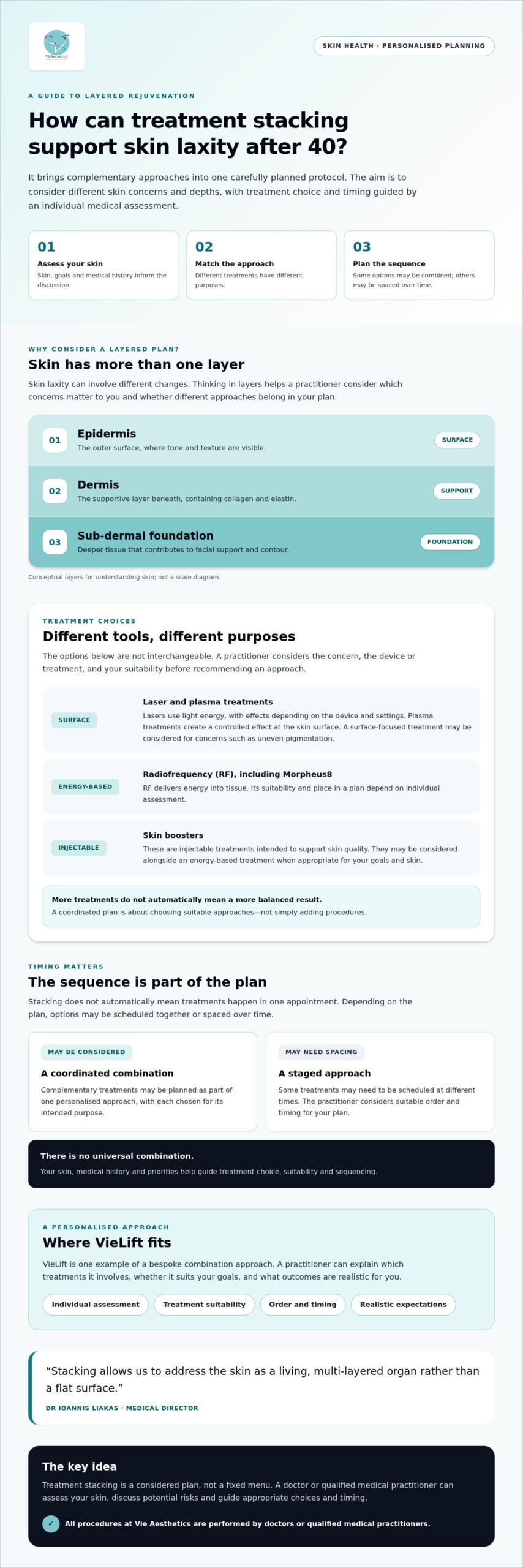
Skin laxity rarely comes from a single change, so a useful way to understand treatment stacking skin is to picture the face in three dimensions. The epidermis is the outer surface, where tone and texture are visible; the dermis is the supportive layer beneath it, containing collagen and elastin; and the sub-dermal foundation includes deeper tissue that contributes to facial support and contour.
Dr Ioannis Liakas, Medical Director, explains: “Stacking allows us to address the skin as a living, multi-layered organ rather than a flat surface.” In practice, a practitioner considers which layer is relevant to your concern, then chooses suitable treatments and timings rather than simply adding procedures.
A surface-focused treatment may be considered for concerns such as uneven pigmentation, while a different approach may be selected to stimulate a response in deeper tissue. Radiofrequency (RF), used by treatments such as Morpheus8, delivers energy into tissue; lasers use light energy, with their effects depending on the device and settings; plasma treatments create a controlled effect at the skin surface. These technologies aren’t interchangeable, and their suitability depends on an individual assessment.
Skin boosters are injectable treatments intended to support skin quality. A practitioner may consider them alongside an energy-based treatment if the combination suits your goals and skin. The skin boosters treatment page explains this option. Treating only one concern may leave other changes unaddressed, but more treatments don’t automatically produce a more balanced result.
“Cellular communication” describes how cells respond to signals in their surrounding tissue. It isn’t a reason to combine injectables and heat-based devices without a plan. Timing matters: a medical practitioner should decide whether treatments are appropriate together or need to be spaced, taking healing and tissue response into account.
If you’re considering a layered approach, you can book a medical consultation to discuss your skin goals and whether a treatment sequence may be suitable.
The most suitable treatment stack depends on what you want to address, your skin and a medical practitioner’s assessment. At Vie Aesthetics, treatment stacking skin plans may bring together complementary approaches, but no combination is right for everyone, and results vary.
For skin laxity, a practitioner might assess whether a deeper tightening approach and a treatment focused on surface skin quality could work towards your goals. Endolift may be considered for internal tightening alongside an external resurfacing treatment, but the choice and timing depend on individual suitability. Morpheus8 and polynucleotides may also be discussed as separate, complementary treatments. Polynucleotides are injectable products used in skin-regeneration treatments; they shouldn’t be described as “raw materials” that guarantee collagen production or faster recovery.
Regenera Activa is a hair restoration treatment, whilst Dermalux Medical LED Therapy is another service offered by Vie Aesthetics. A practitioner can assess whether both are appropriate within a hair-care plan, rather than assume they should be combined or promise a particular outcome.
“The goal of stacking is harmony; we are orchestrating different technologies to sing the same song of rejuvenation.”
The VieLift is an example of Vie Aesthetics’ combination approach. You can explore the VieLift treatment to learn more. Any proposed combination still needs to be tailored to your assessment and goals.
| Approach | What it may address | Planning considerations |
|---|---|---|
| Single treatment | A specific concern or treatment goal | May involve a more focused appointment; outcomes depend on the treatment |
| Stacked protocol | Several concerns across different layers | May require careful sequencing and more than one visit; combined results aren’t guaranteed |
A carefully planned combination isn’t automatically more efficient or effective. Your practitioner can explain the options, likely appointment sequence and what each treatment can realistically address.
A considered treatment plan starts with a medical consultation, not a preset combination. For treatment stacking skin, your practitioner can discuss your goals, medical history and skin concerns, then use skin analysis to help assess suitability and plan a sequence that reflects your needs.
The consultation is a chance to be open about the changes you’d like to see, the treatments you’ve had and any questions you have about downtime or recovery. Skin analysis can inform the discussion, but it doesn’t replace a practitioner’s clinical assessment.
Your practitioner can then explain which options may be appropriate, how they could be sequenced and whether appointments should be spaced apart. Plans may change as your skin responds, so ask how progress will be reviewed and what to do if you have concerns between sessions.
Combining treatments requires decisions about suitability, timing and how your skin is responding. Vie Aesthetics states that procedures are performed by doctors or qualified medical practitioners. That medical oversight supports informed planning; it doesn’t mean every treatment or combination will be suitable for every person.
Vie Aesthetics also cites its 2023 CQC inspection, which recognised “Best Customer Service”. Ask your practitioner how your proposed treatments will be monitored and what follow-up is appropriate for your individual plan.
A stacked plan is not a substitute for everyday skincare or healthy habits, and treatment results vary. The Vie Membership may be relevant if you’re considering ongoing care, but ask what it includes and whether it suits your needs rather than assuming it will maintain a particular result.
Finance terms can change. If spreading the cost matters to you, ask Vie Aesthetics whether interest-free finance is currently available and whether 6, 9 or 10-month terms apply to your proposed plan.
Use your consultation to check the proposed sequence, likely recovery, alternatives and how your practitioner will review your response. You should feel comfortable raising priorities and asking for time to consider the plan.
Treatment stacking skin plans can address more than one aspect of ageing by combining approaches for different layers and concerns. The right sequence is personal: a medical assessment helps determine which treatments may suit your goals, how they should be timed and what results are realistic for you.
Rather than relying on one treatment alone, a carefully planned combination may bring firmness, volume and skin quality into a more balanced overall approach. Vie Aesthetics’ VieLift is one example of its combination treatments. All procedures are performed by doctors or qualified medical practitioners, and the practice was named Global Best Aesthetic Practice of the Year.
Vie Aesthetics states that interest-free finance options are available for plans over £280. Ask the clinic to confirm the current terms and whether they apply to your proposed plan.
You can take the next step at your own pace. A thoughtful conversation can help you feel informed, comfortable and confident about your options.
The cost depends on which treatments are recommended for your individual plan. Vie Aesthetics’ Wellness Packages start from £99, but this is not a price for a stacked skin-treatment plan. Interest-free finance is available for qualifying treatments costing £280 or more, subject to approval. The finance information states that a 10% deposit is paid at the clinic, with the remaining balance repaid in monthly instalments. Ask the clinic to confirm current terms.
Results vary according to the treatments used and your individual response. Structural improvements from some treatment combinations may last around 12–18 months, but this is an estimate, not a set duration for every protocol. Different treatments have different effects and maintenance needs. Ask your practitioner what timeframe is realistic for the specific combination being considered, how progress will be reviewed and whether further treatment may be appropriate.
Botox and fillers can be combined in an overall treatment plan, and a practitioner may consider using them in the same session after assessing your suitability. They have different purposes: Botox targets movement-related wrinkles, whilst fillers can address volume loss. A “liquid facelift” is an informal term for certain combinations of injectables, not one standard procedure. Your practitioner should explain the proposed products, areas and timing before treatment.
Ingredients vary by product. Many skin boosters contain hyaluronic acid, a substance that attracts and holds water in the skin. Polynucleotide products contain DNA fragments, with some formulations derived from salmon. These are different types of injectable treatment and aren’t interchangeable. Ask your practitioner for the ingredient information for the specific product being considered, along with why it may be suitable for your skin and how it fits the wider plan.
Not necessarily, but recovery depends on the treatments, how they’re timed and your individual response. Morpheus8 uses radiofrequency microneedling, while Dermalux is medical LED therapy; combining them doesn’t guarantee less redness or faster healing. Ask your practitioner what recovery to expect from each procedure, whether they recommend separate appointments and what aftercare to follow. They can tailor that advice to the actual treatments in your plan.
Some stacked plans may involve 1–3 primary sessions, with changes developing over 3–6 months as the skin responds. These figures are a guide, not a promise or a recommended course for everyone. The number and spacing of appointments depend on the treatments selected, your goals and your response. Ask your practitioner what each session is intended to address and when they’ll review your progress before discussing any further treatment.

What if treating skin laxity after 40 isn’t about choosing one stronger treatment, but combining complementary ones? Treatment stacking skin protocols can pair approaches for concerns such as firmness and texture, creating a personalised plan without relying on repeated filler alone. The aim is a refreshed result that still looks like you.
It’s understandable to feel unsure about which treatments may work well together or when they should be scheduled. The right combination depends on your skin, your goals and a medical practitioner’s assessment, so stacking should be carefully planned rather than treated as a one-size-fits-all menu.
This guide explains how treatments may be selected to address different skin layers, why sequence matters and what combinations can realistically achieve. You’ll also learn how a consultation can help you make informed choices about a natural-looking approach to rejuvenation.
Skin treatment stacking means planning complementary aesthetic procedures as part of one personalised approach. Rather than expecting a single treatment to address every concern, a practitioner can consider options with different purposes and decide whether they belong in the same session or should be spaced over time.
This can be useful when someone wants to address more than one aspect of ageing, such as skin firmness and texture. The aim is a coordinated plan, not simply adding procedures. Learn more about the range of non-surgical aesthetic treatments that may be considered as part of an individual discussion.
Aesthetic treatment has developed from focusing on individual visible lines towards plans that consider the overall appearance and quality of the skin, while aiming to preserve natural expression. Clinical innovation has given practitioners more treatment options, but technology alone doesn’t determine what’s appropriate. A medical assessment helps guide the choice, order and timing.
People have different skin, medical histories and priorities, so there’s no universal combination. Vie Aesthetics’ VieLift is one example of a bespoke combination approach. A practitioner can explain which treatments it involves, whether it suits your goals and what outcomes are realistic for you.
The “synergy effect” describes the possibility that complementary treatments may contribute to a broader result when used as part of a considered plan. It’s a helpful way to think about coordinated care, not a promise that two treatments will produce a specific or multiplied outcome. All procedures at Vie Aesthetics are performed by doctors or qualified medical practitioners.
Skin laxity rarely comes from a single change, so a useful way to understand treatment stacking skin is to picture the face in three dimensions. The epidermis is the outer surface, where tone and texture are visible; the dermis is the supportive layer beneath it, containing collagen and elastin; and the sub-dermal foundation includes deeper tissue that contributes to facial support and contour.
Dr Ioannis Liakas, Medical Director, explains: “Stacking allows us to address the skin as a living, multi-layered organ rather than a flat surface.” In practice, a practitioner considers which layer is relevant to your concern, then chooses suitable treatments and timings rather than simply adding procedures.
A surface-focused treatment may be considered for concerns such as uneven pigmentation, while a different approach may be selected to stimulate a response in deeper tissue. Radiofrequency (RF), used by treatments such as Morpheus8, delivers energy into tissue; lasers use light energy, with their effects depending on the device and settings; plasma treatments create a controlled effect at the skin surface. These technologies aren’t interchangeable, and their suitability depends on an individual assessment.
Skin boosters are injectable treatments intended to support skin quality. A practitioner may consider them alongside an energy-based treatment if the combination suits your goals and skin. The skin boosters treatment page explains this option. Treating only one concern may leave other changes unaddressed, but more treatments don’t automatically produce a more balanced result.
“Cellular communication” describes how cells respond to signals in their surrounding tissue. It isn’t a reason to combine injectables and heat-based devices without a plan. Timing matters: a medical practitioner should decide whether treatments are appropriate together or need to be spaced, taking healing and tissue response into account.
If you’re considering a layered approach, you can book a medical consultation to discuss your skin goals and whether a treatment sequence may be suitable.
The most suitable treatment stack depends on what you want to address, your skin and a medical practitioner’s assessment. At Vie Aesthetics, treatment stacking skin plans may bring together complementary approaches, but no combination is right for everyone, and results vary.
For skin laxity, a practitioner might assess whether a deeper tightening approach and a treatment focused on surface skin quality could work towards your goals. Endolift may be considered for internal tightening alongside an external resurfacing treatment, but the choice and timing depend on individual suitability. Morpheus8 and polynucleotides may also be discussed as separate, complementary treatments. Polynucleotides are injectable products used in skin-regeneration treatments; they shouldn’t be described as “raw materials” that guarantee collagen production or faster recovery.
Regenera Activa is a hair restoration treatment, whilst Dermalux Medical LED Therapy is another service offered by Vie Aesthetics. A practitioner can assess whether both are appropriate within a hair-care plan, rather than assume they should be combined or promise a particular outcome.
“The goal of stacking is harmony; we are orchestrating different technologies to sing the same song of rejuvenation.”
The VieLift is an example of Vie Aesthetics’ combination approach. You can explore the VieLift treatment to learn more. Any proposed combination still needs to be tailored to your assessment and goals.
| Approach | What it may address | Planning considerations |
|---|---|---|
| Single treatment | A specific concern or treatment goal | May involve a more focused appointment; outcomes depend on the treatment |
| Stacked protocol | Several concerns across different layers | May require careful sequencing and more than one visit; combined results aren’t guaranteed |
A carefully planned combination isn’t automatically more efficient or effective. Your practitioner can explain the options, likely appointment sequence and what each treatment can realistically address.
A considered treatment plan starts with a medical consultation, not a preset combination. For treatment stacking skin, your practitioner can discuss your goals, medical history and skin concerns, then use skin analysis to help assess suitability and plan a sequence that reflects your needs.
The consultation is a chance to be open about the changes you’d like to see, the treatments you’ve had and any questions you have about downtime or recovery. Skin analysis can inform the discussion, but it doesn’t replace a practitioner’s clinical assessment.
Your practitioner can then explain which options may be appropriate, how they could be sequenced and whether appointments should be spaced apart. Plans may change as your skin responds, so ask how progress will be reviewed and what to do if you have concerns between sessions.
Combining treatments requires decisions about suitability, timing and how your skin is responding. Vie Aesthetics states that procedures are performed by doctors or qualified medical practitioners. That medical oversight supports informed planning; it doesn’t mean every treatment or combination will be suitable for every person.
Vie Aesthetics also cites its 2023 CQC inspection, which recognised “Best Customer Service”. Ask your practitioner how your proposed treatments will be monitored and what follow-up is appropriate for your individual plan.
A stacked plan is not a substitute for everyday skincare or healthy habits, and treatment results vary. The Vie Membership may be relevant if you’re considering ongoing care, but ask what it includes and whether it suits your needs rather than assuming it will maintain a particular result.
Finance terms can change. If spreading the cost matters to you, ask Vie Aesthetics whether interest-free finance is currently available and whether 6, 9 or 10-month terms apply to your proposed plan.
Use your consultation to check the proposed sequence, likely recovery, alternatives and how your practitioner will review your response. You should feel comfortable raising priorities and asking for time to consider the plan.
Treatment stacking skin plans can address more than one aspect of ageing by combining approaches for different layers and concerns. The right sequence is personal: a medical assessment helps determine which treatments may suit your goals, how they should be timed and what results are realistic for you.
Rather than relying on one treatment alone, a carefully planned combination may bring firmness, volume and skin quality into a more balanced overall approach. Vie Aesthetics’ VieLift is one example of its combination treatments. All procedures are performed by doctors or qualified medical practitioners, and the practice was named Global Best Aesthetic Practice of the Year.
Vie Aesthetics states that interest-free finance options are available for plans over £280. Ask the clinic to confirm the current terms and whether they apply to your proposed plan.
You can take the next step at your own pace. A thoughtful conversation can help you feel informed, comfortable and confident about your options.
The cost depends on which treatments are recommended for your individual plan. Vie Aesthetics’ Wellness Packages start from £99, but this is not a price for a stacked skin-treatment plan. Interest-free finance is available for qualifying treatments costing £280 or more, subject to approval. The finance information states that a 10% deposit is paid at the clinic, with the remaining balance repaid in monthly instalments. Ask the clinic to confirm current terms.
Results vary according to the treatments used and your individual response. Structural improvements from some treatment combinations may last around 12–18 months, but this is an estimate, not a set duration for every protocol. Different treatments have different effects and maintenance needs. Ask your practitioner what timeframe is realistic for the specific combination being considered, how progress will be reviewed and whether further treatment may be appropriate.
Botox and fillers can be combined in an overall treatment plan, and a practitioner may consider using them in the same session after assessing your suitability. They have different purposes: Botox targets movement-related wrinkles, whilst fillers can address volume loss. A “liquid facelift” is an informal term for certain combinations of injectables, not one standard procedure. Your practitioner should explain the proposed products, areas and timing before treatment.
Ingredients vary by product. Many skin boosters contain hyaluronic acid, a substance that attracts and holds water in the skin. Polynucleotide products contain DNA fragments, with some formulations derived from salmon. These are different types of injectable treatment and aren’t interchangeable. Ask your practitioner for the ingredient information for the specific product being considered, along with why it may be suitable for your skin and how it fits the wider plan.
Not necessarily, but recovery depends on the treatments, how they’re timed and your individual response. Morpheus8 uses radiofrequency microneedling, while Dermalux is medical LED therapy; combining them doesn’t guarantee less redness or faster healing. Ask your practitioner what recovery to expect from each procedure, whether they recommend separate appointments and what aftercare to follow. They can tailor that advice to the actual treatments in your plan.
Some stacked plans may involve 1–3 primary sessions, with changes developing over 3–6 months as the skin responds. These figures are a guide, not a promise or a recommended course for everyone. The number and spacing of appointments depend on the treatments selected, your goals and your response. Ask your practitioner what each session is intended to address and when they’ll review your progress before discussing any further treatment.