Article by
Vicky Grammatikopoulou, BHons, MA, PGCE
Vicky Grammatikopoulou is the founder and CEO of Vie Aesthetics, a multi-award winning UK-based aesthetics business built on a philosophy of safety, excellence, education, innovation, and empowerment.
When evaluating polynucleotides vs PDRN for cellular rejuvenation, the essential distinction comes down to molecular weight, chain length, and how each formulation behaves within your skin tissue.The ongoing aesthetic debate around polynucleotides vs PDRN often suggests two rival therapies, yet PDRN is actually a lighter, fractionated segment of the wider polynucleotide family.
If you feel confused by clinics using these two names interchangeably, you’re certainly not alone. It’s completely natural to hesitate when researching salmon-derived DNA injectables, particularly if you want reassurance about biological safety or wonder whether they can gently restore delicate, crepey texture beneath the eyes without relying on traditional dermal fillers.
In this guide, you’ll discover the exact clinical differences between these regenerative options, giving you the confidence to choose the ideal protocol for your unique complexion. We’ll explore how differing molecular structures influence tissue repair, review established safety profiles, and outline what to expect across your treatment timeline for naturally refreshed, long-term skin health.
Simply put, PDRN is a specific, shorter-chain fraction of the wider polynucleotide family. When clarifying polynucleotides vs PDRN, think of polynucleotides as the broad category of biological polymers, whilst Polydeoxyribonucleotide (PDRN) refers specifically to low-molecular-weight DNA fragments. Both originate from highly purified salmon or trout DNA, which closely mirrors human cellular material.
At a Glance: PN vs PDRN
Unlike traditional hyaluronic acid fillers that mechanically plump tissue to create volume, these regenerative therapies work biologically. Advanced high-temperature purification strips away all active proteins and antigens, which removes fish allergens while ensuring exceptional biocompatibility with human tissue. Discover more about our medical-grade polynucleotides therapies to see how cellular priming revitalises tired complexions.
Polynucleotides consist of long polymeric chains that integrate into the extracellular matrix, creating an enduring micro-scaffold. They activate fibroblast cells to boost natural type I collagen production while drawing water into deep tissue. As Medical Director Dr Ioannis Liakas explains, “Polynucleotides prime the skin at a deep cellular level, restoring natural resilience from within rather than placing temporary volume on top.”
PDRN represents lighter DNA chains that enter cells through the metabolic salvage pathway, recycling nucleotides without depleting cellular energy. Historically trusted in clinical medicine for diabetic wound healing and tendon repair, it calms local inflammation quickly. While all PDRN molecules are technically polynucleotides, their shorter length makes them uniquely suited for surface-level tissue recovery.
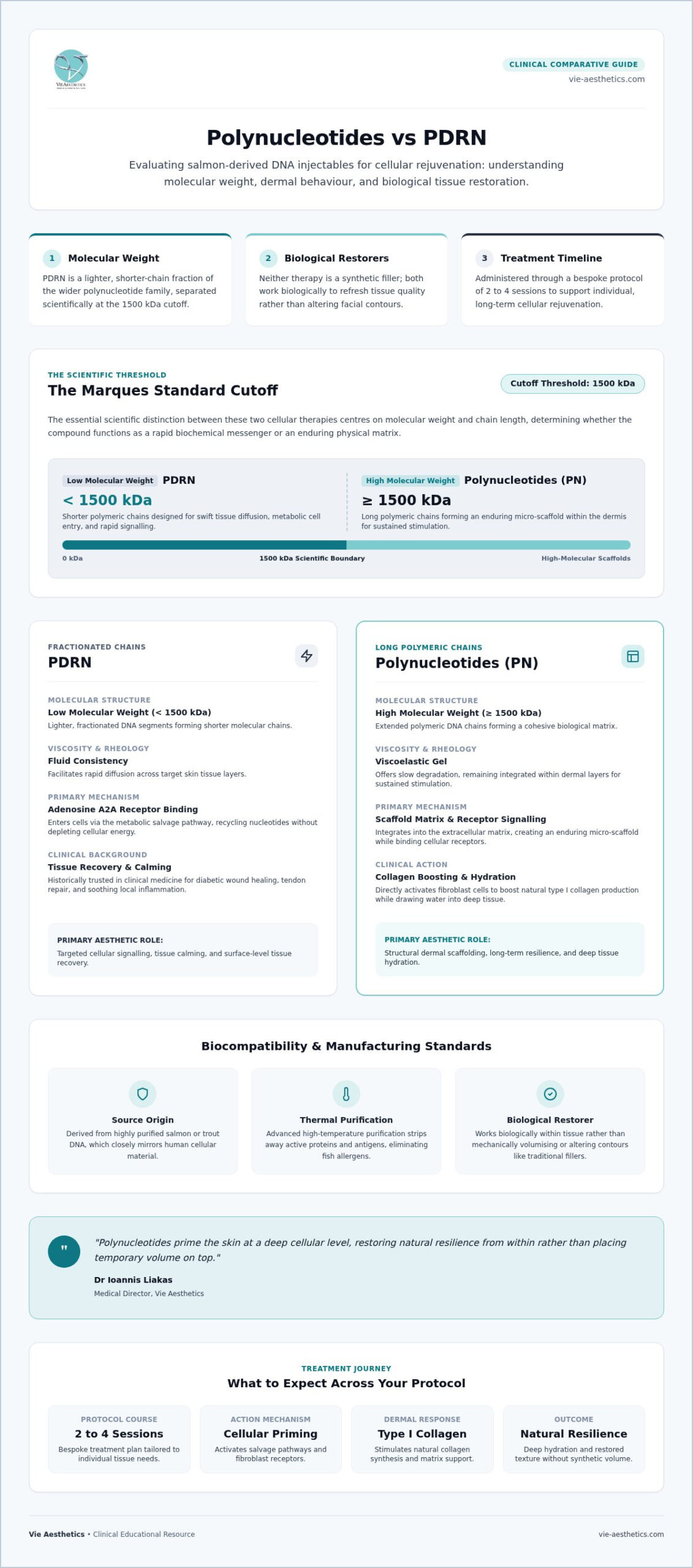
Evaluating polynucleotides vs PDRN comes down to molecular size and how each polymer behaves within dermal layers. The Marques standard sets 1500 kDa as the scientific cutoff between them. This boundary determines whether the solution acts as a rapid biochemical messenger or an enduring physical matrix.
| Characteristic | PDRN | Polynucleotides (PN) |
|---|---|---|
| Molecular Weight | Low (<1500 kDa) | High (≥1500 kDa) |
| Viscosity & Rheology | Fluid, rapid tissue spread | Viscoelastic gel, slow degradation |
| Primary Mechanism | Adenosine A2A receptor binding | Fibroblast matrix scaffolding & receptor signalling |
| Injection Target | Superficial epidermis/dermis | Mid-to-deep dermis, subdermal |
Lighter PDRN disperses fluidly across superficial tissue, acting as an agile metabolic priming agent. In contrast, longer polynucleotide chains retain their cohesive gel structure within the extracellular matrix. As utilised in our bespoke polynucleotides treatments, these heavier chains resist rapid enzymatic breakdown to deliver prolonged restorative stimulation.
PDRN binds selectively to adenosine A2A cell receptors, which quiets micro-inflammation and encourages vascular endothelial growth factor (VEGF) for gentle tissue repair. High-molecular polynucleotides activate this same receptor cascade while adding physical support. Their dense network creates mechanical tension across fibroblasts, promoting endogenous collagen synthesis over subsequent weeks.
Because molecular weight dictates viscosity, injection depth must match the formulation. Low-viscosity PDRN works well with micro-droplet mesotherapy techniques across delicate surfaces. Denser polynucleotides require deliberate intradermal or subdermal placement with an ultra-fine needle or cannula. Medical Director Dr Ioannis Liakas notes: “Accurate placement at the correct tissue depth allows long-chain nucleotides to integrate seamlessly without forming prolonged surface blebs.” To explore the ideal regenerative protocol for your complexion, book a skin assessment with our doctor-led medical team.
A clear understanding of expectations is essential when deciding between polynucleotides vs PDRN. Regenerative DNA therapies restore tissue biology from within; they do not function like dermal fillers that physically sculpt facial features. While cross-linked hyaluronic acid creates immediate structural projection, biological nucleotides trigger progressive cellular remodelling that matures over several weeks.
Every individual skin response develops differently based on baseline tissue health, age, and natural cellular turnover. Pairing nucleotide therapy with complementary treatments such as hyaluronic acid skin boosters offers a complete approach, delivering surface hydration whilst the underlying nucleotides build dermal density.
Both light and heavy fractions offer profound micro-vascular and regenerative benefits:
To avoid disappointment, it helps to be clear about the clinical boundaries of polynucleotides vs PDRN:
Selecting between polynucleotides vs PDRN begins with an unhurried, doctor-led clinical consultation. Because regenerative aesthetics prioritises cellular vitality over temporary filling, your practitioner evaluates skin thickness, vascularity, and underlying tissue laxity to tailor your bespoke plan.
During your medical assessment, your doctor reviews your health history to ensure regenerative injectables are suitable and safe for you. Your practitioner then determines whether your skin goals call for rapid superficial PDRN smoothing or deeper polynucleotide structural priming. To start your personalised treatment roadmap, you can schedule an appointment via our secure online booking portal.
Whether choosing polynucleotides vs PDRN, an initial course typically involves two to four sessions spaced two to four weeks apart. A topical numbing cream ensures your comfort during fine-needle or cannula administration. Small raised papules or mild swelling can appear at the injection points, yet these resolve naturally within 24 to 48 hours. Peak tissue regeneration and improved elasticity emerge around six to eight weeks after completing your course.
To preserve long-term skin resilience, a single maintenance session every six to nine months supports ongoing collagen synthesis. Regenerative nucleotides also pair exceptionally well with hyaluronic acid biostimulators like Profhilo, providing multi-depth hydration while salmon DNA fragments rebuild cellular architecture. To support your unhurried aesthetic care, accessible interest-free payment plans are available across qualifying medical treatment courses.
Choosing between polynucleotides vs PDRN comes down to matching molecular weight to your skin’s unique cellular requirements. Whether your complexion benefits from the rapid anti-inflammatory signalling of lightweight PDRN or the enduring structural scaffold provided by high-molecular polynucleotides, both options stimulate genuine tissue regeneration rather than offering temporary surface volume.
As a recipient of the Global Best Aesthetic Practice of the Year award, Vie Aesthetics delivers treatments exclusively through qualified medical doctors and registered healthcare professionals. Using premium, medical-grade formulations like Plenhyage XL, our clinical team creates bespoke treatment plans tailored to support your personal skin journey with complete transparency and care.
Take the next step towards naturally revitalised, resilient skin with clinical guidance you can trust.
Initial tissue hydration often appears within two to three weeks, but peak structural improvements typically emerge around six to eight weeks after completing your treatment cycle. Because biostimulation relies on your body’s natural cellular timeline to build fresh collagen and elastin, progress develops steadily rather than overnight. Most patients observe a progressive refinement in skin texture, tone, and elasticity over the subsequent months.
When assessing polynucleotides vs PDRN for the under-eye area, high-molecular polynucleotides provide greater structural thickening for thin, crepey skin, whilst PDRN targets microvascular circulation and surface calming. Higher-viscosity formulations like Plenhyage XL offer sustained biostimulation beneath delicate lower eyelids without encouraging fluid retention. Your medical doctor will assess skin thickness and vascular show-through to select the ideal molecular weight.
Yes, most individuals with dietary fish allergies can safely receive these treatments because rigorous clinical purification strips away all active proteins and antigens. Aesthetic-grade DNA harvested from salmon or trout undergoes high-temperature extraction, leaving behind pure, bio-inert nucleotide polymers. Even so, your medical history should be thoroughly reviewed during your doctor-led consultation to evaluate your specific allergy profile and ensure complete safety.
A standard initial course typically consists of two to four treatment sessions spaced two to four weeks apart. This regular interval allows cellular fibroblasts sufficient time to assimilate injected nucleotides and initiate endogenous collagen synthesis between appointments. To maintain renewed dermal density and healthy tissue elasticity over time, single maintenance sessions are generally recommended every six to nine months.
The essential distinction in polynucleotides vs PDRN compared to conventional skin boosters lies in active cellular signalling versus passive moisture retention. Hyaluronic acid skin boosters act primarily as water-binding humectants within the dermis. In contrast, regenerative nucleotides instruct fibroblastic cells to repair tissue architecture, stimulate microcirculation, and synthesise new type I collagen, creating deeper biological restoration.
You should anticipate mild, temporary injection-site reactions such as small raised papules, slight localised swelling, and occasional light bruising. Because nucleotide gels are placed precisely into shallow or mid-dermal layers, tiny blebs resembling small bee stings typically appear, though these resolve naturally within 24 to 48 hours. Avoiding intense heat, saunas, and strenuous exercise for a day promotes swift recovery.
 Read this article
 Read this article