Article by
Vicky Grammatikopoulou, BHons, MA, PGCE
Vicky Grammatikopoulou is the founder and CEO of Vie Aesthetics, a multi-award winning UK-based aesthetics business built on a philosophy of safety, excellence, education, innovation, and empowerment.
Reviewed by Dr Ioannis Liakas
A reliable aesthetic treatment glossary bridges the gap between scientific innovation and confusing marketing trends. By consulting this doctor-led aesthetic treatment glossary, you’ll quickly discover what modern non-surgical procedures actually do for your skin.
If you’ve ever felt uncertain about the difference between dermal fillers and skin boosters, you aren’t alone. Overlapping terminology and unregulated clinics understandably cause anxiety about safety and unnatural results. We promise to demystify this clinical vocabulary with transparent, evidence-based guidance, giving you the fluency to choose treatments that respect your natural tissue anatomy.
A 2026 Professional Standards Authority survey revealed that 46% of the UK public mistakenly believe all cosmetic practitioners are already legally regulated; in reality, safe care begins with your own informed choices. Ahead, our medical team explains 60 essential terms, exploring modern benchmarks like regenerative polynucleotides, Morpheus8, and Endolift so you can speak to your doctor with complete confidence.
Consulting a comprehensive aesthetic treatment glossary clarifies essential medical terminology before you step into a clinical environment. In contemporary Aesthetic medicine, injectable therapies target distinct anatomical layers, from hyperactive facial muscles down to deep periosteal bone. Understanding these biological distinctions ensures you select therapies tailored to your unique facial architecture.
Bio-stimulators are specialised regenerative injectables that trigger your body’s natural collagen and elastin synthesis over time rather than simply taking up physical space. Beyond facial rejuvenation, specialised neurotoxin protocols address medical concerns such as excessive sweating hyperhidrosis treatment by temporarily intercepting chemical signals to overactive sweat glands.
Precision neuromodulators, commonly delivered via targeted injections, intercept acetylcholine release at the neuromuscular junction. This action temporarily relaxes dynamic muscular contractions without freezing natural facial expressions. Conversely, structural dermal filler solutions use hyaluronic acid gel placed into deeper subcutaneous planes, replenishing depleted volume and restoring architectural definition.
Modern injectables prioritise tissue quality over pure volumisation. Non-cross-linked hydrators, known as skin boosters, disperse freely within superficial dermis layers to boost hydration and luminosity. Meanwhile, advanced DNA-derived polynucleotides stimulate cellular repair, promoting microvascular circulation. Bio-fillers containing poly-L-lactic acid or polycaprolactone stimulate fibroblast proliferation, creating a lasting scaffold of fresh structural proteins.
Clinical excellence relies on robust safety protocols and comprehensive vascular awareness:
This doctor-led aesthetic treatment glossary empowers you to discuss clinical mechanics knowledgeably, ensuring every treatment plan protects tissue vitality while delivering balanced results.
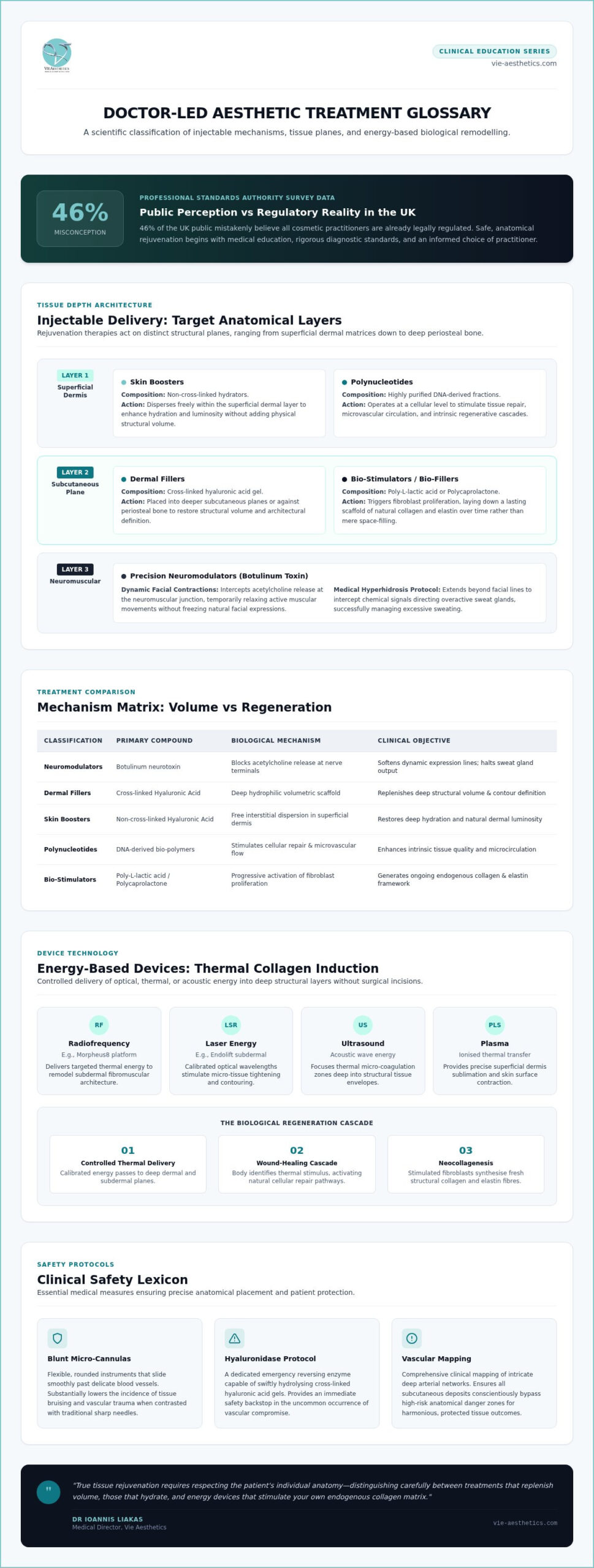
Energy-based aesthetic devices utilise controlled thermal, optical, or acoustic energy to remodel skin architecture from within. Rather than merely addressing superficial concerns, these technologies deliver calibrated heat into deep dermal and subdermal planes. This controlled thermal stimulation triggers natural wound-healing cascades, prompting fibroblasts to manufacture fresh collagen and elastin fibres. While injectables such as FDA-approved dermal fillers restore volume, energy platforms restore structural firmness without surgical incisions.
As Medical Director Dr Ioannis Liakas explains: “True tissue rejuvenation requires delivering the correct thermal energy to the precise anatomical depth. Matching energy modalities directly to individual tissue laxity ensures subtle, predictable lifting without unnecessary trauma.”
Interstitial laser systems represent a major technological leap within our aesthetic treatment glossary. Utilising hair-thin micro-optical fibres inserted beneath the dermis, advanced Endolift protocols deliver targeted laser energy directly into the lower tissue planes. This delivers a dual biological benefit: it selectively liquefies localised subcutaneous fat whilst inducing connective tissue contraction for defined contouring.
Fractional radiofrequency microneedling channels thermal energy through insulated micro-pins directly into the dermis. This controlled micro-trauma triggers robust structural collagen synthesis without damaging the epidermal surface. Unlike superficial microneedling rollers that only treat surface texture, subdermal adipose remodelling platforms—such as the Morpheus8 protocols detailed by Emre Üregen M.D.—target deeper structural fat, tightening underlying tissue layers.
Atmospheric gas ionisation produces micro-plasma arcs that sublimate targeted skin tissue on contact, turning solid surface cells directly into gas. This makes non-surgical blepharoplasty a compelling choice for tightening excess upper eyelid tissue without scalpel incisions or sutures. Alternatively, High-Intensity Focused Ultrasound (HIFU) bypasses the surface entirely, concentrating thermal coagulation points within the deep muscular layer to lift sagging tissue.
Understanding these thermal thresholds within a clinical aesthetic treatment glossary helps you select the right device for your specific aesthetic goals. To explore which modality aligns with your skin, you can book a skin assessment with our medical team.
Managing expectations ensures you achieve refreshed, natural-looking results aligned with personal goals. Non-surgical modalities excel at cellular conditioning, improving skin quality, and delivering moderate tissue tightening. While clinical standards such as FDA regulation of aesthetic devices confirm technical safety, non-surgical treatments cannot replicate full surgical excision. Clear boundaries protect your health and prevent disappointment.
As Medical Director Dr Ioannis Liakas emphasises:
“True clinical ethics mean guiding patients towards procedures that honour their individual anatomy rather than promising impossible transformations. Honesty in consultation is the foundation of patient safety and exceptional outcomes.”
Modern non-surgical treatments refine dermal elasticity, soften expression lines, and replenish subtle structural volume loss. Through progressive bio-stimulation, these therapies awaken your body’s dormant regenerative potential. You can read our comprehensive guide to non-surgical aesthetic treatments to explore how personalised plans restore natural radiance over time.
Non-surgical options have precise physiological boundaries:
Understanding these practical boundaries within an aesthetic treatment glossary allows you to approach your aesthetic journey with realistic, grounded expectations.
Selecting aesthetic treatments begins with a thorough medical assessment, never off-the-shelf packages. While this aesthetic treatment glossary equips you with clear definitions, translating terminology into clinical success demands expert evaluation. True clinical excellence combines complementary modalities, harmonising skin texture with deeper structural support.
Patient safety depends directly on clinical governance. Choosing clinics that employ regulated healthcare professionals guarantees sterile environments, approved medicines, and established complication management protocols.
Protecting your wellbeing means verifying practitioner qualifications prior to any procedure:
A rigorous consultation forms the foundation of clinical care. Your practitioner should evaluate your complete medical history, prescribed medications, and skin health goals before making recommendations. They will assess facial dynamics, tissue laxity, and dermal thickness, creating a phased treatment roadmap tailored precisely to your facial proportions.
Reputable medical providers always encourage an unhurried cooling-off period between your initial consultation and the procedure itself. This space allows you to review your tailored plan, consider outcomes, and feel entirely confident in your choice. When you feel ready to discuss your goals, take the first step toward skin health and book your medical consultation with our clinical team.
Understanding the physiological mechanisms behind bio-stimulators, sub-dermal lasers, and cellular hydrators transforms how you approach restorative care. This aesthetic treatment glossary provides the medical clarity needed to evaluate therapies objectively, keeping your focus firmly on tissue health rather than passing beauty trends.
Your wellbeing always relies on clinical integrity. As a clinic recognised as Global Best Aesthetic Practice at the MyFaceMyBody Awards and accredited with Investors in People Gold status, Vie Aesthetics delivers procedures performed exclusively by qualified doctors and medical practitioners adhering to CQC-inspected standards. Subtle, elegant rejuvenation begins when treatments respect your natural facial harmony.
Armed with clinical understanding, you can enter your consultation feeling informed, empowered, and ready to begin your rejuvenation journey with total confidence.
Toxin relaxes dynamic facial muscles, whereas dermal fillers restore lost volume and structural contour. Botulinim Toxin utilises botulinum toxin type A to temporarily intercept acetylcholine signals at neuromuscular junctions, softening expression lines for three to four months. Dermal fillers consist of cross-linked hyaluronic acid gel placed into deeper tissue planes to lift and shape facial contours, with results typically lasting six to eighteen months.
Polynucleotides stimulate cellular repair at a DNA level, while traditional skin boosters focus primarily on deep dermal hydration. Polynucleotides are purified DNA fractions that activate fibroblast proliferation and microvascular regeneration. Skin boosters use non-cross-linked hyaluronic acid to draw moisture into superficial skin layers. As highlighted in our aesthetic treatment glossary, polynucleotides actively repair damaged tissue rather than simply plumping it with water.
Endolift tightens skin by delivering interstitial laser energy directly beneath dermal layers through hair-thin optical micro-fibres. Operating at a selective 1470nm wavelength, these micro-fibres bypass the epidermis to target water and fat cells. The calibrated thermal energy triggers immediate connective tissue retraction and liquefies small adipose deposits. Over the following three to six months, this thermal stimulus prompts robust neocollagenesis for visible lifting along the jawline.
Non-surgical aesthetic treatments produce temporary results because your body naturally metabolises injected compounds and continues its biological ageing process. Hyaluronic acid fillers gradually dissolve over six to eighteen months, neuromodulators wear off after twelve to sixteen weeks, and energy-induced collagen fibres age naturally. Scheduled maintenance appointments support cellular health, ensuring subtle rejuvenation evolves in harmony with your natural facial architecture over time.
You can verify a practitioner’s medical qualifications by checking their professional registration number on statutory UK health registers. Search the General Medical Council (GMC) register for doctors or the Nursing and Midwifery Council (NMC) register for nurse prescribers. Always confirm the clinic is registered with the Care Quality Commission (CQC), and confirm they maintain comprehensive medical indemnity cover alongside formal emergency complication protocols.
Bio-stimulation refers to the process of triggering your body’s native cellular pathways to manufacture fresh collagen, elastin, and hyaluronic acid. Rather than providing static mechanical volume, bio-stimulatory substances act as biological messengers that awaken dormant fibroblasts. Consulting a doctor-led aesthetic treatment glossary helps you distinguish these restorative, tissue-renewing agents from conventional structural gels, ensuring you choose treatments that rebuild underlying skin architecture gradually and naturally.

 Read this article
 Read this article