Download our brochure Download our app
0 Items £0.00
Book Consultation
profhilo rayleigh

Blog

What is HIFU and How Does it Tighten Skin?

18-09-2026 | Posted in: Blogs
Vicky Grammatikopoulou, BHons, MA, PGCE

Article by

Vicky Grammatikopoulou, BHons, MA, PGCE

Vicky Grammatikopoulou is the founder and CEO of Vie Aesthetics, a multi-award winning UK-based aesthetics business built on a philosophy of safety, excellence, education, innovation, and empowerment.

What if you could achieve a visible facial lift and firmer skin without a single needle or a day of social downtime? HIFU, or High-Intensity Focused Ultrasound, is a non-surgical treatment that uses ultrasound energy to stimulate the body’s natural collagen production, resulting in tighter and firmer skin. By targeting the deep structural layers of the tissue, a hifu session provides a visible lift to areas like the jawline and brow without the need for incisions.

We understand that many people feel overwhelmed by the vast range of skin tightening options or worried about the risks associated with general anaesthesia. It’s common to feel hesitant about invasive procedures that require significant recovery time or the clinical look of traditional surgery. You deserve a solution that fits your lifestyle whilst delivering sophisticated, natural-looking results.

This article explains how High-Intensity Focused Ultrasound (HIFU) provides a non-surgical lift by stimulating your body’s natural collagen production. We will explore the science behind the results, focusing on how we target the SMAS layer, which is the Superficial Musculoaponeurotic System, to create a naturally rejuvenated appearance. By the end, you’ll have a clear understanding of how this innovative technology restores your confidence.

Key Takeaways

  • Understand how HIFU targets the SMAS layer to initiate deep structural tightening and natural rejuvenation from within.
  • Discover the science of collagen banking and how your body’s three-phase repair response helps you proactively manage the ageing process.
  • Learn why a bespoke treatment plan is essential and how we compare ultrasound energy with other options like Endolift.
  • Find out what to expect during your doctor-led session, including the precise mapping and preparation of your treatment area.

Understanding HIFU: How High-Intensity Focused Ultrasound Works

HIFU stands for High-Intensity Focused Ultrasound. It’s a non-invasive procedure that uses focused sound waves to reach deep into the skin’s layers. Unlike traditional treatments that target the surface, hifu bypasses the epidermis to deliver energy where it’s needed most. This energy creates tiny, controlled areas of heat known as thermal coagulation points.

These points act as a catalyst for your body’s natural regenerative processes. Whilst the outer layer of your skin remains completely unharmed, the internal “micro-trauma” triggers a healing response. This leads to the production of fresh, strong collagen, which gradually firms and lifts the treated area. It’s a sophisticated way to achieve rejuvenation without the risks of surgery.

To better understand the biological mechanism behind this lifting effect, watch this helpful video:

The Science of the SMAS Layer

The SMAS, or Superficial Musculoaponeurotic System, is a layer of tissue located deep beneath the skin and fat. It serves as the structural foundation of your face. In a traditional surgical facelift, this is the exact layer surgeons tighten and reposition. HIFU offers a “soft surgery” alternative by targeting this specific tissue with high-intensity focused ultrasound technology.

Dr Ioannis Liakas, our Medical Director, explains its importance: “HIFU is a remarkable tool because it allows us to reach the SMAS layer, the same area surgeons target, without a single incision.” This precision ensures that the lifting effect is grounded in the skin’s deep architecture, providing a more sustainable and natural-looking result.

Myth vs Reality: Ultrasound Technology

There’s often confusion about how this technology differs from other ultrasound uses. Let’s clarify some common misconceptions:
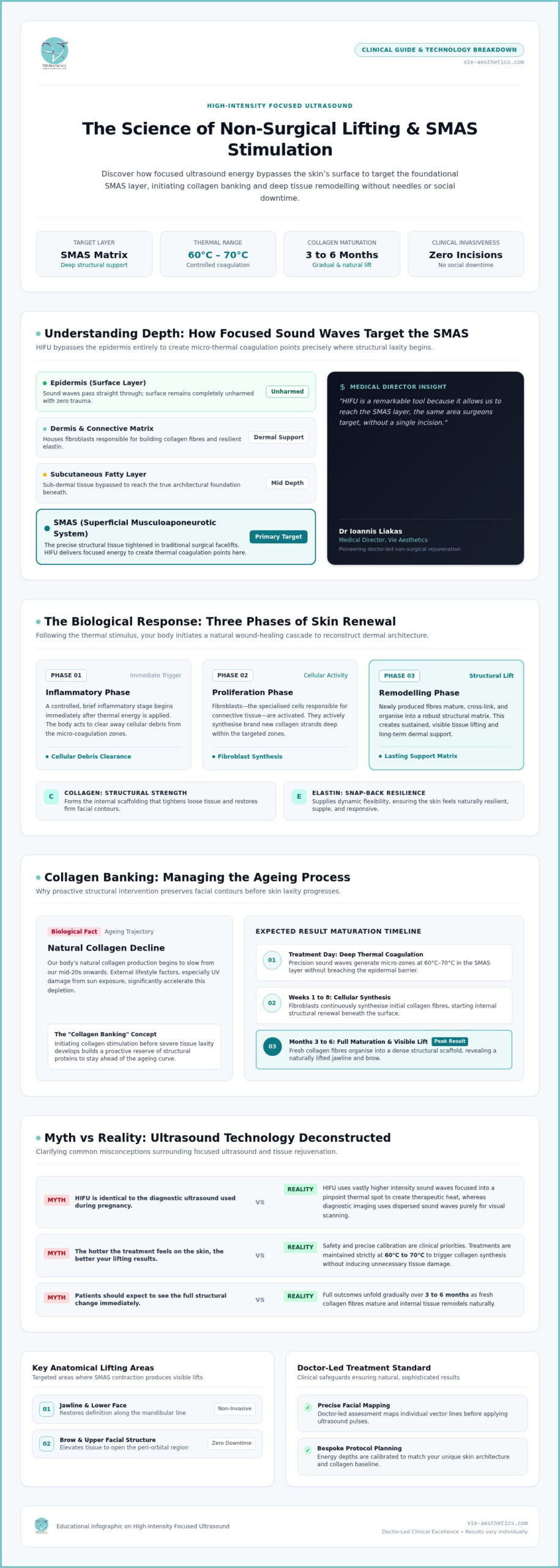
  • Myth: HIFU is the same as the ultrasound used during pregnancy. Reality: Whilst they share a name, hifu uses much higher intensity energy. It’s focused into a tiny point to create therapeutic heat, whereas diagnostic ultrasound is designed purely for imaging.
  • Myth: The hotter the treatment feels, the better the results. Reality: Safety and precision are our priorities. We use controlled temperatures (typically 60°C to 70°C) to stimulate collagen without causing unnecessary damage.
  • Reality Check: Don’t expect to see the full change immediately. Results develop gradually over 3 to 6 months as your new collagen matures and the tissue remodels itself.

What is HIFU and How Does it Tighten Skin?

The Biological Response: How Your Skin Organises New Collagen

Once the thermal coagulation points are created, your body begins a sophisticated three-phase repair process. It starts with a brief inflammatory phase that clears away cellular debris. This is followed by the proliferation phase, where your fibroblasts (the cells responsible for connective tissue) begin synthesising new collagen. Finally, the remodelling phase matures these fibres into a strong, organised matrix that provides lasting support.

Because this ultrasound skin tightening procedure relies on your own biological triggers, the results look entirely natural. You aren’t adding foreign substances or changing your features. Instead, you’re restoring your skin’s internal architecture. This synergy between collagen, which provides strength, and elastin, which offers the “snap-back” quality, ensures your skin feels both firm and resilient.

We often refer to this as “collagen banking”. By initiating these processes before laxity becomes severe, you’re building a reserve of structural proteins. This proactive approach helps you manage the ageing process more effectively over time. If you’re ready to start your own journey, you can book a skin assessment with our expert team.

Why Collagen Production Slows Down

It’s a biological reality that our natural collagen production begins to decline from our mid-20s onwards. External factors, particularly UV damage from sun exposure, significantly accelerate this depletion by breaking down existing fibres. A hifu session acts as a “re-education” for your skin. It signals your fibroblasts to behave like younger cells, kickstarting the production levels that have naturally tapered off over the years.

What this treatment WILL and WON’T do

Managing expectations is a vital part of our clinical approach. Whilst hifu is a powerful tool for rejuvenation, it’s important to understand its specific capabilities. Here is a clear overview of what to expect:

  • WILL: Improve jawline definition and reduce the appearance of jowls.
  • WILL: Lift the brow area for a more refreshed, open-eyed look.
  • WILL: Tighten and smooth the delicate skin on the neck and décolletage.
  • WON’T: Replace the dramatic results of a surgical facelift if you have severe skin laxity.
  • WON’T: Change your fundamental facial structure or make you look like a different person.

The beauty of this technology lies in its subtlety. It provides a refined, rested appearance that develops over several months, ensuring that the changes are noticed for the right reasons.

Choosing Your Path: HIFU vs Other Non-Surgical Face Lift Options

Selecting the right path for your skin isn’t about finding a universal “magic wand”. It requires a nuanced understanding of your facial anatomy and goals. While hifu is a gold standard for non-surgical lifting, we often recommend bespoke plans that layer different technologies to achieve a truly refreshed look. Evidence from clinical research on HIFU skin tightening confirms that targeting the SMAS layer is highly effective, yet some patients benefit from a more multi-dimensional approach.

For those seeking a holistic transformation, the VieLift offers our signature combination protocol. This allows us to address structural laxity, volume loss, and skin texture in a single, cohesive journey. It’s about looking like the best version of yourself, rather than a different person entirely. To help you navigate your options, we’ve contrasted our two most popular lifting technologies below.

Feature HIFU (Ultrasound) Endolift (Laser)
Invasiveness Completely Non-Invasive (External) Minimally Invasive (Internal micro-fibre)
Downtime Zero downtime Minimal (2-3 days of mild swelling)
Fat Melting Primary focus is tightening Highly effective for stubborn fat pockets
Best For Subtle lifting and “collagen banking” Defined jawline sculpting and fat reduction

HIFU vs Endolift: Which is Right for You?

HIFU is a completely non-invasive, external treatment. It’s the ideal choice if you prefer a “walk-in, walk-out” experience with zero recovery time. It works by sending sound waves through the skin surface to the deep structural layers. If you’re looking for a subtle lift and general tightening without any internal intervention, this is often the preferred starting point.

In contrast, Endolift is a minimally invasive laser treatment. A doctor inserts a microscopic fibre, thinner than a hair, just under the skin to deliver energy directly to the tissue. If you have specific, stubborn fat pockets, such as a double chin, Endolift is often superior because it can melt fat whilst simultaneously tightening the skin. During your consultation, we’ll determine which technology aligns best with your tissue type.

The Importance of a Bespoke Treatment Plan

A doctor-led consultation is the most important step in your journey. We don’t believe in one-size-fits-all solutions. We might suggest pairing your structural ultrasound treatment with skin boosters to improve surface hydration and luminosity. In other instances, we use polynucleotides to prime the skin at a cellular level, ensuring it has the resilience to produce the high-quality collagen triggered by your session.

Book your personalised skin assessment

What to Expect During and After Your HIFU Treatment

Your journey begins in a clinical setting that prioritises your comfort and safety. Unlike high-street salons, our hifu sessions are performed only by doctors and qualified medical practitioners. This ensures the technology is applied with the highest level of anatomical expertise and care.

  • Step 1: Your doctor performs a deep cleanse and meticulously maps the treatment area. This step ensures energy is delivered exactly where your skin needs structural support.
  • Step 2: A cool ultrasound gel is applied to your skin. This facilitates the seamless transfer of energy into the deeper dermal layers.
  • Step 3: The ultrasound pulses are delivered to the targeted depths. You may feel a sensation of warmth or tiny prickles, which indicates the collagen-building process has begun.
  • Step 4: Once the session is complete, we apply soothing skincare. You can return to your daily activities immediately with no need for social isolation or recovery time.

Is HIFU Painful? Managing Comfort

We find that sensations vary significantly amongst individuals. Most patients describe the feeling as a light tingling or a dull heat beneath the skin surface. It is generally well-tolerated and does not require general anaesthesia or heavy sedation.

Dr Ioannis Liakas explains our approach to patient comfort: “The beauty of ultrasound technology lies in its precision; we can customise the depth of energy to suit the unique thickness of a patient’s skin.” This bespoke adjustment ensures that the treatment remains effective whilst remaining as comfortable as possible for you.

Aftercare and Longevity of Results

There is typically no downtime following a hifu session. You might notice some slight redness or mild swelling immediately after, but this usually settles within a few hours. Your skin may feel slightly tender to the touch for a few days as the internal remodelling process begins.

To preserve your results, we strongly recommend daily sun protection. UV exposure breaks down the very collagen you are working to build. When you protect your skin, your rejuvenated appearance can last between 12 to 18 months, depending on your individual lifestyle and skin quality.

Organise your consultation at a Vie Aesthetics clinic

Embrace Natural Rejuvenation with Ultrasound Technology

You’ve explored how High-Intensity Focused Ultrasound reaches the SMAS layer to initiate deep structural tightening. This process isn’t just about surface changes; it’s a sophisticated biological re-education for your skin. By stimulating your own natural collagen production, hifu delivers a refined and rested look that honours your unique facial features.

Choosing a CQC-regulated practice ensures your safety and professional integrity are the priorities throughout this journey. At Vie Aesthetics, our doctor-led team provides the clinical excellence and bespoke care required for these advanced regenerative procedures. We also offer interest-free finance options over 6, 9, or 10 months to make your long-term skin health goals more accessible and manageable.

Book your expert HIFU consultation

Your journey toward a firmer jawline and a lifted brow begins with a single, informed step. We look forward to welcoming you to our clinic and supporting you as you rediscover your most confident, rejuvenated self.

Frequently Asked Questions

How much does a HIFU treatment cost?

Prices for a hifu session vary based on the treatment area. At Vie Aesthetics, prices typically start from £400. We provide interest-free finance options for any treatment over £280, allowing you to spread the cost over 6, 9, or 10 months. This requires a 10% down-payment at the clinic on the day of your procedure, making premium medical care more manageable for your budget.

How long does a HIFU session take?

The duration of your appointment depends on the size of the area being treated. A standard session for the full face and neck usually takes between 60 to 90 minutes. Smaller, targeted treatments like a brow lift or jawline definition can be completed much faster. Because there is no downtime, it is a convenient procedure that fits perfectly into a busy working day or a lunch break.

When will I see the results of HIFU?

While you may notice some immediate tightening, the real transformation occurs between 3 to 6 months. This is the time your body needs to organise new collagen fibres and mature the structural support within the skin. Your results will continue to improve as the internal remodelling process reaches its peak. We recommend taking photos at these milestones to track the gradual, natural-looking lift achieved through hifu technology.

Is HIFU safe for all skin colours?

Yes, hifu is safe for all skin types and colours. Unlike certain laser treatments that are attracted to melanin, ultrasound energy bypasses the pigmented surface of the skin. It delivers heat directly to the deeper dermal layers and the SMAS foundation. This significantly reduces the risk of surface damage or hyperpigmentation, ensuring a safe experience for every patient regardless of their specific skin tone or ethnicity.

What are the side effects of HIFU?

Most patients experience only minor and temporary side effects. You might notice slight redness or minor swelling for a few hours immediately after your session. Occasionally, a temporary tingling sensation or slight tenderness may persist for a few days as the internal healing response progresses. These effects are typically mild and don’t require any time off work, allowing you to return to your normal routine immediately after leaving the clinic.

How many HIFU sessions will I need?

Most patients achieve excellent results with just one session. The structural lift and tightening triggered by the ultrasound energy are significant. However, because the natural ageing process continues, a follow-up session after 12 months is often recommended to maintain the lift. During your doctor-led consultation, we will assess your skin quality and tissue laxity to determine the most effective treatment schedule for your personal rejuvenation goals.

What is HIFU and How Does it Tighten Skin?

Vicky Grammatikopoulou, BHons, MA, PGCE

Article by

Vicky Grammatikopoulou, BHons, MA, PGCE

Vicky Grammatikopoulou is the founder and CEO of Vie Aesthetics, a multi-award winning UK-based aesthetics business built on a philosophy of safety, excellence, education, innovation, and empowerment.

What if you could achieve a visible facial lift and firmer skin without a single needle or a day of social downtime? HIFU, or High-Intensity Focused Ultrasound, is a non-surgical treatment that uses ultrasound energy to stimulate the body’s natural collagen production, resulting in tighter and firmer skin. By targeting the deep structural layers of the tissue, a hifu session provides a visible lift to areas like the jawline and brow without the need for incisions.

We understand that many people feel overwhelmed by the vast range of skin tightening options or worried about the risks associated with general anaesthesia. It’s common to feel hesitant about invasive procedures that require significant recovery time or the clinical look of traditional surgery. You deserve a solution that fits your lifestyle whilst delivering sophisticated, natural-looking results.

This article explains how High-Intensity Focused Ultrasound (HIFU) provides a non-surgical lift by stimulating your body’s natural collagen production. We will explore the science behind the results, focusing on how we target the SMAS layer, which is the Superficial Musculoaponeurotic System, to create a naturally rejuvenated appearance. By the end, you’ll have a clear understanding of how this innovative technology restores your confidence.

Key Takeaways

  • Understand how HIFU targets the SMAS layer to initiate deep structural tightening and natural rejuvenation from within.
  • Discover the science of collagen banking and how your body’s three-phase repair response helps you proactively manage the ageing process.
  • Learn why a bespoke treatment plan is essential and how we compare ultrasound energy with other options like Endolift.
  • Find out what to expect during your doctor-led session, including the precise mapping and preparation of your treatment area.

Understanding HIFU: How High-Intensity Focused Ultrasound Works

HIFU stands for High-Intensity Focused Ultrasound. It’s a non-invasive procedure that uses focused sound waves to reach deep into the skin’s layers. Unlike traditional treatments that target the surface, hifu bypasses the epidermis to deliver energy where it’s needed most. This energy creates tiny, controlled areas of heat known as thermal coagulation points.

These points act as a catalyst for your body’s natural regenerative processes. Whilst the outer layer of your skin remains completely unharmed, the internal “micro-trauma” triggers a healing response. This leads to the production of fresh, strong collagen, which gradually firms and lifts the treated area. It’s a sophisticated way to achieve rejuvenation without the risks of surgery.

To better understand the biological mechanism behind this lifting effect, watch this helpful video:

The Science of the SMAS Layer

The SMAS, or Superficial Musculoaponeurotic System, is a layer of tissue located deep beneath the skin and fat. It serves as the structural foundation of your face. In a traditional surgical facelift, this is the exact layer surgeons tighten and reposition. HIFU offers a “soft surgery” alternative by targeting this specific tissue with high-intensity focused ultrasound technology.

Dr Ioannis Liakas, our Medical Director, explains its importance: “HIFU is a remarkable tool because it allows us to reach the SMAS layer, the same area surgeons target, without a single incision.” This precision ensures that the lifting effect is grounded in the skin’s deep architecture, providing a more sustainable and natural-looking result.

Myth vs Reality: Ultrasound Technology

There’s often confusion about how this technology differs from other ultrasound uses. Let’s clarify some common misconceptions:

  • Myth: HIFU is the same as the ultrasound used during pregnancy. Reality: Whilst they share a name, hifu uses much higher intensity energy. It’s focused into a tiny point to create therapeutic heat, whereas diagnostic ultrasound is designed purely for imaging.
  • Myth: The hotter the treatment feels, the better the results. Reality: Safety and precision are our priorities. We use controlled temperatures (typically 60°C to 70°C) to stimulate collagen without causing unnecessary damage.
  • Reality Check: Don’t expect to see the full change immediately. Results develop gradually over 3 to 6 months as your new collagen matures and the tissue remodels itself.

The Biological Response: How Your Skin Organises New Collagen

Once the thermal coagulation points are created, your body begins a sophisticated three-phase repair process. It starts with a brief inflammatory phase that clears away cellular debris. This is followed by the proliferation phase, where your fibroblasts (the cells responsible for connective tissue) begin synthesising new collagen. Finally, the remodelling phase matures these fibres into a strong, organised matrix that provides lasting support.

Because this ultrasound skin tightening procedure relies on your own biological triggers, the results look entirely natural. You aren’t adding foreign substances or changing your features. Instead, you’re restoring your skin’s internal architecture. This synergy between collagen, which provides strength, and elastin, which offers the “snap-back” quality, ensures your skin feels both firm and resilient.

We often refer to this as “collagen banking”. By initiating these processes before laxity becomes severe, you’re building a reserve of structural proteins. This proactive approach helps you manage the ageing process more effectively over time. If you’re ready to start your own journey, you can book a skin assessment with our expert team.

Why Collagen Production Slows Down

It’s a biological reality that our natural collagen production begins to decline from our mid-20s onwards. External factors, particularly UV damage from sun exposure, significantly accelerate this depletion by breaking down existing fibres. A hifu session acts as a “re-education” for your skin. It signals your fibroblasts to behave like younger cells, kickstarting the production levels that have naturally tapered off over the years.

What this treatment WILL and WON’T do

Managing expectations is a vital part of our clinical approach. Whilst hifu is a powerful tool for rejuvenation, it’s important to understand its specific capabilities. Here is a clear overview of what to expect:

  • WILL: Improve jawline definition and reduce the appearance of jowls.
  • WILL: Lift the brow area for a more refreshed, open-eyed look.
  • WILL: Tighten and smooth the delicate skin on the neck and décolletage.
  • WON’T: Replace the dramatic results of a surgical facelift if you have severe skin laxity.
  • WON’T: Change your fundamental facial structure or make you look like a different person.

The beauty of this technology lies in its subtlety. It provides a refined, rested appearance that develops over several months, ensuring that the changes are noticed for the right reasons.

Choosing Your Path: HIFU vs Other Non-Surgical Face Lift Options

Selecting the right path for your skin isn’t about finding a universal “magic wand”. It requires a nuanced understanding of your facial anatomy and goals. While hifu is a gold standard for non-surgical lifting, we often recommend bespoke plans that layer different technologies to achieve a truly refreshed look. Evidence from clinical research on HIFU skin tightening confirms that targeting the SMAS layer is highly effective, yet some patients benefit from a more multi-dimensional approach.

For those seeking a holistic transformation, the VieLift offers our signature combination protocol. This allows us to address structural laxity, volume loss, and skin texture in a single, cohesive journey. It’s about looking like the best version of yourself, rather than a different person entirely. To help you navigate your options, we’ve contrasted our two most popular lifting technologies below.

Feature HIFU (Ultrasound) Endolift (Laser)
Invasiveness Completely Non-Invasive (External) Minimally Invasive (Internal micro-fibre)
Downtime Zero downtime Minimal (2-3 days of mild swelling)
Fat Melting Primary focus is tightening Highly effective for stubborn fat pockets
Best For Subtle lifting and “collagen banking” Defined jawline sculpting and fat reduction

HIFU vs Endolift: Which is Right for You?

HIFU is a completely non-invasive, external treatment. It’s the ideal choice if you prefer a “walk-in, walk-out” experience with zero recovery time. It works by sending sound waves through the skin surface to the deep structural layers. If you’re looking for a subtle lift and general tightening without any internal intervention, this is often the preferred starting point.

In contrast, Endolift is a minimally invasive laser treatment. A doctor inserts a microscopic fibre, thinner than a hair, just under the skin to deliver energy directly to the tissue. If you have specific, stubborn fat pockets, such as a double chin, Endolift is often superior because it can melt fat whilst simultaneously tightening the skin. During your consultation, we’ll determine which technology aligns best with your tissue type.

The Importance of a Bespoke Treatment Plan

A doctor-led consultation is the most important step in your journey. We don’t believe in one-size-fits-all solutions. We might suggest pairing your structural ultrasound treatment with skin boosters to improve surface hydration and luminosity. In other instances, we use polynucleotides to prime the skin at a cellular level, ensuring it has the resilience to produce the high-quality collagen triggered by your session.

What to Expect During and After Your HIFU Treatment

Your journey begins in a clinical setting that prioritises your comfort and safety. Unlike high-street salons, our hifu sessions are performed only by doctors and qualified medical practitioners. This ensures the technology is applied with the highest level of anatomical expertise and care.

  • Step 1: Your doctor performs a deep cleanse and meticulously maps the treatment area. This step ensures energy is delivered exactly where your skin needs structural support.
  • Step 2: A cool ultrasound gel is applied to your skin. This facilitates the seamless transfer of energy into the deeper dermal layers.
  • Step 3: The ultrasound pulses are delivered to the targeted depths. You may feel a sensation of warmth or tiny prickles, which indicates the collagen-building process has begun.
  • Step 4: Once the session is complete, we apply soothing skincare. You can return to your daily activities immediately with no need for social isolation or recovery time.

Is HIFU Painful? Managing Comfort

We find that sensations vary significantly amongst individuals. Most patients describe the feeling as a light tingling or a dull heat beneath the skin surface. It is generally well-tolerated and does not require general anaesthesia or heavy sedation.

Dr Ioannis Liakas explains our approach to patient comfort: “The beauty of ultrasound technology lies in its precision; we can customise the depth of energy to suit the unique thickness of a patient’s skin.” This bespoke adjustment ensures that the treatment remains effective whilst remaining as comfortable as possible for you.

Aftercare and Longevity of Results

There is typically no downtime following a hifu session. You might notice some slight redness or mild swelling immediately after, but this usually settles within a few hours. Your skin may feel slightly tender to the touch for a few days as the internal remodelling process begins.

To preserve your results, we strongly recommend daily sun protection. UV exposure breaks down the very collagen you are working to build. When you protect your skin, your rejuvenated appearance can last between 12 to 18 months, depending on your individual lifestyle and skin quality.

Embrace Natural Rejuvenation with Ultrasound Technology

You’ve explored how High-Intensity Focused Ultrasound reaches the SMAS layer to initiate deep structural tightening. This process isn’t just about surface changes; it’s a sophisticated biological re-education for your skin. By stimulating your own natural collagen production, hifu delivers a refined and rested look that honours your unique facial features.

Choosing a CQC-regulated practice ensures your safety and professional integrity are the priorities throughout this journey. At Vie Aesthetics, our doctor-led team provides the clinical excellence and bespoke care required for these advanced regenerative procedures. We also offer interest-free finance options over 6, 9, or 10 months to make your long-term skin health goals more accessible and manageable.

Your journey toward a firmer jawline and a lifted brow begins with a single, informed step. We look forward to welcoming you to our clinic and supporting you as you rediscover your most confident, rejuvenated self.

Frequently Asked Questions

How much does a HIFU treatment cost?

Prices for a hifu session vary based on the treatment area. At Vie Aesthetics, prices typically start from £400. We provide interest-free finance options for any treatment over £280, allowing you to spread the cost over 6, 9, or 10 months. This requires a 10% down-payment at the clinic on the day of your procedure, making premium medical care more manageable for your budget.

How long does a HIFU session take?

The duration of your appointment depends on the size of the area being treated. A standard session for the full face and neck usually takes between 60 to 90 minutes. Smaller, targeted treatments like a brow lift or jawline definition can be completed much faster. Because there is no downtime, it is a convenient procedure that fits perfectly into a busy working day or a lunch break.

When will I see the results of HIFU?

While you may notice some immediate tightening, the real transformation occurs between 3 to 6 months. This is the time your body needs to organise new collagen fibres and mature the structural support within the skin. Your results will continue to improve as the internal remodelling process reaches its peak. We recommend taking photos at these milestones to track the gradual, natural-looking lift achieved through hifu technology.

Is HIFU safe for all skin colours?

Yes, hifu is safe for all skin types and colours. Unlike certain laser treatments that are attracted to melanin, ultrasound energy bypasses the pigmented surface of the skin. It delivers heat directly to the deeper dermal layers and the SMAS foundation. This significantly reduces the risk of surface damage or hyperpigmentation, ensuring a safe experience for every patient regardless of their specific skin tone or ethnicity.

What are the side effects of HIFU?

Most patients experience only minor and temporary side effects. You might notice slight redness or minor swelling for a few hours immediately after your session. Occasionally, a temporary tingling sensation or slight tenderness may persist for a few days as the internal healing response progresses. These effects are typically mild and don’t require any time off work, allowing you to return to your normal routine immediately after leaving the clinic.

How many HIFU sessions will I need?

Most patients achieve excellent results with just one session. The structural lift and tightening triggered by the ultrasound energy are significant. However, because the natural ageing process continues, a follow-up session after 12 months is often recommended to maintain the lift. During your doctor-led consultation, we will assess your skin quality and tissue laxity to determine the most effective treatment schedule for your personal rejuvenation goals.

Back to our blogs
Have any questions?
Submit Enquiry
Vie Aesthetics Clinics
Holborn

95 Gray’s Inn Rd,
Holborn,
London,
WC1X 8TX

///simply.void.saying

Rayleigh

78 London Hill Road,
Rayleigh,
Essex,
SS6 7HP

///stores.weds.joke

Accreditations

What is HIFU and How Does it Tighten Skin?