Article by
Vicky Grammatikopoulou, BHons, MA, PGCE
Vicky Grammatikopoulou is the founder and CEO of Vie Aesthetics, a multi-award winning UK-based aesthetics business built on a philosophy of safety, excellence, education, innovation, and empowerment.
Did you know that non-medics could previously administer facial injectables without recognised clinical oversight? The incoming framework for aesthetics licensing England directly addresses this risk by introducing a mandatory three-tier traffic light system for both practitioners and clinical premises. Understanding how aesthetics licensing England works ensures you always know which qualifications your practitioner must hold before you sit in their chair.
If you’ve felt confused by who is legally allowed to perform treatments, or worried about booking an unregulated salon by mistake, you aren’t alone. In this guide, you’ll discover how the new regulatory framework protects your wellbeing, what specific credentials you need to check, and how to choose an accredited clinic that prioritises clinical safety.
We’ll break down the official Green, Amber, and Red procedure categories to reveal exactly what these legal shifts mean for your aesthetic journey. Here is everything you need to make empowered, confident choices about your care.
The UK Government introduced powers under Section 180 of the Health and Care Act 2022 to establish a unified licensing regime across the country. Following a public consultation that received over 11,800 responses, the Department of Health and Social Care confirmed a twin-pillar system. This structure requires practitioners to hold an individual licence while operating exclusively from an approved, licensed clinical environment.
For patients, the upcoming framework for aesthetics licensing England shifts non-surgical cosmetic interventions into formal healthcare oversight. Rather than treating clinics like standard high-street salons, the regime evaluates clinical governance, emergency protocols, and verifiable training standards. It ensures that every clinic performing aesthetic medicine adheres to accountable, enforceable codes of practice.
For over a decade, the UK cosmetic sector operated primarily on voluntary registers. This lack of legal enforcement meant anyone could administer facial injectables after taking a single weekend training course. Unsurprisingly, this led to a rise in complications such as vascular occlusion, where filler accidentally blocks a blood vessel.
Mandatory aesthetics licensing England resolves this accountability gap. By creating legal penalties for unlicensed practice, the scheme ensures that only qualified individuals who understand facial anatomy and emergency care can treat patients. You can explore our comprehensive guide to non-surgical aesthetic treatments to see how clinical standards protect individual care.
The government categorises treatments using a traffic light risk model. This structure ensures regulatory oversight directly matches clinical risk:
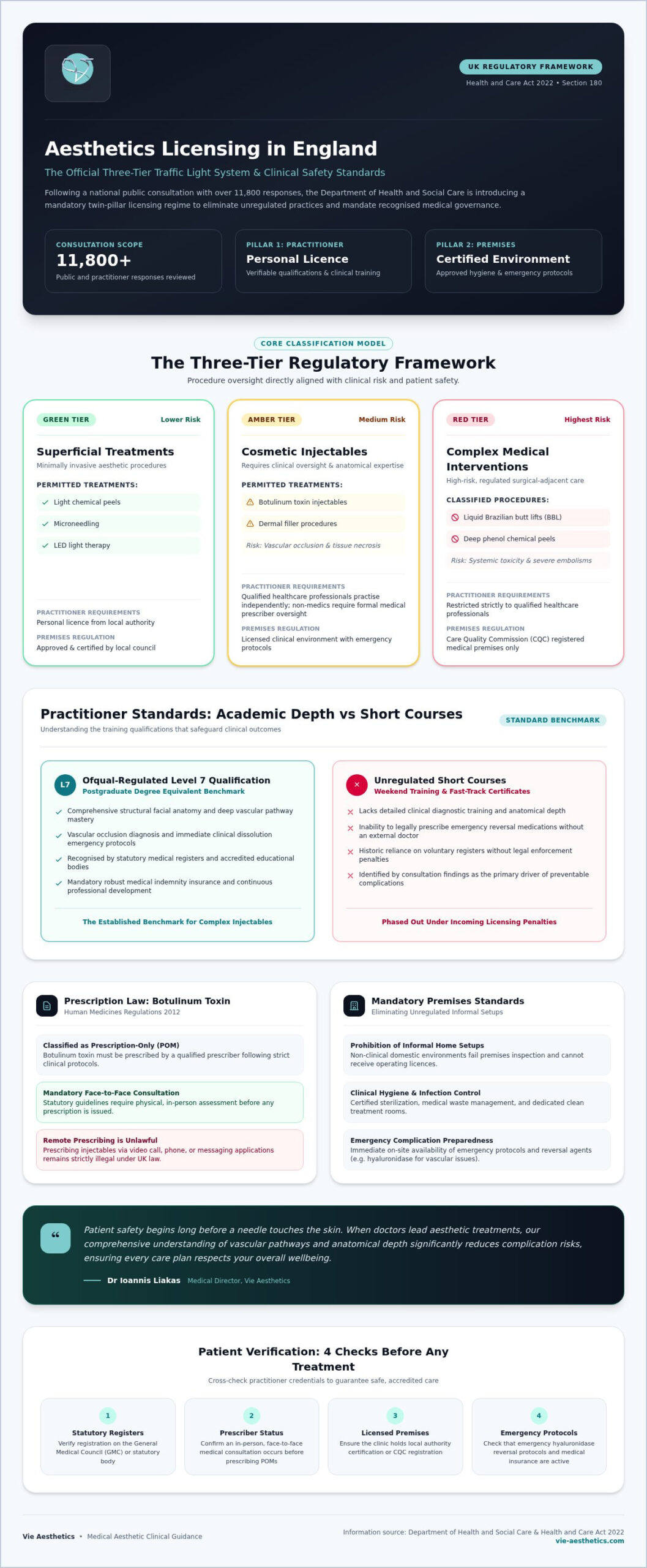
The distinction between comprehensive medical training and short-course certifications forms the core of regulatory reform. Under standards established for the licensing of non-surgical cosmetic procedures in England, the benchmark for administering complex injectables like dermal filler is an Ofqual-regulated Level 7 qualification, equivalent to a postgraduate degree. Weekend certificates simply cannot match this depth of clinical education.
Prescription medications present another critical legal boundary. Under the Human Medicines Regulations 2012, botulinum toxin is a Prescription-Only Medicine (POM). Statutory guidelines mandate a face-to-face consultation between the prescriber and the patient beforehand. Remote prescribing via video calls or messaging apps remains strictly unlawful. Robust indemnity insurance and ongoing professional development are also mandatory to maintain clinical accountability.
Doctor-led care provides deep diagnostic capability and structural anatomical knowledge. Medical doctors assess your complete health history, potential drug interactions, and skin physiology to determine clinical suitability before recommending any aesthetic procedure.
As Dr Ioannis Liakas, Medical Director at Vie Aesthetics, explains: “Patient safety begins long before a needle touches the skin. When doctors lead aesthetic treatments, our comprehensive understanding of vascular pathways and anatomical depth significantly reduces complication risks, ensuring every care plan respects your overall wellbeing.”
You don’t need to guess whether a practitioner has genuine credentials. The framework for aesthetics licensing England encourages patients to cross-check qualifications on respected statutory registers:
Before proceeding with any injectable treatment, take a moment to schedule an in-depth medical consultation with a certified doctor who prioritises patient safety above all else.
Administering injectable aesthetic treatments requires far more than a steady hand. Domestic spaces, living rooms, and mobile setups simply cannot provide the sterile conditions necessary to prevent severe bacterial contamination. Under the incoming rules for aesthetics licensing England, local councils will inspect physical premises against stringent clinical sanitation benchmarks before granting an operating permit.
Every accredited facility must maintain medical-grade environments that align with established NHS guidance on cosmetic procedures. These measures transform the standard of cosmetic delivery by treating subtle facial enhancements as the invasive clinical procedures they truly are.
Safe clinical practice relies on controlled operating environments designed to eliminate cross-contamination risks:
A sterile environment is vital, yet immediate emergency readiness remains the most critical safety differentiator. An unlicensed injector working from a home setup usually relies solely on a 999 call when an adverse reaction develops. In contrast, an accredited medical clinic maintains rapid protocols for rare systemic allergic responses like anaphylaxis, alongside mandatory supplies of intramuscular adrenaline.
When administering hyaluronic acid fillers, clinics must keep hyaluronidase readily accessible in the treatment room. Hyaluronidase is a prescription-only enzyme that dissolves dermal filler swiftly during a suspected vascular blockage, restoring blood flow before tissue necrosis can occur. Because hyaluronidase is a prescription-only medicine, non-prescribing injectors cannot legally purchase or store emergency stock on site. Doctor-led clinics ensure direct access to reversal drugs under the framework for aesthetics licensing England.
Before scheduling any procedure, you can protect your wellbeing by following a clear vetting process. The shift toward mandatory aesthetics licensing England empowers you to evaluate clinics with complete transparency. You should never feel pressured into a treatment without having your questions answered first.
Follow this practical five-step checklist before booking:
Be alert to common warning signs. Heavily discounted group deals, mobile house calls, and rushed consultations without medical health assessments are immediate red flags.
A reputable clinician welcomes open scrutiny. During your initial consultation, ask these direct questions:
If an injector avoids these questions or brushes off your concerns, seek care elsewhere.
Choosing a doctor-led clinic ensures your treatment plan supports your overall wellbeing rather than chasing quick trends. At Vie Aesthetics, all treatments are delivered solely by qualified medical doctors and registered healthcare professionals adhering to robust clinical governance. You can meet the team or view our awards and accreditations to see how our standards already exceed the incoming benchmarks for aesthetics licensing England.
Taking time to make an unhurried, fully informed decision keeps you safe and confident throughout your aesthetic care.
The implementation of aesthetics licensing England represents an essential turning point for patient protection. By categorising treatments into clear risk tiers, the new regulations empower you to demand verified credentials, sterile clinical premises, and comprehensive emergency readiness.
At Vie Aesthetics, we hold ourselves to these exacting standards every single day. All aesthetic procedures are performed exclusively by qualified doctors and registered medical practitioners within state-of-the-art clinical environments that meet the most stringent medical hygiene protocols. Recognised nationally for excellence in patient safety, our team believes your care should always be unhurried, transparent, and ethically guided.
Your wellbeing deserves nothing less than complete clinical reassurance. When you’re ready to explore aesthetic treatments, take your time, ask the right questions, and let expert medical care support your journey.
The statutory powers for aesthetics licensing England exist under Section 180 of the Health and Care Act 2022, but single-licence enforcement by every local council is rolling out in phased stages. Following the government consultation response in August 2025, secondary regulations are introducing practitioner and premises licensing across English local authorities through 2026 and 2027. High-risk procedures face immediate oversight first, with broader council enforcement expanding across all tiers.
Regulated healthcare professionals, including GMC-registered doctors, NMC nurses, and GDC dentists, can legally prescribe and administer anti-wrinkle injections independently. Non-medical practitioners must hold an accredited licence and practise under the direct oversight of a qualified medical prescriber. Botulinum toxin remains a prescription-only medicine requiring an in-person physical consultation before prescribing. Additionally, the Botulinum Toxin and Cosmetic Fillers (Children) Act 2021 makes it a criminal offence to treat anyone under 18.
You can verify your practitioner’s credentials by searching their registration number on statutory public registers. Check the General Medical Council register for doctors, the Nursing and Midwifery Council for nurses, or the General Dental Council for dentists. These registers confirm whether a clinician holds an active, unrestricted licence to practise in the UK. You can also review accredited voluntary registers such as the JCCP to verify audited clinical premises and training.
The three tiers categorise treatments by invasiveness and potential risk under aesthetics licensing England. Green procedures, like microneedling and superficial peels, require personal licences and hygienic premises. Amber procedures include botulinum toxin and dermal fillers; healthcare professionals can perform them independently, whilst non-medics need formal medical supervision. Red procedures carry severe complication risks, such as liquid Brazilian butt lifts, and are strictly restricted to regulated healthcare professionals operating within CQC-registered facilities.
No. Domestic living rooms and mobile home setups cannot satisfy the mandatory premises standards enforced by local authorities. Aesthetic injectables require clinical environments equipped with medical-grade ventilation, non-porous surfaces, sterile fields, and contracted hazardous waste disposal. Mobile setups also lack reliable cold-chain refrigeration for sensitive prescription medicines and cannot support necessary emergency resuscitation gear. Safe, compliant practice requires a dedicated, inspected clinical facility designed specifically for medical procedures.
Your clinic should immediately provide a face-to-face medical assessment and deploy on-site reversal protocols. If a dermal filler obstructs a blood vessel, a qualified doctor or prescriber must immediately administer hyaluronidase, a prescription-only enzyme that dissolves filler and restores vital blood circulation. Doctor-led clinics maintain these emergency medications in stock and provide dedicated aftercare contact details. Never rely on an injector who advises waiting or simply directs you to call 999.
 Read this article
 Read this article