Article by
Vicky Grammatikopoulou, BHons, MA
Vicky Grammatikopoulou is the founder and CEO of Vie Aesthetics, a multi-award winning UK-based aesthetics business built on a philosophy of safety, excellence, education, innovation, and empowerment.
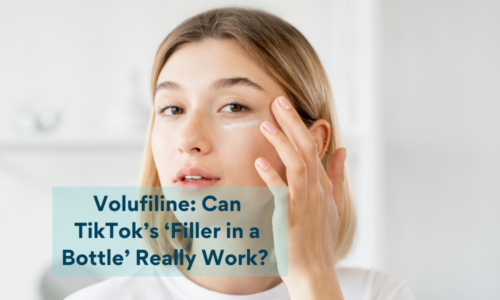
The Ordinary’s Volufiline 92% + Pal-Isoleucine 1% serum has become one of TikTok’s most talked-about skincare products. Priced at £19.50 in the UK, it is being applied to hollow under-eyes, cheeks and smile lines by people hoping to restore lost facial volume without injections. Social media users have called it “filler in a bottle”, but is that medically accurate?
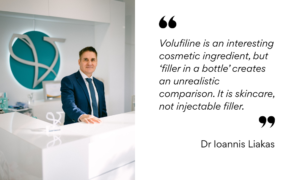
I wanted to shed more light on this trend and the science behind it, so I spoke to our Medical Director, Dr Ioannis Liakas, about what Volufiline is, what the research actually shows and why a striking online before-and-after does not necessarily mean that a serum has created new facial volume. His verdict is measured: it may make some skin look smoother and subtly more cushioned, but there is no convincing independent evidence that it can replace lost facial fat or reproduce injectable filler.
Volufiline is not a plant or a pure active ingredient. It is the trade name for a cosmetic raw-material blend developed by Sederma, now part of Croda Beauty. It combines hydrogenated polyisobutene, an emollient carrier, with Anemarrhena asphodeloides root extract. A compound called sarsasapogenin is associated with its proposed plumping action.
Croda states that Volufiline is intended to encourage lipid storage and adipocyte differentiation. Adipocytes are fat cells. In simple terms, the proposed mechanism is that existing cells may store more lipid while precursor cells may develop into mature adipocytes, potentially giving the treated area a fuller appearance.
The Ordinary’s formula contains 92% Volufiline technology alongside 1% palmitoyl isoleucine, a lipoamino acid intended to support elasticity and the appearance of fine lines. Crucially, “92% Volufiline” does not mean 92% pure sarsasapogenin. Volufiline is itself a mixture of botanical extract and carrier.
This is where the language used online moves ahead of the science.
Laboratory work associated with Volufiline placed the ingredient directly onto cells. This can explore biological potential, but it does not establish that the substance will cross intact human skin, reach facial fat and cause a visible change.
The human test most often quoted was conducted by the ingredient manufacturer. A cream containing 5% Volufiline was reportedly applied twice daily to one breast in 30 women for 56 days. The commonly reported average volume increase was approximately 2.2% on the treated side.
That result is not proof that the serum fills hollow cheeks or under-eyes. The test was small, manufacturer-led and conducted on breast tissue, not an independent, peer-reviewed facial trial of The Ordinary’s product.
A separate peer-reviewed study published in 2026 assessed a different multi-ingredient “volumising” face cream in people who had experienced rapid weight loss. Twenty-nine participants completed the 12-week study, and researchers reported improvements in measures including hydration, wrinkles and ultrasound-measured skin and subcutaneous thickness.
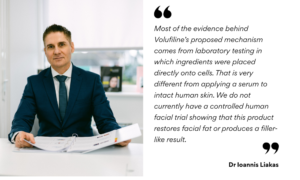
This does not prove that Volufiline works. The product was not The Ordinary’s serum, contained multiple different ingredients, had no placebo control and was manufacturer-funded. Volufiline was not the ingredient under investigation. Dr Liakas explains:
:
Some topical medicines can penetrate the skin, so it would be inaccurate to claim that no substance applied to the surface can ever pass through it. The more useful question is whether Volufiline reaches the appropriate facial tissue in a sufficient concentration to produce a meaningful, controlled and symmetrical increase in volume.
That has not been demonstrated. For the claimed mechanism to create facial volume, the relevant component would need to cross the skin barrier, reach the intended fat cells and affect them reliably. Published human studies have not demonstrated that topical Volufiline completes this process in facial skin.
True facial hollowness also has several possible causes. Ageing and weight loss can change:
A serum may support the skin’s appearance, but it cannot be expected to rebuild all these deeper structures.
Some before-and-after videos appear to show fuller under-eyes or softer smile lines immediately after application. That change cannot realistically represent the creation or enlargement of fat cells. Biological tissue changes do not occur within a few minutes.
The formula can leave an emollient film over the skin, temporarily softening dry lines and altering how light reflects from the face. Mild irritation can also produce swelling that looks like plumping, although this is an unwanted reaction and a reason to stop.
The images themselves require caution. Lighting, exposure, facial expression, head position, camera distance, lens distortion, make-up and automated phone processing can all alter the apparent depth of a hollow or line. Under-eye fluid retention also changes during the day.
“A meaningful comparison requires photographs taken with the same camera, lighting, distance, expression and time of day,” says Dr Liakas. “Without those controls, a dramatic before-and-after image tells us very little.”
An improvement in superficial fine lines is more plausible than the correction of genuinely hollow cheeks or tear troughs.
Fine lines often appear more prominent when the skin is dry or its surface is rough. An emollient product can make that surface feel softer and look more supple. This can be a worthwhile cosmetic effect, but it does not establish that the product has generated fat or replaced lost structural volume.
The complete formula matters. A user cannot assume that every improvement comes from its headline ingredient.
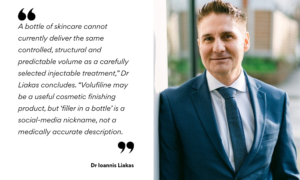
“Skincare can improve the quality of the skin overlying a hollow,” Dr Liakas explains. “It cannot predictably rebuild depleted fat compartments, restore bone support or reposition facial ligaments.”
This distinction matters because the word “hollow” is often used loosely online. A tear trough can create a depression and shadow between the lower eyelid and cheek. Under-eye bags involve protruding fat, fluid retention or lax supporting tissues. Dark circles may instead result from pigmentation, visible blood vessels, thin skin, shadowing or a combination of factors.
These concerns may look similar online but require different approaches. A product promoted as increasing fullness may be poorly suited to somebody whose main concern is puffiness or an already prominent fat pad.
Dr Liakas says:
“The correct treatment depends on the diagnosis. An under-eye shadow may come from hollowness, pigmentation, thin skin, puffiness or several of these together. Treating every tired-looking under-eye as volume loss can produce a disappointing result.”
There is no scientifically validated testing period for The Ordinary’s facial serum. The frequently quoted Volufiline test assessed another formulation on breast tissue over 56 days, so its findings cannot simply be transferred to this product or the face.
As a practical skincare trial, Dr Liakas suggests using the serum consistently and exactly as instructed for around eight weeks. Take a baseline photograph and one photograph each week under the same conditions. Do not judge it from a single image taken immediately after application.
If there is no discernible change after eight to twelve weeks, continued use is unlikely to suddenly deliver a filler-like effect. It is also important to distinguish smoother fine lines and softer-feeling skin from measurable restoration of facial volume.
The Ordinary describes the serum as suitable for hollow-looking facial areas, including beneath the eyes. Apply it only as directed and on unbroken skin. Around the eyes, use a small amount and avoid the eyelid margin, lash line and eye itself. Patch test it first and stop if redness, burning, itching, swelling or irritation develops.
The product’s official directions do not specifically tell consumers to apply it directly to the lips. Dr Liakas therefore advises against placing it on the wet inner lip or other mucosal tissue. A product specifically formulated and tested for lip use is the safer choice.
Avoid unverified products marketed as “100% Volufiline”. Croda describes Volufiline as a cosmetic raw material for professionally formulated products, not a pure active to buy from an unknown seller and dilute at home.
The truth is that there are no reliable discontinuation studies showing what happens after facial use stops. Any smoothing caused by the surface film, emollient effect or temporary improvement in skin softness will diminish once the product is no longer used. If Volufiline genuinely alters lipid storage in superficial fat cells, the duration and reversibility of that change remain unknown because researchers have not properly studied them in human facial skin.
It is therefore sensible to regard any benefit as subtle and maintenance-dependent. Claims that the serum permanently creates new facial volume go beyond the evidence.
“These options are not interchangeable” dr Liakas explains. A topical serum may improve softness, smoothness and fine lines. Any true volumising effect remains uncertain and, if present, is likely to be gradual and modest.
Dermal filler involves placing a measured amount of gel, commonly cross-linked hyaluronic acid, into a carefully selected tissue plane. This physically adds volume at a controlled depth and can alter facial contours immediately. Results are temporary and their longevity varies according to the product, treatment area and individual.
“Skin booster” is a broad term for small injections of products intended primarily to support hydration, elasticity and skin quality. Skin boosters generally do not replace depleted facial fat or create the same structural contour as filler.
Injectables carry risks that a cosmetic serum does not. Possible effects include bruising, swelling, infection and inflammatory reactions. With dermal filler, accidental injection into a blood vessel is rare but can cause serious complications. A medical consultation, detailed understanding of facial anatomy and the ability to recognise and manage complications are essential.
Filler is not automatically the correct answer to every hollow or under-eye concern. Some people are unsuitable, particularly where swelling, prominent bags or certain anatomical features are present. A responsible consultation identifies the cause before discussing treatment.
This depends on your expectations.
Dr Liakas does not dismiss the product. Somebody who enjoys skincare and understands its limitations may find that it makes their skin feel softer or look smoother and slightly more cushioned. At £19.50, they may consider that worthwhile.
The difficulty lies in expecting it to perform like a medical treatment.
If you are concerned about hollow cheeks, tear troughs, dark circles or changes in facial volume, begin with a consultation rather than choosing a treatment from a social-media video. At Vie Aesthetics, our medical team assesses your facial anatomy, skin quality and the cause of your concern before explaining whether skincare, an injectable treatment or no treatment is the most appropriate option.
This article provides general information and does not replace individual medical advice. Suitability for any injectable or skin treatment must be assessed during a consultation.