Profhilo Structura is designed to address changes in facial volume and structural support, while standard Profhilo focuses on skin quality. If you’re comparing Profhilo Structura with standard Profhilo, the main difference is their intended purpose, not simply the name or ingredient they share.
It’s understandable to feel unsure about how these injectables compare. This guide explains their different aims, how they compare with dermal fillers and what to discuss with a clinician before deciding whether either approach suits you.
You’ll also find practical questions to take to an assessment, including questions about suitability, potential risks and alternatives. The aim is to help you make an informed choice, without feeling you need to arrive with a decision already made.
Profhilo Structura is an injectable hyaluronic acid treatment designed to address facial volume changes by supporting deeper tissue structures. Standard Profhilo has a different focus: skin quality. Structura is intended to work within superficial fat compartments, but suitability and individual outcomes depend on clinical assessment.
In brief: Profhilo Structura contains hyaluronic acid and is designed for facial structural support. This describes the product’s intended use, not a guaranteed result for any individual.
The product contains 90 mg of high- and low-molecular-weight hyaluronic acid in a 2 ml syringe, with 45 mg of each. Hyaluronic acid is a substance found naturally in the body and is used in a range of medical and aesthetic applications. Learn more about hyaluronic acid.
Manufacturer information describes its production using NAHYCO® thermal technology, which combines the two forms of hyaluronic acid without chemical cross-linking agents. Cross-linking means chemically joining molecules to create a gel structure. This formulation and its intended action distinguish it from standard Profhilo treatment, but product details alone cannot predict how someone’s face will respond.
You might ask about this treatment if you’ve noticed changes in facial volume or support, such as a more hollow or less full appearance. These changes can have different causes, and noticing them doesn’t mean treatment is necessary. An assessment starts with what you would like to discuss, rather than treating any feature as a defect.
A doctor or qualified medical practitioner can consider your goals, medical history and facial anatomy, then discuss whether this approach is suitable or whether another option may be more appropriate. Structura’s intended purpose is not a promise to restore a particular contour or create a specific lifting effect. Treatment plans and outcomes are individual.
It helps to separate product information from personal suitability. Formulation and intended purpose describe the treatment; a clinician’s assessment considers whether it may be appropriate for you. A consultation gives you time to explore both before making a decision.
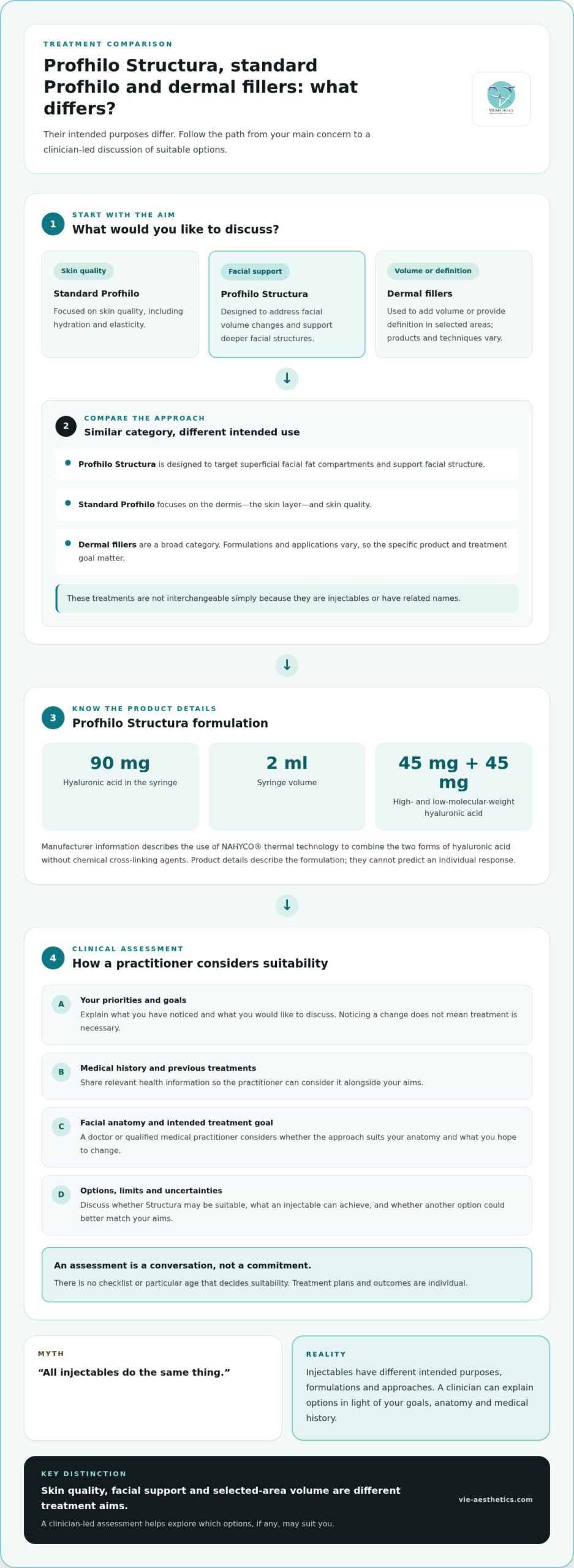
The main difference is the treatment goal. Standard Profhilo is intended to support skin quality, Profhilo Structura is designed to address deeper facial support and volume changes, and dermal fillers are used to add volume or definition in selected areas. These treatments aren’t interchangeable simply because they’re injectables or have related names.
| Treatment | General purpose | What assessment considers |
|---|---|---|
| Profhilo Structura | Designed to target superficial facial fat compartments and support facial structure. | Whether your goals and facial anatomy suit this intended approach. |
| Standard Profhilo | Focused on skin quality, including hydration and elasticity. | Whether skin quality is your main concern and whether this treatment is appropriate. |
| Dermal fillers | Used to add volume or provide definition in selected areas. Products and techniques can vary. | The area being considered, desired change, medical history and suitable product approach. |
Although the names are similar, their intended treatment levels differ. Standard Profhilo focuses on the dermis, the skin layer, while Structura is designed to act deeper, in superficial fat compartments. This helps explain why one may be discussed for skin quality and the other for changes in facial support. The clinic’s Profhilo 5-point lift information explains the standard Profhilo approach.
Dermal fillers are a broad category of injectable products used to add volume or definition. Their formulations and applications vary, so a clinician needs to consider the specific product and your treatment goal. Structura has a different stated purpose and approach; it shouldn’t be presented as a filler substitute or as producing identical effects.
Myth: All injectables do the same thing.
Reality: Different injectables have different intended purposes, formulations and approaches. A doctor or qualified medical practitioner can explain which options may align with your goals, anatomy and medical history.
There isn’t one option that is right for everyone. A doctor-led assessment can clarify the differences and explore suitable alternatives, without assuming that a particular treatment is the answer.
A clinician determines suitability for Profhilo Structura; there isn’t a checklist or particular age that can decide it for you. An assessment gives you time to explain what you hope to change, share relevant medical history and discuss whether the treatment’s intended approach fits your facial anatomy and expectations.
Your practitioner will listen to your priorities and ask about your health and any relevant previous treatments. They’ll assess your facial anatomy and discuss whether the proposed treatment goal is appropriate, along with possible alternatives and the limits of what an injectable can achieve.
This is a conversation, not a commitment. Ask what outcome may be realistic for you, what uncertainties remain and whether another option could better match your aims. Vie Aesthetics’ medical team provides practitioner-led care, with treatment planning tailored to the individual.
WILL: Profhilo Structura is designed to address facial structural support and volume changes by targeting superficial fat compartments. This describes its intended purpose, not a promise about the result you’ll see.
WON’T: It can’t guarantee a particular lift, contour or degree of change, and it isn’t automatically the right choice for everyone. It shouldn’t be assumed to work like standard Profhilo or a dermal filler, as these have different intended purposes.
Individual outcomes vary. Your clinician should explain what may be achievable in your circumstances and where results are uncertain. No specific result or timeline can be promised for everyone, so use the assessment to agree on expectations before deciding whether to proceed.
You don’t need to arrive with a diagnosis. It may help to note your goals, relevant medical history and questions about alternatives or limitations. A careful discussion can help you make an informed choice, including choosing not to have treatment.
A consultation can move you from general research to a discussion about your individual needs. You can explain what you hope to achieve, hear the clinician’s assessment and consider your options without committing to treatment.
A few notes can help you make the most of the conversation. You may find it useful to prepare in this order:
You could also ask how the practitioner will assess your facial anatomy and what might make another approach more suitable. Aim to understand the reasoning behind any recommendation, including what the treatment is not expected to achieve.
At Vie Aesthetics, aesthetic procedures are performed only by doctors and qualified medical practitioners. They discuss your goals and relevant history, assess suitability and tailor the treatment plan to your individual needs. You can learn about the Vie Aesthetics medical team and its practitioner-led approach.
Shared decision-making means you and your clinician can weigh potential benefits, limitations and alternatives together. You’re free to take time to consider the information, ask further questions or decide that treatment isn’t right for you. A recommendation is not a promise of a particular result.
Before booking a Profhilo Structura consultation, consider whether you’re ready to discuss your aims and hear an individual clinical assessment. You don’t need to have every answer beforehand; the consultation is a chance to get relevant information and make a considered choice.
Choosing whether to explore Profhilo Structura is a personal decision. Before moving forward, consider what you hope to achieve and whether you feel comfortable with the treatment’s intended purpose, possible limitations and the individual nature of results.
A consultation can turn your questions into a thoughtful conversation about your goals and suitable options. Ask for anything unclear to be explained in plain English, take time to weigh the information and decide whether you want to proceed. You don’t need to arrive with a decision already made.
If you’re ready to discuss your options, book a doctor-led consultation with Vie Aesthetics. Your treatment plan will be considered around your individual needs.
Take the time you need to make an informed choice that feels right for you.
Profhilo Structura is an injectable hyaluronic acid treatment designed to address changes in facial volume and structural support. The product contains 90 mg of hyaluronic acid in a 2 ml syringe. That ingredient information describes the formulation, not the result a person will experience. If you’re considering it, ask the clinician how its intended purpose relates to your concerns and what outcomes may be realistic for you.
The main difference is the intended treatment focus: standard Profhilo is used to support skin quality, while Structura is designed to target deeper facial support. The names are related, but the treatments aren’t automatically interchangeable. If your main aim is to discuss skin hydration rather than facial volume changes, ask which option best matches that goal and why.
Profhilo Structura is a hyaluronic acid injectable, but it shouldn’t be assumed to work like a dermal filler. Fillers are a broad group of products used for purposes such as adding volume or definition, and their formulations and applications vary. Ask which treatment goal is being considered and how the proposed approach differs, rather than judging suitability by the fact that both involve injections.
Suitability can only be determined through an individual clinical assessment. Someone exploring changes in facial volume may wish to discuss the treatment, but that concern alone doesn’t establish that it’s appropriate. A clinician will consider factors such as medical history, facial anatomy and personal goals. Share relevant medicines and previous aesthetic treatments so the practitioner can consider your circumstances when discussing options.
There isn’t one result timeframe that can be promised for everyone. Visible changes and when they may become apparent can vary between individuals, so another person’s experience may not predict yours. Ask your clinician what changes may be realistic in your case, when they would suggest reviewing progress and what options you have if your expectations aren’t met.
Expect a discussion of your aims, relevant health history and facial anatomy, followed by an explanation of suitable options and their limitations. Bring questions about the proposed goal, possible alternatives and how individual results may vary. You can take time to consider the information; attending a consultation doesn’t commit you to treatment.

Profhilo Structura is designed to address changes in facial volume and structural support, while standard Profhilo focuses on skin quality. If you’re comparing Profhilo Structura with standard Profhilo, the main difference is their intended purpose, not simply the name or ingredient they share.
It’s understandable to feel unsure about how these injectables compare. This guide explains their different aims, how they compare with dermal fillers and what to discuss with a clinician before deciding whether either approach suits you.
You’ll also find practical questions to take to an assessment, including questions about suitability, potential risks and alternatives. The aim is to help you make an informed choice, without feeling you need to arrive with a decision already made.
Profhilo Structura is an injectable hyaluronic acid treatment designed to address facial volume changes by supporting deeper tissue structures. Standard Profhilo has a different focus: skin quality. Structura is intended to work within superficial fat compartments, but suitability and individual outcomes depend on clinical assessment.
In brief: Profhilo Structura contains hyaluronic acid and is designed for facial structural support. This describes the product’s intended use, not a guaranteed result for any individual.
The product contains 90 mg of high- and low-molecular-weight hyaluronic acid in a 2 ml syringe, with 45 mg of each. Hyaluronic acid is a substance found naturally in the body and is used in a range of medical and aesthetic applications. Learn more about hyaluronic acid.
Manufacturer information describes its production using NAHYCO® thermal technology, which combines the two forms of hyaluronic acid without chemical cross-linking agents. Cross-linking means chemically joining molecules to create a gel structure. This formulation and its intended action distinguish it from standard Profhilo treatment, but product details alone cannot predict how someone’s face will respond.
You might ask about this treatment if you’ve noticed changes in facial volume or support, such as a more hollow or less full appearance. These changes can have different causes, and noticing them doesn’t mean treatment is necessary. An assessment starts with what you would like to discuss, rather than treating any feature as a defect.
A doctor or qualified medical practitioner can consider your goals, medical history and facial anatomy, then discuss whether this approach is suitable or whether another option may be more appropriate. Structura’s intended purpose is not a promise to restore a particular contour or create a specific lifting effect. Treatment plans and outcomes are individual.
It helps to separate product information from personal suitability. Formulation and intended purpose describe the treatment; a clinician’s assessment considers whether it may be appropriate for you. A consultation gives you time to explore both before making a decision.
The main difference is the treatment goal. Standard Profhilo is intended to support skin quality, Profhilo Structura is designed to address deeper facial support and volume changes, and dermal fillers are used to add volume or definition in selected areas. These treatments aren’t interchangeable simply because they’re injectables or have related names.
| Treatment | General purpose | What assessment considers |
|---|---|---|
| Profhilo Structura | Designed to target superficial facial fat compartments and support facial structure. | Whether your goals and facial anatomy suit this intended approach. |
| Standard Profhilo | Focused on skin quality, including hydration and elasticity. | Whether skin quality is your main concern and whether this treatment is appropriate. |
| Dermal fillers | Used to add volume or provide definition in selected areas. Products and techniques can vary. | The area being considered, desired change, medical history and suitable product approach. |
Although the names are similar, their intended treatment levels differ. Standard Profhilo focuses on the dermis, the skin layer, while Structura is designed to act deeper, in superficial fat compartments. This helps explain why one may be discussed for skin quality and the other for changes in facial support. The clinic’s Profhilo 5-point lift information explains the standard Profhilo approach.
Dermal fillers are a broad category of injectable products used to add volume or definition. Their formulations and applications vary, so a clinician needs to consider the specific product and your treatment goal. Structura has a different stated purpose and approach; it shouldn’t be presented as a filler substitute or as producing identical effects.
Myth: All injectables do the same thing.
Reality: Different injectables have different intended purposes, formulations and approaches. A doctor or qualified medical practitioner can explain which options may align with your goals, anatomy and medical history.
There isn’t one option that is right for everyone. A doctor-led assessment can clarify the differences and explore suitable alternatives, without assuming that a particular treatment is the answer.
A clinician determines suitability for Profhilo Structura; there isn’t a checklist or particular age that can decide it for you. An assessment gives you time to explain what you hope to change, share relevant medical history and discuss whether the treatment’s intended approach fits your facial anatomy and expectations.
Your practitioner will listen to your priorities and ask about your health and any relevant previous treatments. They’ll assess your facial anatomy and discuss whether the proposed treatment goal is appropriate, along with possible alternatives and the limits of what an injectable can achieve.
This is a conversation, not a commitment. Ask what outcome may be realistic for you, what uncertainties remain and whether another option could better match your aims. Vie Aesthetics’ medical team provides practitioner-led care, with treatment planning tailored to the individual.
WILL: Profhilo Structura is designed to address facial structural support and volume changes by targeting superficial fat compartments. This describes its intended purpose, not a promise about the result you’ll see.
WON’T: It can’t guarantee a particular lift, contour or degree of change, and it isn’t automatically the right choice for everyone. It shouldn’t be assumed to work like standard Profhilo or a dermal filler, as these have different intended purposes.
Individual outcomes vary. Your clinician should explain what may be achievable in your circumstances and where results are uncertain. No specific result or timeline can be promised for everyone, so use the assessment to agree on expectations before deciding whether to proceed.
You don’t need to arrive with a diagnosis. It may help to note your goals, relevant medical history and questions about alternatives or limitations. A careful discussion can help you make an informed choice, including choosing not to have treatment.
A consultation can move you from general research to a discussion about your individual needs. You can explain what you hope to achieve, hear the clinician’s assessment and consider your options without committing to treatment.
A few notes can help you make the most of the conversation. You may find it useful to prepare in this order:
You could also ask how the practitioner will assess your facial anatomy and what might make another approach more suitable. Aim to understand the reasoning behind any recommendation, including what the treatment is not expected to achieve.
At Vie Aesthetics, aesthetic procedures are performed only by doctors and qualified medical practitioners. They discuss your goals and relevant history, assess suitability and tailor the treatment plan to your individual needs. You can learn about the Vie Aesthetics medical team and its practitioner-led approach.
Shared decision-making means you and your clinician can weigh potential benefits, limitations and alternatives together. You’re free to take time to consider the information, ask further questions or decide that treatment isn’t right for you. A recommendation is not a promise of a particular result.
Before booking a Profhilo Structura consultation, consider whether you’re ready to discuss your aims and hear an individual clinical assessment. You don’t need to have every answer beforehand; the consultation is a chance to get relevant information and make a considered choice.
Choosing whether to explore Profhilo Structura is a personal decision. Before moving forward, consider what you hope to achieve and whether you feel comfortable with the treatment’s intended purpose, possible limitations and the individual nature of results.
A consultation can turn your questions into a thoughtful conversation about your goals and suitable options. Ask for anything unclear to be explained in plain English, take time to weigh the information and decide whether you want to proceed. You don’t need to arrive with a decision already made.
If you’re ready to discuss your options, book a doctor-led consultation with Vie Aesthetics. Your treatment plan will be considered around your individual needs.
Take the time you need to make an informed choice that feels right for you.
Profhilo Structura is an injectable hyaluronic acid treatment designed to address changes in facial volume and structural support. The product contains 90 mg of hyaluronic acid in a 2 ml syringe. That ingredient information describes the formulation, not the result a person will experience. If you’re considering it, ask the clinician how its intended purpose relates to your concerns and what outcomes may be realistic for you.
The main difference is the intended treatment focus: standard Profhilo is used to support skin quality, while Structura is designed to target deeper facial support. The names are related, but the treatments aren’t automatically interchangeable. If your main aim is to discuss skin hydration rather than facial volume changes, ask which option best matches that goal and why.
Profhilo Structura is a hyaluronic acid injectable, but it shouldn’t be assumed to work like a dermal filler. Fillers are a broad group of products used for purposes such as adding volume or definition, and their formulations and applications vary. Ask which treatment goal is being considered and how the proposed approach differs, rather than judging suitability by the fact that both involve injections.
Suitability can only be determined through an individual clinical assessment. Someone exploring changes in facial volume may wish to discuss the treatment, but that concern alone doesn’t establish that it’s appropriate. A clinician will consider factors such as medical history, facial anatomy and personal goals. Share relevant medicines and previous aesthetic treatments so the practitioner can consider your circumstances when discussing options.
There isn’t one result timeframe that can be promised for everyone. Visible changes and when they may become apparent can vary between individuals, so another person’s experience may not predict yours. Ask your clinician what changes may be realistic in your case, when they would suggest reviewing progress and what options you have if your expectations aren’t met.
Expect a discussion of your aims, relevant health history and facial anatomy, followed by an explanation of suitable options and their limitations. Bring questions about the proposed goal, possible alternatives and how individual results may vary. You can take time to consider the information; attending a consultation doesn’t commit you to treatment.
 Read this article
 Read this article