By Dr Ioannis Liakas, Medical Director
Dermalux LED light therapy uses selected wavelengths of light to prompt responses in skin cells. It may be considered for concerns such as breakouts, redness or signs of ageing, but Dermalux LED light therapy cannot promise a particular result, and responses vary between individuals.
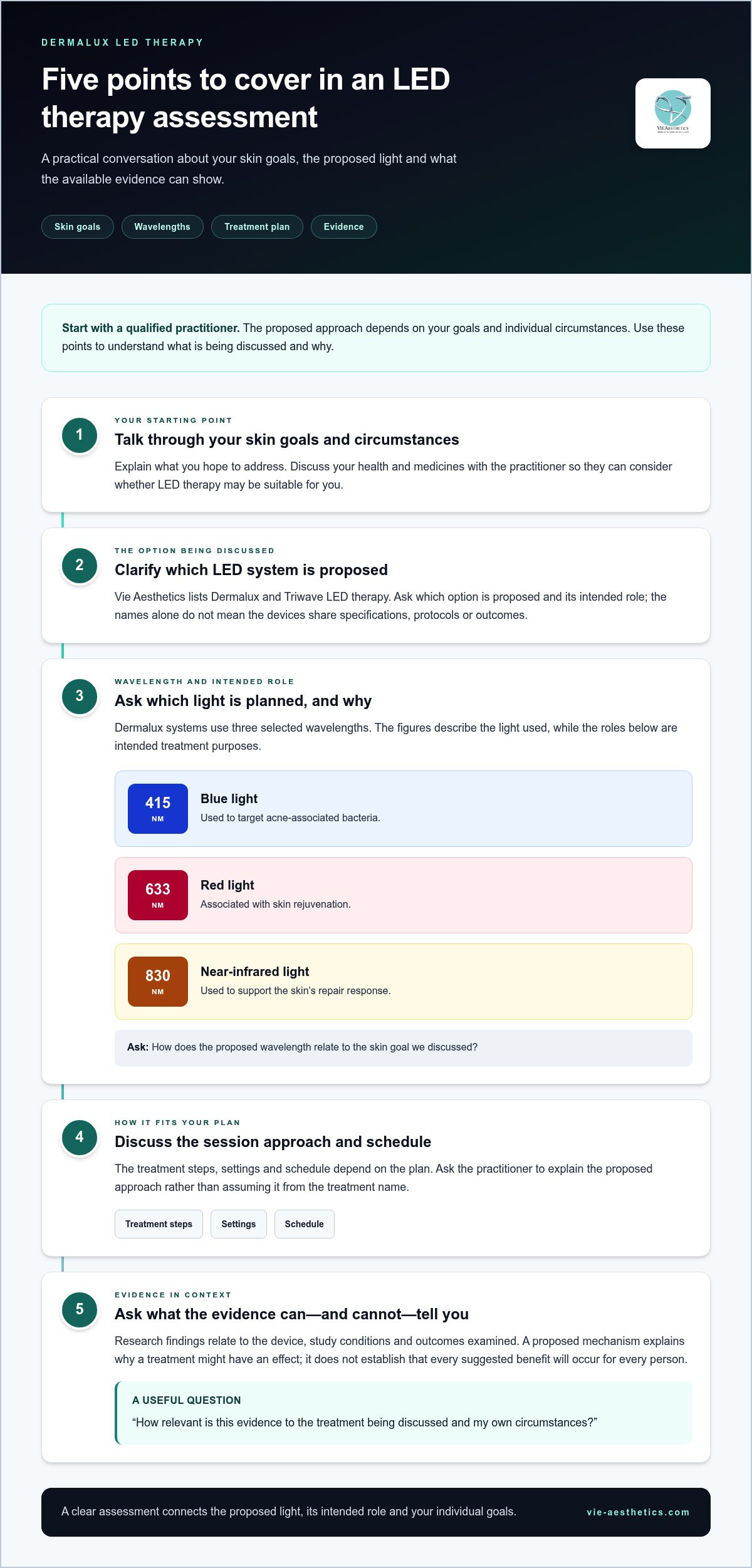
It’s understandable to feel unsure when cosmetic claims make LED sound like a solution for everything. In simple terms, blue, red and near-infrared light have different intended roles: blue light is used to target acne-associated bacteria, red light is associated with skin rejuvenation, and near-infrared light is used to support the skin’s repair response. The process is called photobiomodulation, which means light prompts responses within cells.
This guide explains what to ask about a session, how to interpret treatment claims, and what to consider before deciding whether LED therapy fits your goals. A qualified practitioner can discuss your health, medicines and skin concerns to help assess whether it may be suitable for you.
Dermalux LED light therapy is a non-invasive aesthetic treatment that uses light-emitting diodes, or LEDs, to deliver light to the skin. Vie Aesthetics offers Dermalux Medical LED Therapy as part of its skincare treatments. The treatment name describes the approach, not a guaranteed result.
In brief: Dermalux LED light therapy is a form of phototherapy used in an aesthetic skincare setting. Phototherapy is a broad term for using light in different treatment applications, but a general explanation of the term is not evidence for a particular device or outcome. Read more about phototherapy.
LED stands for “light-emitting diode”, a technology that produces light. In skincare, LED therapy is a treatment category, rather than one identical procedure. The device, wavelength and treatment plan matter, so don’t assume that all LED sessions work in the same way.
LED therapy may be considered alongside other aesthetic skincare options. The right approach depends on your goals and individual circumstances. You can explore Vie Aesthetics’ wider facial treatment options to understand the choices available.
Vie Aesthetics offers Dermalux Medical LED Therapy and lists Dermalux and Triwave LED therapy among its skincare treatments. These names refer to options in the treatment range. They do not establish that the devices have identical specifications, protocols or outcomes.
During an assessment, ask which option is proposed, what its intended role is, and how it relates to your skin goals. This can also help you compare LED therapy with other treatments, such as Cryopen therapy.
Bring your questions and explain what you hope to address. A practitioner can discuss the proposed approach in the context of your circumstances, so you can make an informed decision.
Dermalux LED light therapy uses selected wavelengths in a process known as photobiomodulation. In simple terms, cells absorb light and may respond by changing their activity. This explains the proposed treatment rationale, but it does not prove that every suggested skin benefit will occur for every person.
An appointment should begin with a discussion of your skin goals and relevant circumstances. A qualified practitioner can explain the proposed plan, including how LED therapy may fit into it. The treatment steps, settings and schedule depend on that plan, so they should be discussed rather than assumed from the treatment name.
Dermalux systems use blue light at 415 nm, red light at 633 nm and near-infrared light at 830 nm. These figures describe the wavelengths, not a promised result. Ask which wavelength is intended for your treatment and how its proposed role relates to your goals.
Evidence-based summary: Research into LED phototherapy can inform the use of particular wavelengths for specific concerns. However, findings from one device, study or outcome cannot automatically predict results from another treatment or for an individual.
A proposed mechanism explains why a treatment might have an effect. It is not the same as evidence that a visible change will follow. A study’s measured outcome relates to its participants and conditions, so ask how relevant that evidence is to the treatment being discussed and your own circumstances.
Vie Aesthetics offers Dermalux Medical LED Therapy, and its aesthetic procedures are performed by doctors and qualified medical practitioners. They can explain the treatment rationale, discuss what the available evidence can and cannot show, and help you consider whether LED therapy fits your goals.
LED therapy can sound straightforward: sit beneath a light and expect a visible change. In practice, the intended treatment, your skin and your individual response all matter. Dermalux LED light therapy is an approach to treatment, not a promise that one session will produce a specific cosmetic outcome.
A single session should not be presented as a guarantee of a particular visible result. Whether LED therapy is appropriate, what it is intended to address and how progress may be reviewed depend on your treatment plan and personal circumstances. A possible effect is not a prediction of how your own skin will respond.
Use this comparison to distinguish careful explanations from claims that go too far:
| Careful, supported framing | Overgeneralised claim |
|---|---|
| LED therapy uses light as part of an aesthetic treatment plan. | Every LED session produces the same visible change. |
| Research findings relate to the conditions and outcomes studied. | A result reported in one study will apply to everyone. |
| A practitioner can explain the treatment’s intended role for your goals. | One treatment guarantees a particular outcome. |
Evidence from a particular study or treatment plan cannot predict an individual’s response. Use it as context for a discussion, not as a promise about your own results.
It will: deliver LED light as part of a planned aesthetic treatment. A qualified practitioner can explain what the proposed treatment is designed to address and whether that aim is relevant to your skin goals.
It won’t: prove every broad skincare claim, guarantee a visible change or make individual outcomes predictable. It should not replace assessment when a skin concern needs a different kind of care.
Before deciding, be specific about what you hope to address and what information would help you feel confident. An individual assessment can help set realistic expectations and clarify the next steps.
A conversation with a qualified practitioner can help you decide whether Dermalux LED light therapy is relevant to your skincare goals. Treatment planning depends on individual assessment, so use the appointment to explain your circumstances and ask what the treatment can realistically offer.
Bring a clear description of your skincare goals and relevant treatment history. Explain what you have already tried, what you hope to understand about LED therapy and which claims you are unsure about. This helps make the conversation specific to you rather than based on general promises.
Vie Aesthetics’ aesthetic procedures are performed by doctors and qualified medical practitioners. You can learn about Vie Aesthetics’ medical team and discuss how LED therapy may relate to your goals. Ask what is known, where there is uncertainty and whether another option may be more appropriate.
If you choose to continue, your practitioner can explain the proposed treatment plan and relevant next steps. Ask about the suggested schedule and any aftercare guidance for your individual plan rather than relying on a general session count or routine.
Keep expectations personal. A treatment plan can clarify the intended role of LED therapy, but it cannot predict exactly how your skin will respond. You can take time to consider the discussion before making a decision.
If you would like to explore whether LED therapy fits your goals, arrange a consultation with a qualified practitioner.
Deciding whether to explore Dermalux LED light therapy starts with your priorities, not a promise of a particular result. Before an appointment, consider what you most want to understand: whether LED therapy relates to your goals, what a proposed plan involves, or how the evidence applies to your circumstances.
Vie Aesthetics offers Dermalux Medical LED Therapy, with treatment planning tailored to the individual. Its aesthetic procedures are performed by doctors and qualified medical practitioners, giving you the opportunity to discuss your questions in a clinical setting. Results vary between individuals, and there is no need to rush your decision.
A thoughtful conversation can help you move forward with clearer expectations and confidence in your next step, whatever you decide.
It delivers selected wavelengths of light to the skin, where light may be absorbed and prompt cellular responses. This process is called photobiomodulation. The device and chosen wavelength matter, so a general claim about LED does not establish what a particular treatment can do. Ask your practitioner to explain the rationale for the approach proposed for your skin.
No treatment should be assumed suitable for everyone. Tell your practitioner about relevant health conditions and medicines, including any photosensitivity disorder or medication that makes you more sensitive to light. These circumstances may affect whether LED therapy is appropriate. A qualified practitioner can review your information and advise you individually. Do not stop or change prescribed medicine based on general treatment information.
It may be considered alongside other aesthetic treatments, but compatibility depends on the treatments involved and your individual plan. For example, a facial or another skin procedure around the same time may affect how your care is scheduled. Share recent and planned treatments during your assessment, then follow tailored advice rather than assuming every combination is suitable.
There is no single session number that can be recommended for everyone. Your plan depends on your skin goals, the treatment approach and how your skin responds. Ask the practitioner to explain the proposed schedule and when they would review your progress. This helps you decide whether the time commitment suits you without relying on a generic session count.
Downtime should not be assumed to be identical for every person or treatment plan. Ask what to expect immediately afterwards and whether your skincare routine or planned procedures need to be considered. Your practitioner can advise you based on your appointment and circumstances. If you notice an unexpected reaction after treatment, follow the clinic’s guidance for seeking appropriate advice rather than relying on general online information.

By Dr Ioannis Liakas, Medical Director
Dermalux LED light therapy uses selected wavelengths of light to prompt responses in skin cells. It may be considered for concerns such as breakouts, redness or signs of ageing, but Dermalux LED light therapy cannot promise a particular result, and responses vary between individuals.
It’s understandable to feel unsure when cosmetic claims make LED sound like a solution for everything. In simple terms, blue, red and near-infrared light have different intended roles: blue light is used to target acne-associated bacteria, red light is associated with skin rejuvenation, and near-infrared light is used to support the skin’s repair response. The process is called photobiomodulation, which means light prompts responses within cells.
This guide explains what to ask about a session, how to interpret treatment claims, and what to consider before deciding whether LED therapy fits your goals. A qualified practitioner can discuss your health, medicines and skin concerns to help assess whether it may be suitable for you.
Dermalux LED light therapy is a non-invasive aesthetic treatment that uses light-emitting diodes, or LEDs, to deliver light to the skin. Vie Aesthetics offers Dermalux Medical LED Therapy as part of its skincare treatments. The treatment name describes the approach, not a guaranteed result.
In brief: Dermalux LED light therapy is a form of phototherapy used in an aesthetic skincare setting. Phototherapy is a broad term for using light in different treatment applications, but a general explanation of the term is not evidence for a particular device or outcome. Read more about phototherapy.
LED stands for “light-emitting diode”, a technology that produces light. In skincare, LED therapy is a treatment category, rather than one identical procedure. The device, wavelength and treatment plan matter, so don’t assume that all LED sessions work in the same way.
LED therapy may be considered alongside other aesthetic skincare options. The right approach depends on your goals and individual circumstances. You can explore Vie Aesthetics’ wider facial treatment options to understand the choices available.
Vie Aesthetics offers Dermalux Medical LED Therapy and lists Dermalux and Triwave LED therapy among its skincare treatments. These names refer to options in the treatment range. They do not establish that the devices have identical specifications, protocols or outcomes.
During an assessment, ask which option is proposed, what its intended role is, and how it relates to your skin goals. This can also help you compare LED therapy with other treatments, such as Cryopen therapy.
Bring your questions and explain what you hope to address. A practitioner can discuss the proposed approach in the context of your circumstances, so you can make an informed decision.
Dermalux LED light therapy uses selected wavelengths in a process known as photobiomodulation. In simple terms, cells absorb light and may respond by changing their activity. This explains the proposed treatment rationale, but it does not prove that every suggested skin benefit will occur for every person.
An appointment should begin with a discussion of your skin goals and relevant circumstances. A qualified practitioner can explain the proposed plan, including how LED therapy may fit into it. The treatment steps, settings and schedule depend on that plan, so they should be discussed rather than assumed from the treatment name.
Dermalux systems use blue light at 415 nm, red light at 633 nm and near-infrared light at 830 nm. These figures describe the wavelengths, not a promised result. Ask which wavelength is intended for your treatment and how its proposed role relates to your goals.
Evidence-based summary: Research into LED phototherapy can inform the use of particular wavelengths for specific concerns. However, findings from one device, study or outcome cannot automatically predict results from another treatment or for an individual.
A proposed mechanism explains why a treatment might have an effect. It is not the same as evidence that a visible change will follow. A study’s measured outcome relates to its participants and conditions, so ask how relevant that evidence is to the treatment being discussed and your own circumstances.
Vie Aesthetics offers Dermalux Medical LED Therapy, and its aesthetic procedures are performed by doctors and qualified medical practitioners. They can explain the treatment rationale, discuss what the available evidence can and cannot show, and help you consider whether LED therapy fits your goals.
LED therapy can sound straightforward: sit beneath a light and expect a visible change. In practice, the intended treatment, your skin and your individual response all matter. Dermalux LED light therapy is an approach to treatment, not a promise that one session will produce a specific cosmetic outcome.
A single session should not be presented as a guarantee of a particular visible result. Whether LED therapy is appropriate, what it is intended to address and how progress may be reviewed depend on your treatment plan and personal circumstances. A possible effect is not a prediction of how your own skin will respond.
Use this comparison to distinguish careful explanations from claims that go too far:
| Careful, supported framing | Overgeneralised claim |
|---|---|
| LED therapy uses light as part of an aesthetic treatment plan. | Every LED session produces the same visible change. |
| Research findings relate to the conditions and outcomes studied. | A result reported in one study will apply to everyone. |
| A practitioner can explain the treatment’s intended role for your goals. | One treatment guarantees a particular outcome. |
Evidence from a particular study or treatment plan cannot predict an individual’s response. Use it as context for a discussion, not as a promise about your own results.
It will: deliver LED light as part of a planned aesthetic treatment. A qualified practitioner can explain what the proposed treatment is designed to address and whether that aim is relevant to your skin goals.
It won’t: prove every broad skincare claim, guarantee a visible change or make individual outcomes predictable. It should not replace assessment when a skin concern needs a different kind of care.
Before deciding, be specific about what you hope to address and what information would help you feel confident. An individual assessment can help set realistic expectations and clarify the next steps.
A conversation with a qualified practitioner can help you decide whether Dermalux LED light therapy is relevant to your skincare goals. Treatment planning depends on individual assessment, so use the appointment to explain your circumstances and ask what the treatment can realistically offer.
Bring a clear description of your skincare goals and relevant treatment history. Explain what you have already tried, what you hope to understand about LED therapy and which claims you are unsure about. This helps make the conversation specific to you rather than based on general promises.
Vie Aesthetics’ aesthetic procedures are performed by doctors and qualified medical practitioners. You can learn about Vie Aesthetics’ medical team and discuss how LED therapy may relate to your goals. Ask what is known, where there is uncertainty and whether another option may be more appropriate.
If you choose to continue, your practitioner can explain the proposed treatment plan and relevant next steps. Ask about the suggested schedule and any aftercare guidance for your individual plan rather than relying on a general session count or routine.
Keep expectations personal. A treatment plan can clarify the intended role of LED therapy, but it cannot predict exactly how your skin will respond. You can take time to consider the discussion before making a decision.
If you would like to explore whether LED therapy fits your goals, arrange a consultation with a qualified practitioner.
Deciding whether to explore Dermalux LED light therapy starts with your priorities, not a promise of a particular result. Before an appointment, consider what you most want to understand: whether LED therapy relates to your goals, what a proposed plan involves, or how the evidence applies to your circumstances.
Vie Aesthetics offers Dermalux Medical LED Therapy, with treatment planning tailored to the individual. Its aesthetic procedures are performed by doctors and qualified medical practitioners, giving you the opportunity to discuss your questions in a clinical setting. Results vary between individuals, and there is no need to rush your decision.
A thoughtful conversation can help you move forward with clearer expectations and confidence in your next step, whatever you decide.
It delivers selected wavelengths of light to the skin, where light may be absorbed and prompt cellular responses. This process is called photobiomodulation. The device and chosen wavelength matter, so a general claim about LED does not establish what a particular treatment can do. Ask your practitioner to explain the rationale for the approach proposed for your skin.
No treatment should be assumed suitable for everyone. Tell your practitioner about relevant health conditions and medicines, including any photosensitivity disorder or medication that makes you more sensitive to light. These circumstances may affect whether LED therapy is appropriate. A qualified practitioner can review your information and advise you individually. Do not stop or change prescribed medicine based on general treatment information.
It may be considered alongside other aesthetic treatments, but compatibility depends on the treatments involved and your individual plan. For example, a facial or another skin procedure around the same time may affect how your care is scheduled. Share recent and planned treatments during your assessment, then follow tailored advice rather than assuming every combination is suitable.
There is no single session number that can be recommended for everyone. Your plan depends on your skin goals, the treatment approach and how your skin responds. Ask the practitioner to explain the proposed schedule and when they would review your progress. This helps you decide whether the time commitment suits you without relying on a generic session count.
Downtime should not be assumed to be identical for every person or treatment plan. Ask what to expect immediately afterwards and whether your skincare routine or planned procedures need to be considered. Your practitioner can advise you based on your appointment and circumstances. If you notice an unexpected reaction after treatment, follow the clinic’s guidance for seeking appropriate advice rather than relying on general online information.
 Read this article
 Read this article