Regenera Activa UK treatment takes about 30 minutes and involves collecting three small samples of scalp tissue. A Regenera Activa UK appointment is followed by a short recovery, with most people returning to normal activities the next day. Hair changes may develop gradually over the following months.
It’s understandable to want a clear picture before considering a treatment that involves collecting scalp tissue. The samples are processed into a solution for application to the scalp, and the donor area does not need to be shaved.
This guide explains how the treatment is intended to support hair growth, what tissue collection and application involve, and what recovery may be like. It also outlines the expected timeline to help you decide whether the process suits your needs.
Regenera Activa uses a person’s own scalp tissue to prepare a solution for application to thinning areas. This autologous approach, meaning the tissue comes from the person receiving treatment, is intended to support existing follicles rather than relocate hair. For people considering Regenera Activa UK, that distinction helps clarify the treatment’s intended role.
In androgenetic alopecia, follicles are sensitive to androgens, hormones that influence hair growth. Dihydrotestosterone (DHT), an androgen, can contribute to follicle miniaturisation: follicles gradually become smaller and produce finer, shorter hairs. As this pattern progresses, visible density may decrease.
The process uses small samples from a scalp area with healthy follicles. The tissue is processed into a solution containing growth factors and progenitor cells, which are involved in tissue development and repair. The prepared solution is then applied to areas affected by thinning.
Regenera Activa is intended for androgenetic alopecia, also called pattern hair loss, in men and women. The treatment information describes men with grade I to III hair loss as potential candidates, but this grading alone does not establish suitability. The type and extent of hair loss, along with the condition of the remaining follicles, also matter.
Hair thickening or new growth may develop over 3-12 months. Response depends on factors such as follicle health and the pattern of hair loss. A consultation can help distinguish pattern hair loss from other causes, since this treatment is intended for androgenetic alopecia.
Regenera Activa, PRP, medication and hair transplant surgery use different methods. The comparison below outlines their basic approaches.
| Approach | What it uses | How it differs |
|---|---|---|
| Regenera Activa | Processed scalp tissue | Applies a prepared tissue solution to areas with thinning. |
| PRP | Platelet-rich plasma from blood | Uses a blood-derived preparation delivered by injection. |
| Medication | Medicinal treatment, including topical options | Acts through medication rather than processed scalp tissue. |
| Hair transplant surgery | Follicles moved from one scalp area to another | Relocates follicles rather than applying a tissue solution. |
As an adjunct to a hair transplant, micrografting may be considered separately to support existing follicles; it does not perform the transplant or move donor hair. The pattern and extent of hair loss help shape a suitable restoration plan.
Is Regenera Activa regulated or approved for use in the UK? It is described as having secured EU approval, but that statement alone does not establish UK approval. EU approval and UK regulatory status are distinct considerations.
To check a UK clinic’s credentials, ask for the practitioner’s full name, professional registration and relevant training. Verify their registration on the appropriate professional regulator’s public register, then review their listed scope of practice and any restrictions.
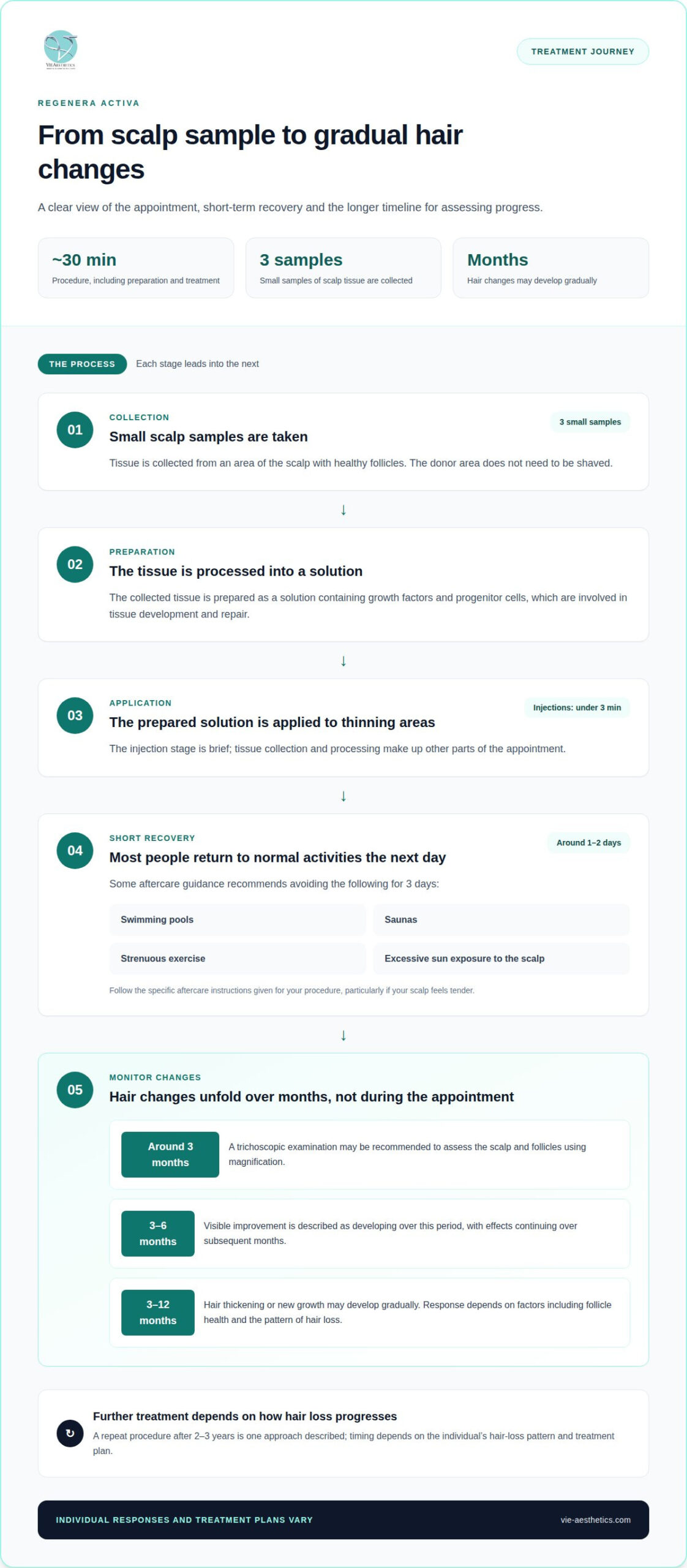
A Regenera Activa procedure takes about 30 minutes, including preparation and treatment. The injections themselves are described as taking less than 3 minutes; tissue collection and processing account for other parts of the appointment. The length of the visit can therefore differ from the time needed to deliver the prepared solution.
Most patients can return to normal activities the next day, and recovery is commonly described as taking around 1-2 days. Some aftercare guidance advises avoiding swimming pools, saunas, strenuous exercise and excessive sun exposure to the scalp for 3 days. Follow the specific instructions given for your procedure, especially if your scalp feels tender.
Regenera Activa is intended for androgenetic alopecia, also known as pattern hair loss. Treatment is often described as a single session, with further treatment depending on how hair loss progresses. A repeat procedure after 2-3 years is one approach described for managing progression; the timing depends on the individual’s hair-loss pattern and treatment plan.
Hair changes take longer than the appointment itself. Visible improvement is described as developing over 3-6 months, with effects continuing over subsequent months. A trichoscopic examination, which uses magnification to assess the scalp and follicles, is recommended at around three months in some treatment plans. It helps assess progress rather than relying only on day-to-day impressions.
Regenera Activa is available through clinics in the UK. Clinics offering it vary by location, and treatment details depend on their individual clinical approach. A consultation can establish whether the pattern of hair loss is appropriate for this treatment.
The price depends on the case and is provided after a quote request; cost factors include the treatment plan, practitioner and any additional therapies. Comparing headline fees alone may not show whether the same elements are included.
Regenera Activa can be combined with platelet-rich plasma (PRP), which uses a concentrated component of the patient’s blood, or with topical dutasteride, finasteride and minoxidil. These options work differently: PRP is an additional injectable treatment, while topical medication is applied to the scalp. Combining approaches should be part of a planned treatment programme, not an automatic addition.
If you’re considering treatment for pattern hair loss, a hair restoration consultation can help clarify the procedure, recovery and suitable treatment plan.
The clinic advertises Regenera Activa as requiring ONE treatment, with top-ups depending on how hair loss progresses. It recommends a trichoscopic examination about three months after starting treatment to assess progress. The clinic’s displayed before-and-after photographs were taken 30-60 days after treatment, but these images show a particular point in the process rather than the full course of change. The clinic says improvements can continue over a period of 3-10 months, so early photographs may not represent the eventual result.
The London clinic states that peak effects from AMT Regenera Activa typically appear around 6-12 months after treatment. These timings are not a guarantee of a particular result, and individual progress may differ. The London clinic says most patients can resume normal activities immediately after AMT Regenera Activa treatment. Follow the aftercare advice provided by the clinic, and use scheduled reviews to discuss how your scalp and hair are responding.
Autologous micrografting uses tissue collected from the person receiving treatment. In Regenera Activa, a practitioner takes three small samples from the back of the scalp, an area also described as the nape. The samples provide material for preparing a solution to apply to thinning areas.
Each scalp sample is described as measuring 2 mm. Collection uses a small punch biopsy, a technique that removes a tiny circular piece of skin. A local anaesthetic is used at the sampling site to help manage discomfort during this step. The donor area does not need to be shaved.
Scalp tissue and adipose tissue, meaning tissue from body fat, are different sources. This procedure uses scalp tissue rather than fat-derived cells. The clinic information states that obtaining a similar amount of progenitor cells from fat tissue requires at least 10 ml. That comparison describes the tissue source, not a measure of treatment results.
After collection, the samples are processed into a suspension containing growth factors and progenitor cells. Progenitor cells can develop into specialised cell types. The prepared tissue solution is then applied to the scalp by mesotherapy, a technique that delivers material through small injections. This differs from platelet-rich plasma, which comes from blood.
The process is straightforward: the practitioner selects a healthy scalp area, numbs the collection site, takes three samples, processes the tissue, then applies the prepared solution. Collection and application are separate stages, so the sample is not simply placed back into the scalp unchanged. Processing prepares the material for the intended treatment approach.
Patients often ask whether this means the procedure harvests “stem cells”. The described process produces a solution containing growth factors and progenitor cells; these terms are not interchangeable. The method uses a patient’s own tissue, but that fact alone does not establish how much hair growth an individual will experience.
The scalp sample is taken from an area with healthy follicles, then the prepared solution is applied to areas affected by thinning. This approach aims to support existing follicles; it does not transplant follicles from one scalp area to another. It is therefore different from surgical hair transplantation, which relocates follicles.
For example, someone with pattern thinning may have tissue collected from the back of the scalp and the prepared solution applied to the thinning area. The exact sites depend on the treatment plan. The practitioner’s assessment of the scalp and hair-loss pattern guides where samples are taken and injections are placed.
The appointment follows a sequence: consultation, tissue processing and scalp application. The procedure takes about 30 minutes, although each stage serves a different purpose.
Micrografting means processing small tissue samples into material for application to the scalp. After collection, the samples are prepared as a suspension containing growth factors and progenitor cells. The practitioner then applies this suspension to selected areas using mesotherapy, a method that delivers material through small injections.
This is a tissue-based approach, not a hair transplant: it does not relocate follicles. During consultation, the treatment area and pattern of thinning help guide where the suspension is applied. Understanding these steps gives you a clearer picture of the method beyond the injection stage.
Autologous means the tissue comes from the person receiving treatment. In this procedure, three small samples are collected from the back of the scalp, using local anaesthetic at the sampling site. The donor area does not need to be shaved, and the collected tissue is processed before being applied to the scalp.
“Progenitor cells” are cells that can develop into specialised cell types. The prepared suspension also contains growth factors. These terms describe components of the processed tissue; by themselves, they do not predict how much hair growth a person will experience.
In practical terms, the practitioner first identifies the scalp area for collection and the areas to receive treatment. The sample site is prepared with anaesthetic, then tissue is collected using a small punch biopsy. The samples are processed, and the resulting suspension is applied to the selected scalp areas.
The injection stage takes less than 3 minutes, while the full procedure takes about 30 minutes. These timings refer to different parts of the appointment, not competing estimates. Tissue collection and preparation are also necessary stages, so the total visit includes more than the time spent applying the suspension.
The method is described as minimally invasive because it uses small scalp samples and injections rather than a hair transplant operation. It still involves skin collection and scalp injections. Knowing the difference can help you understand the procedure and discuss its steps during consultation.
Hair growth is gradual, rather than part of the appointment itself. Changes may develop over the months following treatment, so the procedure’s immediate endpoint is application of the prepared suspension, not visible new growth on the day.
Throughout your appointment, the Regenera Activa follicle-harvesting procedure does not require shaving the donor site. The clinic describes the prepared cell suspension as being applied to the scalp by mesotherapy, distinguishing collection from application.
Endolift Laser Treatment is a separate aesthetic option, not a treatment for hair loss. If your main concern is thinning hair, Vie Aesthetics offers Regenera Activa for Hair and Stem Cell Hair Restoration. The distinction matters: a treatment plan should match the area and concern you want addressed.
Consider Endolift when exploring aesthetic treatment for a different concern, rather than as an alternative to scalp micrografting. A medical consultation can help clarify which option relates to your goals and what each treatment involves. You can contact Vie Aesthetics to discuss your concerns and the appropriate next step.
Choosing Regenera Activa in the UK is a personal decision. A useful next step is to relate the treatment’s intended purpose to your own hair concerns. The cause and pattern of hair loss matter when considering whether a regenerative approach belongs in your plan. A consultation can help you discuss your priorities, understand the proposed approach and consider how progress would be assessed.
It is reasonable to take time before deciding. Use your appointment to raise questions about tissue collection, aftercare and how the treatment fits alongside any existing hair-loss plan. Whether this approach suits you depends on your individual circumstances and an assessment of your hair and scalp.
If you’d like to explore your options, contact Vie Aesthetics to discuss treatment in a considered, informative setting. You can begin with a conversation and decide what feels right for you.
Taking an informed next step can help you feel more confident about your hair-restoration choices.
Most people can return to normal activities the next day, although recovery may take around 1-2 days. Aftercare guidance advises avoiding swimming pools, saunas, strenuous exercise and excessive sun exposure to the scalp for 3 days. If you’re planning your appointment around work or exercise, allow flexibility for the first few days and follow the practitioner’s individual aftercare instructions.
The treatment is intended for androgenetic alopecia, or pattern hair loss, in men and women. Treatment information describes men with grade I to III hair loss as potential candidates. Results from one treatment may last up to 3 years, while hair-loss progression can influence whether another treatment is considered. Individual suitability and outcomes depend on the hair-loss pattern and the condition of the follicles.
Vie Aesthetics describes regenerative treatments as “without the risk of side-effects”. The procedure still involves scalp tissue collection and injections, so discuss these steps and aftercare during consultation. Local anaesthetic is used at the sample site. Ask the practitioner what to expect at the collection and application areas, and how to raise concerns following treatment. Results may vary between individuals.

Regenera Activa UK treatment takes about 30 minutes and involves collecting three small samples of scalp tissue. A Regenera Activa UK appointment is followed by a short recovery, with most people returning to normal activities the next day. Hair changes may develop gradually over the following months.
It’s understandable to want a clear picture before considering a treatment that involves collecting scalp tissue. The samples are processed into a solution for application to the scalp, and the donor area does not need to be shaved.
This guide explains how the treatment is intended to support hair growth, what tissue collection and application involve, and what recovery may be like. It also outlines the expected timeline to help you decide whether the process suits your needs.
Regenera Activa uses a person’s own scalp tissue to prepare a solution for application to thinning areas. This autologous approach, meaning the tissue comes from the person receiving treatment, is intended to support existing follicles rather than relocate hair. For people considering Regenera Activa UK, that distinction helps clarify the treatment’s intended role.
In androgenetic alopecia, follicles are sensitive to androgens, hormones that influence hair growth. Dihydrotestosterone (DHT), an androgen, can contribute to follicle miniaturisation: follicles gradually become smaller and produce finer, shorter hairs. As this pattern progresses, visible density may decrease.
The process uses small samples from a scalp area with healthy follicles. The tissue is processed into a solution containing growth factors and progenitor cells, which are involved in tissue development and repair. The prepared solution is then applied to areas affected by thinning.
Regenera Activa is intended for androgenetic alopecia, also called pattern hair loss, in men and women. The treatment information describes men with grade I to III hair loss as potential candidates, but this grading alone does not establish suitability. The type and extent of hair loss, along with the condition of the remaining follicles, also matter.
Hair thickening or new growth may develop over 3-12 months. Response depends on factors such as follicle health and the pattern of hair loss. A consultation can help distinguish pattern hair loss from other causes, since this treatment is intended for androgenetic alopecia.
Regenera Activa, PRP, medication and hair transplant surgery use different methods. The comparison below outlines their basic approaches.
| Approach | What it uses | How it differs |
|---|---|---|
| Regenera Activa | Processed scalp tissue | Applies a prepared tissue solution to areas with thinning. |
| PRP | Platelet-rich plasma from blood | Uses a blood-derived preparation delivered by injection. |
| Medication | Medicinal treatment, including topical options | Acts through medication rather than processed scalp tissue. |
| Hair transplant surgery | Follicles moved from one scalp area to another | Relocates follicles rather than applying a tissue solution. |
As an adjunct to a hair transplant, micrografting may be considered separately to support existing follicles; it does not perform the transplant or move donor hair. The pattern and extent of hair loss help shape a suitable restoration plan.
Is Regenera Activa regulated or approved for use in the UK? It is described as having secured EU approval, but that statement alone does not establish UK approval. EU approval and UK regulatory status are distinct considerations.
To check a UK clinic’s credentials, ask for the practitioner’s full name, professional registration and relevant training. Verify their registration on the appropriate professional regulator’s public register, then review their listed scope of practice and any restrictions.
A Regenera Activa procedure takes about 30 minutes, including preparation and treatment. The injections themselves are described as taking less than 3 minutes; tissue collection and processing account for other parts of the appointment. The length of the visit can therefore differ from the time needed to deliver the prepared solution.
Most patients can return to normal activities the next day, and recovery is commonly described as taking around 1-2 days. Some aftercare guidance advises avoiding swimming pools, saunas, strenuous exercise and excessive sun exposure to the scalp for 3 days. Follow the specific instructions given for your procedure, especially if your scalp feels tender.
Regenera Activa is intended for androgenetic alopecia, also known as pattern hair loss. Treatment is often described as a single session, with further treatment depending on how hair loss progresses. A repeat procedure after 2-3 years is one approach described for managing progression; the timing depends on the individual’s hair-loss pattern and treatment plan.
Hair changes take longer than the appointment itself. Visible improvement is described as developing over 3-6 months, with effects continuing over subsequent months. A trichoscopic examination, which uses magnification to assess the scalp and follicles, is recommended at around three months in some treatment plans. It helps assess progress rather than relying only on day-to-day impressions.
Regenera Activa is available through clinics in the UK. Clinics offering it vary by location, and treatment details depend on their individual clinical approach. A consultation can establish whether the pattern of hair loss is appropriate for this treatment.
The price depends on the case and is provided after a quote request; cost factors include the treatment plan, practitioner and any additional therapies. Comparing headline fees alone may not show whether the same elements are included.
Regenera Activa can be combined with platelet-rich plasma (PRP), which uses a concentrated component of the patient’s blood, or with topical dutasteride, finasteride and minoxidil. These options work differently: PRP is an additional injectable treatment, while topical medication is applied to the scalp. Combining approaches should be part of a planned treatment programme, not an automatic addition.
If you’re considering treatment for pattern hair loss, a hair restoration consultation can help clarify the procedure, recovery and suitable treatment plan.
The clinic advertises Regenera Activa as requiring ONE treatment, with top-ups depending on how hair loss progresses. It recommends a trichoscopic examination about three months after starting treatment to assess progress. The clinic’s displayed before-and-after photographs were taken 30-60 days after treatment, but these images show a particular point in the process rather than the full course of change. The clinic says improvements can continue over a period of 3-10 months, so early photographs may not represent the eventual result.
The London clinic states that peak effects from AMT Regenera Activa typically appear around 6-12 months after treatment. These timings are not a guarantee of a particular result, and individual progress may differ. The London clinic says most patients can resume normal activities immediately after AMT Regenera Activa treatment. Follow the aftercare advice provided by the clinic, and use scheduled reviews to discuss how your scalp and hair are responding.
Autologous micrografting uses tissue collected from the person receiving treatment. In Regenera Activa, a practitioner takes three small samples from the back of the scalp, an area also described as the nape. The samples provide material for preparing a solution to apply to thinning areas.
Each scalp sample is described as measuring 2 mm. Collection uses a small punch biopsy, a technique that removes a tiny circular piece of skin. A local anaesthetic is used at the sampling site to help manage discomfort during this step. The donor area does not need to be shaved.
Scalp tissue and adipose tissue, meaning tissue from body fat, are different sources. This procedure uses scalp tissue rather than fat-derived cells. The clinic information states that obtaining a similar amount of progenitor cells from fat tissue requires at least 10 ml. That comparison describes the tissue source, not a measure of treatment results.
After collection, the samples are processed into a suspension containing growth factors and progenitor cells. Progenitor cells can develop into specialised cell types. The prepared tissue solution is then applied to the scalp by mesotherapy, a technique that delivers material through small injections. This differs from platelet-rich plasma, which comes from blood.
The process is straightforward: the practitioner selects a healthy scalp area, numbs the collection site, takes three samples, processes the tissue, then applies the prepared solution. Collection and application are separate stages, so the sample is not simply placed back into the scalp unchanged. Processing prepares the material for the intended treatment approach.
Patients often ask whether this means the procedure harvests “stem cells”. The described process produces a solution containing growth factors and progenitor cells; these terms are not interchangeable. The method uses a patient’s own tissue, but that fact alone does not establish how much hair growth an individual will experience.
The scalp sample is taken from an area with healthy follicles, then the prepared solution is applied to areas affected by thinning. This approach aims to support existing follicles; it does not transplant follicles from one scalp area to another. It is therefore different from surgical hair transplantation, which relocates follicles.
For example, someone with pattern thinning may have tissue collected from the back of the scalp and the prepared solution applied to the thinning area. The exact sites depend on the treatment plan. The practitioner’s assessment of the scalp and hair-loss pattern guides where samples are taken and injections are placed.
The appointment follows a sequence: consultation, tissue processing and scalp application. The procedure takes about 30 minutes, although each stage serves a different purpose.
Micrografting means processing small tissue samples into material for application to the scalp. After collection, the samples are prepared as a suspension containing growth factors and progenitor cells. The practitioner then applies this suspension to selected areas using mesotherapy, a method that delivers material through small injections.
This is a tissue-based approach, not a hair transplant: it does not relocate follicles. During consultation, the treatment area and pattern of thinning help guide where the suspension is applied. Understanding these steps gives you a clearer picture of the method beyond the injection stage.
Autologous means the tissue comes from the person receiving treatment. In this procedure, three small samples are collected from the back of the scalp, using local anaesthetic at the sampling site. The donor area does not need to be shaved, and the collected tissue is processed before being applied to the scalp.
“Progenitor cells” are cells that can develop into specialised cell types. The prepared suspension also contains growth factors. These terms describe components of the processed tissue; by themselves, they do not predict how much hair growth a person will experience.
In practical terms, the practitioner first identifies the scalp area for collection and the areas to receive treatment. The sample site is prepared with anaesthetic, then tissue is collected using a small punch biopsy. The samples are processed, and the resulting suspension is applied to the selected scalp areas.
The injection stage takes less than 3 minutes, while the full procedure takes about 30 minutes. These timings refer to different parts of the appointment, not competing estimates. Tissue collection and preparation are also necessary stages, so the total visit includes more than the time spent applying the suspension.
The method is described as minimally invasive because it uses small scalp samples and injections rather than a hair transplant operation. It still involves skin collection and scalp injections. Knowing the difference can help you understand the procedure and discuss its steps during consultation.
Hair growth is gradual, rather than part of the appointment itself. Changes may develop over the months following treatment, so the procedure’s immediate endpoint is application of the prepared suspension, not visible new growth on the day.
Throughout your appointment, the Regenera Activa follicle-harvesting procedure does not require shaving the donor site. The clinic describes the prepared cell suspension as being applied to the scalp by mesotherapy, distinguishing collection from application.
Endolift Laser Treatment is a separate aesthetic option, not a treatment for hair loss. If your main concern is thinning hair, Vie Aesthetics offers Regenera Activa for Hair and Stem Cell Hair Restoration. The distinction matters: a treatment plan should match the area and concern you want addressed.
Consider Endolift when exploring aesthetic treatment for a different concern, rather than as an alternative to scalp micrografting. A medical consultation can help clarify which option relates to your goals and what each treatment involves. You can contact Vie Aesthetics to discuss your concerns and the appropriate next step.
Choosing Regenera Activa in the UK is a personal decision. A useful next step is to relate the treatment’s intended purpose to your own hair concerns. The cause and pattern of hair loss matter when considering whether a regenerative approach belongs in your plan. A consultation can help you discuss your priorities, understand the proposed approach and consider how progress would be assessed.
It is reasonable to take time before deciding. Use your appointment to raise questions about tissue collection, aftercare and how the treatment fits alongside any existing hair-loss plan. Whether this approach suits you depends on your individual circumstances and an assessment of your hair and scalp.
If you’d like to explore your options, contact Vie Aesthetics to discuss treatment in a considered, informative setting. You can begin with a conversation and decide what feels right for you.
Taking an informed next step can help you feel more confident about your hair-restoration choices.
Most people can return to normal activities the next day, although recovery may take around 1-2 days. Aftercare guidance advises avoiding swimming pools, saunas, strenuous exercise and excessive sun exposure to the scalp for 3 days. If you’re planning your appointment around work or exercise, allow flexibility for the first few days and follow the practitioner’s individual aftercare instructions.
The treatment is intended for androgenetic alopecia, or pattern hair loss, in men and women. Treatment information describes men with grade I to III hair loss as potential candidates. Results from one treatment may last up to 3 years, while hair-loss progression can influence whether another treatment is considered. Individual suitability and outcomes depend on the hair-loss pattern and the condition of the follicles.
Vie Aesthetics describes regenerative treatments as “without the risk of side-effects”. The procedure still involves scalp tissue collection and injections, so discuss these steps and aftercare during consultation. Local anaesthetic is used at the sample site. Ask the practitioner what to expect at the collection and application areas, and how to raise concerns following treatment. Results may vary between individuals.