By the Vie Aesthetics medical team
Could FaceTite UK offer a middle ground between surface treatments and a surgical facelift? FaceTite UK may be worth discussing if you’re concerned about facial contour or mild-to-moderate skin laxity, but suitability and results vary between individuals.
FaceTite is a minimally invasive surgical treatment, not a non-invasive procedure. It uses a small probe placed beneath the skin to deliver controlled radiofrequency heat, with the aim of affecting localised fat and stimulating collagen. A medical assessment helps clarify what the treatment may address, its limitations and what other options could suit your goals.
This guide explains how FaceTite works and how it differs from AccuTite and BodyTite. It also covers what to consider before treatment and questions to raise with a qualified medical practitioner, so you can compare the options and make an informed decision.
FaceTite is a minimally invasive procedure intended to support facial contouring and skin tightening. People considering FaceTite UK may want to discuss changes such as mild-to-moderate skin laxity or a less defined-looking jawline, but an individual clinical assessment is needed to decide whether it fits their concerns.
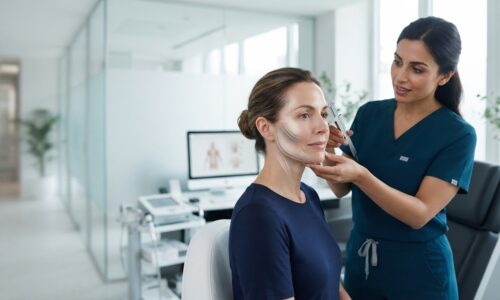
FaceTite uses an instrument placed beneath the skin to target facial contouring and tightening, rather than working only at the skin’s surface.
FaceTite’s intended role is to address changes in facial definition and skin firmness. You might ask about it if you’ve noticed looseness around the lower face or neck, or a less defined jawline. These changes can have different causes, so the treatment may not be appropriate for every concern.
The aim is a potential change in appearance, not a promised result. Your clinician can discuss what may be realistic in light of your features, skin and goals. Outcomes vary between individuals, so expectations and suitability should be considered together.
“Minimally invasive” does not mean that nothing enters the body. FaceTite involves small incisions and an instrument placed beneath the skin. A non-invasive treatment does not involve incisions or placing an instrument under the skin, although that distinction alone does not explain the full treatment experience or recovery.
The approach, considerations and aftercare can differ between treatments. Discuss the procedure and potential risks with a qualified medical practitioner before deciding. For comparison, HIFU skin tightening is another approach that does not involve the same under-skin access.
A consultation can help clarify whether your concern relates mainly to skin laxity, facial contour or another factor. Useful questions include:
These questions support a measured conversation about your options. The decision should be based on your individual assessment, rather than an assumption that one treatment suits everyone.
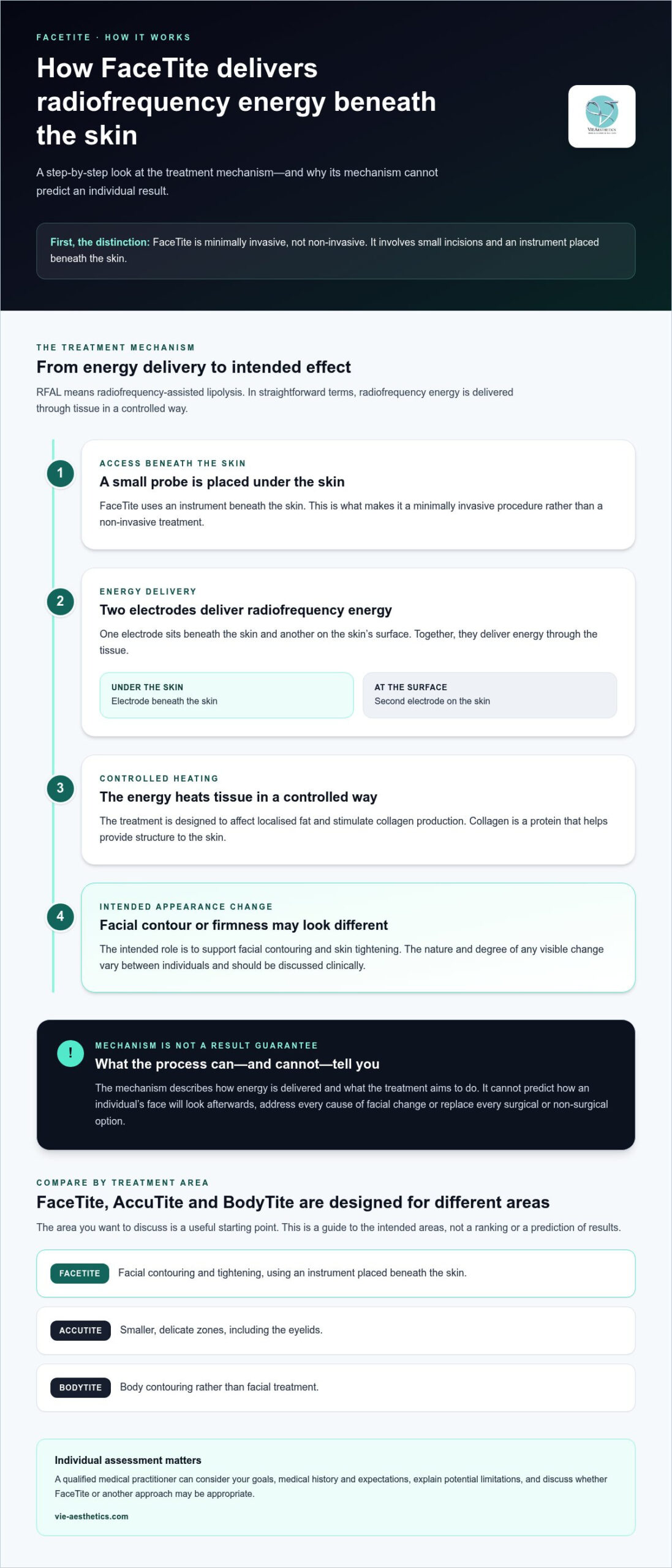
FaceTite uses radiofrequency-assisted lipolysis, often shortened to RFAL. In plain English, radiofrequency energy is delivered beneath the skin to heat tissue in a controlled way. The treatment is designed to affect localised fat and stimulate collagen production, but this mechanism cannot predict how an individual’s face will look afterwards.
RFAL uses an electrode beneath the skin and another on the skin’s surface to deliver energy through the tissue. The heat is intended to liquefy fat and stimulate collagen, a protein that helps provide structure to the skin. This describes the treatment’s mechanism, not the degree of visible change any individual will experience.
Mechanism
Radiofrequency energy is delivered beneath the skin, with the aim of affecting fat and stimulating collagen.
Possible appearance changes
Facial contour or skin firmness may look different for some people. The nature and degree of any change vary and should be discussed clinically.
FaceTite is intended to support facial contouring and skin tightening. A practitioner can discuss whether those aims relate to your concerns and what may be realistic for you.
It does not promise a particular appearance, address every cause of facial change or replace every surgical or non-surgical option. Your facial structure, skin and goals all matter. A consultation should explain what FaceTite is designed to do, its limitations and how individual results can vary.
Keep the treatment mechanism separate from expectations about appearance when weighing up your options. Ask what FaceTite is intended to address in your case, what it may not change and how other approaches differ. Endolift laser treatment is another option to discuss if you’re comparing approaches.
FaceTite UK suitability is decided through an individual clinical assessment, not a self-check based on age, skin type or a single concern. A qualified medical practitioner can consider your goals, medical history and expectations, then explain whether FaceTite or another approach may be appropriate.
If you’re considering treatment, describe what you’d like to change and which areas you want to discuss. Share relevant medical history and be clear about the result you hope to achieve. This helps the practitioner assess your circumstances rather than rely on general eligibility rules.
Use the consultation to understand both suitability and limitations. Ask what FaceTite may address in your case, what it may not change and what factors could affect your individual outcome.
FaceTite, AccuTite and BodyTite are intended for different treatment areas. The area you want to address is a useful starting point for comparing them, but the right option depends on a clinical assessment. The comparison below is a guide for discussion, not a ranking or a prediction of results.
| Treatment | Area and approach to discuss |
|---|---|
| FaceTite | A minimally invasive approach for facial contouring and tightening, with an instrument placed beneath the skin. |
| AccuTite | Designed for smaller, delicate zones, including the eyelids. |
| BodyTite | Designed for body contouring rather than facial areas. |
| HIFU | Uses focused ultrasound energy without the same under-skin access as FaceTite. |
When comparing options, ask what each is intended to address, how the approach differs and what limitations apply. For a wider overview of options and terminology, explore this guide to non-surgical aesthetic treatments. It can help you prepare questions, while a practitioner’s assessment remains central to a personal recommendation.
Myth: A minimally invasive treatment involves no recovery or risk. Reality: “Minimally invasive” describes how a procedure accesses tissue. FaceTite involves small incisions and an instrument beneath the skin, so it is not non-invasive or risk-free. Recovery considerations and potential risks depend on the treatment and individual circumstances. Discuss them with your practitioner rather than relying on a general timeline.
Before deciding, ask what aftercare involves, which alternatives may be relevant and how outcomes can vary for your goals. A consultation is a chance to gather information and consider your options.
Vie Aesthetics offers FaceTite, with treatment plans tailored to individual goals and circumstances. A consultation gives you space to explore whether the treatment aligns with what you want to address, rather than assuming it is suitable based on a general description.
The discussion starts with what you hope to change and what matters most to you. Your practitioner can consider your relevant medical history, assess suitability and talk through realistic expectations, including the treatment’s limitations and other options.
You can also ask what the procedure involves, what aftercare may be advised and what risks are relevant to your circumstances. At Vie Aesthetics, aesthetic procedures are performed only by doctors and qualified medical practitioners. Meet the Vie Aesthetics medical team and bring any questions you have written down. You do not need to have decided on treatment before attending.
A considered next step
After your consultation, consider how the possible benefits align with your priorities, alongside the limitations and alternatives discussed. Ask for clarification if anything about the approach, aftercare or variation in individual outcomes is unclear.
A personalised plan is based on your assessment. It does not promise that FaceTite will be suitable or produce a particular result. Take time to reflect on the information before deciding. Waiting or considering another option can also be a reasonable outcome.
Before booking, note any questions about the treatment’s intended role, relevant risks, limitations and aftercare. This can help you focus the consultation on the information you need to make a considered choice.
Considering FaceTite UK does not mean you need to commit to treatment. A consultation can help clarify what may suit your goals, what the limitations are and whether another option deserves consideration.
At Vie Aesthetics, qualified medical practitioners guide the discussion around your individual circumstances. Take time afterwards to reflect on the information and decide what feels right for you. An informed decision can include choosing to wait.
Book a consultation with Vie Aesthetics to discuss whether FaceTite may be appropriate for you and explore your options with a qualified medical practitioner.
FaceTite is a minimally invasive surgical procedure, not a non-surgical treatment. It involves small incisions and an instrument placed beneath the skin, so “minimally invasive” does not mean there is no recovery or risk. Ask your practitioner to explain the planned approach, relevant risks and aftercare for your circumstances.
Another facial treatment may be discussed as part of an individual plan, but combining treatments is not automatically appropriate. Morpheus8 uses radiofrequency microneedling, which is a different approach from FaceTite. Ask what each treatment is intended to address and whether they should be considered together or separately.
AccuTite is designed for smaller, delicate zones, including the eyelids, while FaceTite is intended for areas such as the lower face and neck. A medical practitioner can assess the area you’re concerned about and explain which approach, if any, may be suitable. These devices are designed for different areas and should not be assumed to be interchangeable.
FaceTite may be worth discussing if your concern after weight loss relates to facial skin laxity, but it will not address every change associated with weight loss. A change in facial appearance may involve skin, facial contour or other factors. Explain what you’ve noticed and what you hope to achieve so the practitioner can assess whether FaceTite is relevant or another approach may be more appropriate.
No treatment should be assumed suitable for every person or skin type. A practitioner considers your individual features, relevant medical history and treatment goals rather than using skin type alone to decide. Share any skin-related concerns and previous aesthetic treatments during your assessment to help inform the discussion about suitability and limitations.
Note the changes you’d like to discuss, your relevant medical history, current medicines and any previous facial treatments. You may also want to write down questions about the procedure, risks, aftercare, alternatives and how outcomes can vary between individuals. You do not need to decide on treatment beforehand. The consultation is a chance to understand the options and discuss whether FaceTite is appropriate for you.

By the Vie Aesthetics medical team
Could FaceTite UK offer a middle ground between surface treatments and a surgical facelift? FaceTite UK may be worth discussing if you’re concerned about facial contour or mild-to-moderate skin laxity, but suitability and results vary between individuals.
FaceTite is a minimally invasive surgical treatment, not a non-invasive procedure. It uses a small probe placed beneath the skin to deliver controlled radiofrequency heat, with the aim of affecting localised fat and stimulating collagen. A medical assessment helps clarify what the treatment may address, its limitations and what other options could suit your goals.
This guide explains how FaceTite works and how it differs from AccuTite and BodyTite. It also covers what to consider before treatment and questions to raise with a qualified medical practitioner, so you can compare the options and make an informed decision.
FaceTite is a minimally invasive procedure intended to support facial contouring and skin tightening. People considering FaceTite UK may want to discuss changes such as mild-to-moderate skin laxity or a less defined-looking jawline, but an individual clinical assessment is needed to decide whether it fits their concerns.
FaceTite uses an instrument placed beneath the skin to target facial contouring and tightening, rather than working only at the skin’s surface.
FaceTite’s intended role is to address changes in facial definition and skin firmness. You might ask about it if you’ve noticed looseness around the lower face or neck, or a less defined jawline. These changes can have different causes, so the treatment may not be appropriate for every concern.
The aim is a potential change in appearance, not a promised result. Your clinician can discuss what may be realistic in light of your features, skin and goals. Outcomes vary between individuals, so expectations and suitability should be considered together.
“Minimally invasive” does not mean that nothing enters the body. FaceTite involves small incisions and an instrument placed beneath the skin. A non-invasive treatment does not involve incisions or placing an instrument under the skin, although that distinction alone does not explain the full treatment experience or recovery.
The approach, considerations and aftercare can differ between treatments. Discuss the procedure and potential risks with a qualified medical practitioner before deciding. For comparison, HIFU skin tightening is another approach that does not involve the same under-skin access.
A consultation can help clarify whether your concern relates mainly to skin laxity, facial contour or another factor. Useful questions include:
These questions support a measured conversation about your options. The decision should be based on your individual assessment, rather than an assumption that one treatment suits everyone.
FaceTite uses radiofrequency-assisted lipolysis, often shortened to RFAL. In plain English, radiofrequency energy is delivered beneath the skin to heat tissue in a controlled way. The treatment is designed to affect localised fat and stimulate collagen production, but this mechanism cannot predict how an individual’s face will look afterwards.
RFAL uses an electrode beneath the skin and another on the skin’s surface to deliver energy through the tissue. The heat is intended to liquefy fat and stimulate collagen, a protein that helps provide structure to the skin. This describes the treatment’s mechanism, not the degree of visible change any individual will experience.
Mechanism
Radiofrequency energy is delivered beneath the skin, with the aim of affecting fat and stimulating collagen.
Possible appearance changes
Facial contour or skin firmness may look different for some people. The nature and degree of any change vary and should be discussed clinically.
FaceTite is intended to support facial contouring and skin tightening. A practitioner can discuss whether those aims relate to your concerns and what may be realistic for you.
It does not promise a particular appearance, address every cause of facial change or replace every surgical or non-surgical option. Your facial structure, skin and goals all matter. A consultation should explain what FaceTite is designed to do, its limitations and how individual results can vary.
Keep the treatment mechanism separate from expectations about appearance when weighing up your options. Ask what FaceTite is intended to address in your case, what it may not change and how other approaches differ. Endolift laser treatment is another option to discuss if you’re comparing approaches.
FaceTite UK suitability is decided through an individual clinical assessment, not a self-check based on age, skin type or a single concern. A qualified medical practitioner can consider your goals, medical history and expectations, then explain whether FaceTite or another approach may be appropriate.
If you’re considering treatment, describe what you’d like to change and which areas you want to discuss. Share relevant medical history and be clear about the result you hope to achieve. This helps the practitioner assess your circumstances rather than rely on general eligibility rules.
Use the consultation to understand both suitability and limitations. Ask what FaceTite may address in your case, what it may not change and what factors could affect your individual outcome.
FaceTite, AccuTite and BodyTite are intended for different treatment areas. The area you want to address is a useful starting point for comparing them, but the right option depends on a clinical assessment. The comparison below is a guide for discussion, not a ranking or a prediction of results.
| Treatment | Area and approach to discuss |
|---|---|
| FaceTite | A minimally invasive approach for facial contouring and tightening, with an instrument placed beneath the skin. |
| AccuTite | Designed for smaller, delicate zones, including the eyelids. |
| BodyTite | Designed for body contouring rather than facial areas. |
| HIFU | Uses focused ultrasound energy without the same under-skin access as FaceTite. |
When comparing options, ask what each is intended to address, how the approach differs and what limitations apply. For a wider overview of options and terminology, explore this guide to non-surgical aesthetic treatments. It can help you prepare questions, while a practitioner’s assessment remains central to a personal recommendation.
Myth: A minimally invasive treatment involves no recovery or risk. Reality: “Minimally invasive” describes how a procedure accesses tissue. FaceTite involves small incisions and an instrument beneath the skin, so it is not non-invasive or risk-free. Recovery considerations and potential risks depend on the treatment and individual circumstances. Discuss them with your practitioner rather than relying on a general timeline.
Before deciding, ask what aftercare involves, which alternatives may be relevant and how outcomes can vary for your goals. A consultation is a chance to gather information and consider your options.
Vie Aesthetics offers FaceTite, with treatment plans tailored to individual goals and circumstances. A consultation gives you space to explore whether the treatment aligns with what you want to address, rather than assuming it is suitable based on a general description.
The discussion starts with what you hope to change and what matters most to you. Your practitioner can consider your relevant medical history, assess suitability and talk through realistic expectations, including the treatment’s limitations and other options.
You can also ask what the procedure involves, what aftercare may be advised and what risks are relevant to your circumstances. At Vie Aesthetics, aesthetic procedures are performed only by doctors and qualified medical practitioners. Meet the Vie Aesthetics medical team and bring any questions you have written down. You do not need to have decided on treatment before attending.
A considered next step
After your consultation, consider how the possible benefits align with your priorities, alongside the limitations and alternatives discussed. Ask for clarification if anything about the approach, aftercare or variation in individual outcomes is unclear.
A personalised plan is based on your assessment. It does not promise that FaceTite will be suitable or produce a particular result. Take time to reflect on the information before deciding. Waiting or considering another option can also be a reasonable outcome.
Before booking, note any questions about the treatment’s intended role, relevant risks, limitations and aftercare. This can help you focus the consultation on the information you need to make a considered choice.
Considering FaceTite UK does not mean you need to commit to treatment. A consultation can help clarify what may suit your goals, what the limitations are and whether another option deserves consideration.
At Vie Aesthetics, qualified medical practitioners guide the discussion around your individual circumstances. Take time afterwards to reflect on the information and decide what feels right for you. An informed decision can include choosing to wait.
Book a consultation with Vie Aesthetics to discuss whether FaceTite may be appropriate for you and explore your options with a qualified medical practitioner.
FaceTite is a minimally invasive surgical procedure, not a non-surgical treatment. It involves small incisions and an instrument placed beneath the skin, so “minimally invasive” does not mean there is no recovery or risk. Ask your practitioner to explain the planned approach, relevant risks and aftercare for your circumstances.
Another facial treatment may be discussed as part of an individual plan, but combining treatments is not automatically appropriate. Morpheus8 uses radiofrequency microneedling, which is a different approach from FaceTite. Ask what each treatment is intended to address and whether they should be considered together or separately.
AccuTite is designed for smaller, delicate zones, including the eyelids, while FaceTite is intended for areas such as the lower face and neck. A medical practitioner can assess the area you’re concerned about and explain which approach, if any, may be suitable. These devices are designed for different areas and should not be assumed to be interchangeable.
FaceTite may be worth discussing if your concern after weight loss relates to facial skin laxity, but it will not address every change associated with weight loss. A change in facial appearance may involve skin, facial contour or other factors. Explain what you’ve noticed and what you hope to achieve so the practitioner can assess whether FaceTite is relevant or another approach may be more appropriate.
No treatment should be assumed suitable for every person or skin type. A practitioner considers your individual features, relevant medical history and treatment goals rather than using skin type alone to decide. Share any skin-related concerns and previous aesthetic treatments during your assessment to help inform the discussion about suitability and limitations.
Note the changes you’d like to discuss, your relevant medical history, current medicines and any previous facial treatments. You may also want to write down questions about the procedure, risks, aftercare, alternatives and how outcomes can vary between individuals. You do not need to decide on treatment beforehand. The consultation is a chance to understand the options and discuss whether FaceTite is appropriate for you.

 Read this article
 Read this article