PlexR plasma treatment UK is a non-surgical aesthetic treatment that uses controlled plasma energy to create tiny points on the skin’s surface, with the aim of supporting a tighter appearance in selected areas. Vie Aesthetics offers PlexR soft surgery, and whether PlexR plasma treatment UK may suit hooded eyelids or loose skin depends on an individual clinical assessment.
It helps to understand the intended effect, possible recovery and risks before considering treatment. PlexR is not a universal alternative to surgery, and results vary between individuals.
This guide explains how the treatment is described, what to discuss at an assessment and how to compare PlexR with eyelid surgery. Use the practical questions to clarify whether the approach matches your goals and what to expect from a personalised plan.
PlexR plasma treatment UK is a non-surgical aesthetic treatment that uses plasma energy to target selected areas of skin, with the aim of supporting a tighter appearance where clinically suitable. “Non-surgical” describes the treatment category. It does not mean there is no recovery, discomfort or risk.
PlexR: A plasma-based treatment that may be considered for selected skin concerns after assessment.
Surgical blepharoplasty: An operation involving the eyelids. The approaches differ and are not interchangeable in their suitability or potential results.
Plasma is a form of matter in which gas has been energised. In PlexR, the term describes the energy used by the treatment device. The clinician should explain how the treatment works and how it relates to the area being considered.
PlexR may be considered for skin tightening, subject to clinical review. That intended purpose is not a promise of a particular change. Suitability and response vary, so an assessment should connect your concern and expectations with the treatment’s potential role.
Loose or hooded eyelid skin may lead someone to ask about PlexR. The concern alone does not establish that treatment is suitable or predict a result. An assessment considers the area you want to discuss and what you hope to achieve.
PlexR is sometimes described in relation to non-surgical blepharoplasty. The phrase does not mean plasma treatment and surgical blepharoplasty are equivalent: blepharoplasty is an operation, and the approaches may suit different circumstances. Read about Vie Aesthetics’ non-surgical eyelid lift with PlexR to learn about this application. Individual suitability still needs clinical consideration.
A PlexR assessment turns a general question into a discussion about your concern, relevant health history and goals. It helps the clinician consider whether PlexR may be suitable, explain its limitations and outline the recovery guidance that applies to you.
Use the appointment to understand potential benefits and risks before deciding whether to proceed. “Non-surgical” does not mean the treatment suits everyone or involves no downtime.
Explain what you would like to address and what a satisfactory change would mean to you. The clinician can discuss whether your expectations are realistic for PlexR and consider relevant health information and, where appropriate, your skin. Ask whether PlexR or another approach is more appropriate for your circumstances.
To make the discussion useful, ask what the proposed treatment is intended to address, what it cannot address and what factors could affect your individual outcome. You can also ask what preparation and aftercare instructions would apply to your plan.
An assessment can support an informed decision, but it cannot predict a particular outcome. Individual responses vary, and PlexR is not a substitute for every surgical option. Ask the clinician to explain the potential benefits, limitations and risks relevant to your proposed treatment.
What this treatment WILL do: It can be considered for selected concerns when the clinician judges it appropriate, with the aim of supporting a tighter-looking appearance.
What this treatment WON’T do: It will not promise a particular result, address every concern about eyelid or loose skin, or replace all surgical procedures.
If you would like to discuss your goals and suitability, book a PlexR consultation.
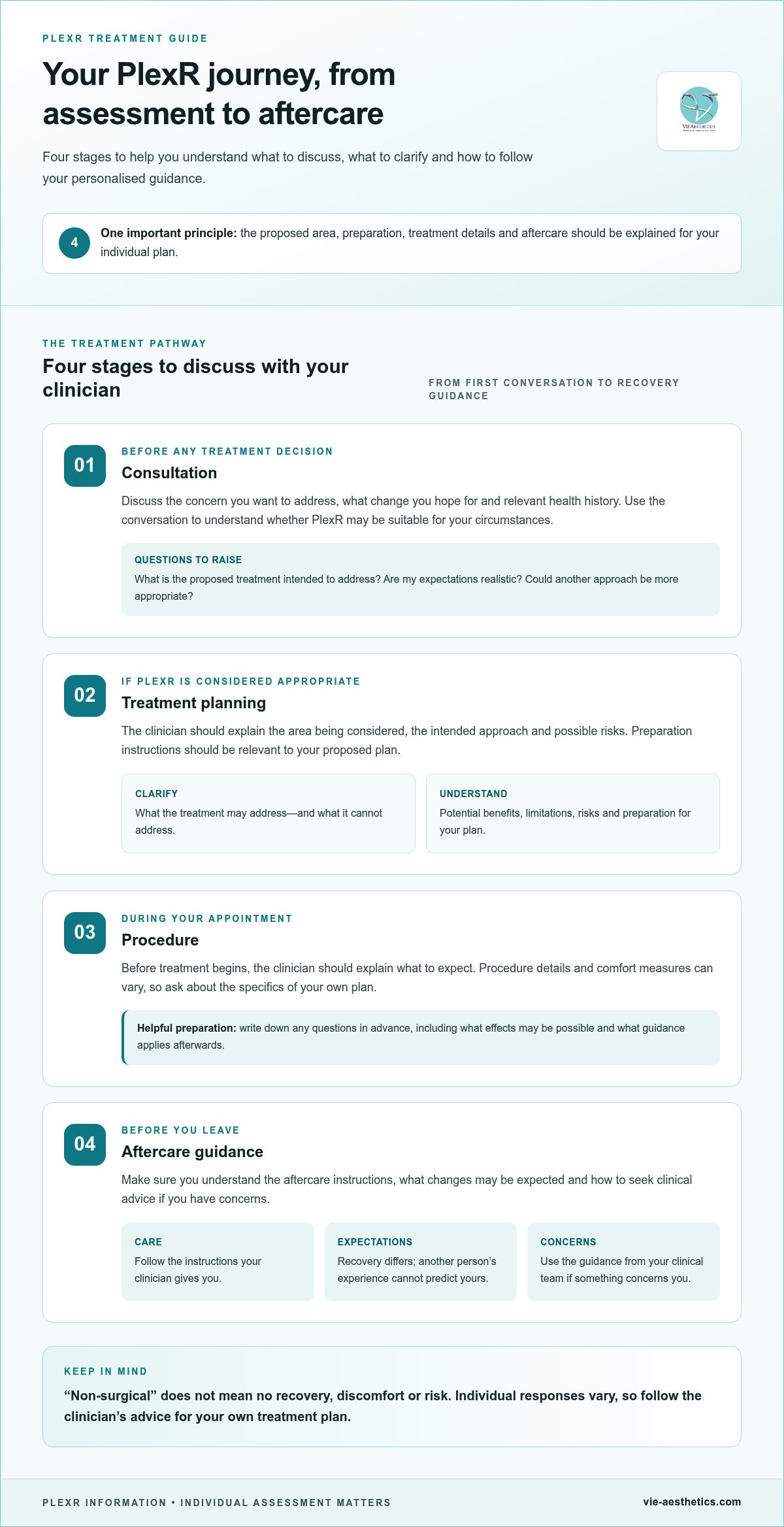
The treatment journey should be explained in stages, from the first discussion to aftercare. The procedure, possible effects and preparation instructions depend on the treatment area and your individual circumstances, so ask the clinician to explain the plan specific to you.
General information can help you prepare, but your clinician’s advice should guide your personal recovery and aftercare. Another person’s experience or a general timeline cannot predict your own recovery.
It can help to write down questions in advance. Ask what effects are possible, what skincare or activity guidance applies afterwards, and what signs should prompt you to contact the clinic. The answers should reflect your treatment plan, not a universal checklist.
Recovery experiences differ. The clinical team should explain the potential effects relevant to your treatment and how to care for the area. Do not assume that your recovery will follow the same course as someone else’s.
Follow the aftercare instructions your clinician gives you, even if they differ from accounts you have read elsewhere. If something concerns you during recovery, use the guidance provided by your clinical team rather than trying to interpret it from general advice.
If you are considering PlexR plasma treatment UK, an individual consultation can clarify the proposed plan and the recovery guidance that would apply to you.
A consultation can help you decide whether PlexR is worth exploring by relating your concern to the treatment’s potential role. It also gives you a chance to understand how a non-surgical approach differs from eyelid surgery, without assuming either option is right for everyone.
PlexR is a non-surgical treatment that may be considered for selected skin concerns. Surgical blepharoplasty is an operation involving the eyelids. They are different approaches, and suitability depends on the concern and clinical assessment.
| Consideration | PlexR | Surgical blepharoplasty |
|---|---|---|
| Treatment category | Non-surgical, plasma-based treatment. | An operation involving the eyelids. |
| Assessment | The clinician considers the concern and whether PlexR may be appropriate. | Assessment considers whether surgery is appropriate for the individual. |
| Expectations | Suitability and response vary between individuals. | Potential outcomes and considerations depend on the operation and individual circumstances. |
Use the comparison to frame questions, not to decide which approach suits you without an assessment. Ask the clinician to explain the options in light of your priorities and the concern you want to discuss.
Myth: A non-surgical treatment has no risks or recovery. Reality: “Non-surgical” describes the treatment category. It does not mean there can be no side effects, downtime or individual considerations. Ask which risks and recovery guidance relate to your proposed plan.
Before your consultation, note what you hope to address and what matters most in your decision. You might want to understand the treatment’s limitations, discuss possible recovery or compare the non-surgical approach with surgery. A short list of questions helps keep the conversation focused on the information you need.
There is no need to decide in advance. A considered conversation can help you weigh the information and choose whether to explore PlexR further.
Exploring PlexR plasma treatment UK does not mean you need to commit to treatment. A consultation gives you space to discuss your goals, understand the options and decide whether you have the information you need to take another step.
Vie Aesthetics offers PlexR soft surgery as part of its non-surgical aesthetic treatments. Bring the questions that matter to you, take time to reflect on the discussion and make a decision that feels right for you.
You do not need to arrive with every answer. Feeling informed is a worthwhile outcome in itself.
No. Suitability depends on the person and the concern being assessed, so PlexR plasma treatment UK is not a universal option. Share relevant health information and explain what you hope to achieve; this gives the clinician context to discuss whether treatment is appropriate or another approach may be more suitable. Ask which personal factors could affect the recommendation before deciding.
PlexR may be considered for selected concerns involving eyelid skin, but it is not appropriate for every person or every eyelid concern. Explain whether you are concerned about the appearance of loose upper eyelid skin or something else, then ask what the proposed treatment is intended to address. An assessment can clarify how the approach relates to your goal and what its limitations are.
The appointment should follow the plan discussed with your clinician. They should explain the proposed treatment area and what to expect before proceeding. Ask them to clarify the intended outcome, the steps involved and your aftercare instructions, as appointment details depend on your individual plan.
There is no single recovery timeframe that applies to everyone. The area treated and your individual response can affect recovery, so ask how it may fit around your routine and what signs should prompt you to seek guidance from the clinical team. Follow your aftercare instructions rather than using another person’s timeline to plan your return to usual activities.
Your clinician should explain possible side effects and how they relate to your circumstances and treatment area. Before agreeing to treatment, ask which effects are relevant to your plan, how to care for the area and what to do if a change concerns you during recovery. General online lists cannot predict what you will experience.
There is no single duration that can be promised for everyone. The appearance of treated skin can change over time, and individual results depend on personal factors. Ask what outcome is realistic for your concern, how your response will be reviewed and whether further treatment might be discussed. A careful answer should relate to your assessment, not offer a fixed timeframe as if it applied to everyone.

PlexR plasma treatment UK is a non-surgical aesthetic treatment that uses controlled plasma energy to create tiny points on the skin’s surface, with the aim of supporting a tighter appearance in selected areas. Vie Aesthetics offers PlexR soft surgery, and whether PlexR plasma treatment UK may suit hooded eyelids or loose skin depends on an individual clinical assessment.
It helps to understand the intended effect, possible recovery and risks before considering treatment. PlexR is not a universal alternative to surgery, and results vary between individuals.
This guide explains how the treatment is described, what to discuss at an assessment and how to compare PlexR with eyelid surgery. Use the practical questions to clarify whether the approach matches your goals and what to expect from a personalised plan.
PlexR plasma treatment UK is a non-surgical aesthetic treatment that uses plasma energy to target selected areas of skin, with the aim of supporting a tighter appearance where clinically suitable. “Non-surgical” describes the treatment category. It does not mean there is no recovery, discomfort or risk.
PlexR: A plasma-based treatment that may be considered for selected skin concerns after assessment.
Surgical blepharoplasty: An operation involving the eyelids. The approaches differ and are not interchangeable in their suitability or potential results.
Plasma is a form of matter in which gas has been energised. In PlexR, the term describes the energy used by the treatment device. The clinician should explain how the treatment works and how it relates to the area being considered.
PlexR may be considered for skin tightening, subject to clinical review. That intended purpose is not a promise of a particular change. Suitability and response vary, so an assessment should connect your concern and expectations with the treatment’s potential role.
Loose or hooded eyelid skin may lead someone to ask about PlexR. The concern alone does not establish that treatment is suitable or predict a result. An assessment considers the area you want to discuss and what you hope to achieve.
PlexR is sometimes described in relation to non-surgical blepharoplasty. The phrase does not mean plasma treatment and surgical blepharoplasty are equivalent: blepharoplasty is an operation, and the approaches may suit different circumstances. Read about Vie Aesthetics’ non-surgical eyelid lift with PlexR to learn about this application. Individual suitability still needs clinical consideration.
A PlexR assessment turns a general question into a discussion about your concern, relevant health history and goals. It helps the clinician consider whether PlexR may be suitable, explain its limitations and outline the recovery guidance that applies to you.
Use the appointment to understand potential benefits and risks before deciding whether to proceed. “Non-surgical” does not mean the treatment suits everyone or involves no downtime.
Explain what you would like to address and what a satisfactory change would mean to you. The clinician can discuss whether your expectations are realistic for PlexR and consider relevant health information and, where appropriate, your skin. Ask whether PlexR or another approach is more appropriate for your circumstances.
To make the discussion useful, ask what the proposed treatment is intended to address, what it cannot address and what factors could affect your individual outcome. You can also ask what preparation and aftercare instructions would apply to your plan.
An assessment can support an informed decision, but it cannot predict a particular outcome. Individual responses vary, and PlexR is not a substitute for every surgical option. Ask the clinician to explain the potential benefits, limitations and risks relevant to your proposed treatment.
What this treatment WILL do: It can be considered for selected concerns when the clinician judges it appropriate, with the aim of supporting a tighter-looking appearance.
What this treatment WON’T do: It will not promise a particular result, address every concern about eyelid or loose skin, or replace all surgical procedures.
If you would like to discuss your goals and suitability, book a PlexR consultation.
The treatment journey should be explained in stages, from the first discussion to aftercare. The procedure, possible effects and preparation instructions depend on the treatment area and your individual circumstances, so ask the clinician to explain the plan specific to you.
General information can help you prepare, but your clinician’s advice should guide your personal recovery and aftercare. Another person’s experience or a general timeline cannot predict your own recovery.
It can help to write down questions in advance. Ask what effects are possible, what skincare or activity guidance applies afterwards, and what signs should prompt you to contact the clinic. The answers should reflect your treatment plan, not a universal checklist.
Recovery experiences differ. The clinical team should explain the potential effects relevant to your treatment and how to care for the area. Do not assume that your recovery will follow the same course as someone else’s.
Follow the aftercare instructions your clinician gives you, even if they differ from accounts you have read elsewhere. If something concerns you during recovery, use the guidance provided by your clinical team rather than trying to interpret it from general advice.
If you are considering PlexR plasma treatment UK, an individual consultation can clarify the proposed plan and the recovery guidance that would apply to you.
A consultation can help you decide whether PlexR is worth exploring by relating your concern to the treatment’s potential role. It also gives you a chance to understand how a non-surgical approach differs from eyelid surgery, without assuming either option is right for everyone.
PlexR is a non-surgical treatment that may be considered for selected skin concerns. Surgical blepharoplasty is an operation involving the eyelids. They are different approaches, and suitability depends on the concern and clinical assessment.
| Consideration | PlexR | Surgical blepharoplasty |
|---|---|---|
| Treatment category | Non-surgical, plasma-based treatment. | An operation involving the eyelids. |
| Assessment | The clinician considers the concern and whether PlexR may be appropriate. | Assessment considers whether surgery is appropriate for the individual. |
| Expectations | Suitability and response vary between individuals. | Potential outcomes and considerations depend on the operation and individual circumstances. |
Use the comparison to frame questions, not to decide which approach suits you without an assessment. Ask the clinician to explain the options in light of your priorities and the concern you want to discuss.
Myth: A non-surgical treatment has no risks or recovery. Reality: “Non-surgical” describes the treatment category. It does not mean there can be no side effects, downtime or individual considerations. Ask which risks and recovery guidance relate to your proposed plan.
Before your consultation, note what you hope to address and what matters most in your decision. You might want to understand the treatment’s limitations, discuss possible recovery or compare the non-surgical approach with surgery. A short list of questions helps keep the conversation focused on the information you need.
There is no need to decide in advance. A considered conversation can help you weigh the information and choose whether to explore PlexR further.
Exploring PlexR plasma treatment UK does not mean you need to commit to treatment. A consultation gives you space to discuss your goals, understand the options and decide whether you have the information you need to take another step.
Vie Aesthetics offers PlexR soft surgery as part of its non-surgical aesthetic treatments. Bring the questions that matter to you, take time to reflect on the discussion and make a decision that feels right for you.
You do not need to arrive with every answer. Feeling informed is a worthwhile outcome in itself.
No. Suitability depends on the person and the concern being assessed, so PlexR plasma treatment UK is not a universal option. Share relevant health information and explain what you hope to achieve; this gives the clinician context to discuss whether treatment is appropriate or another approach may be more suitable. Ask which personal factors could affect the recommendation before deciding.
PlexR may be considered for selected concerns involving eyelid skin, but it is not appropriate for every person or every eyelid concern. Explain whether you are concerned about the appearance of loose upper eyelid skin or something else, then ask what the proposed treatment is intended to address. An assessment can clarify how the approach relates to your goal and what its limitations are.
The appointment should follow the plan discussed with your clinician. They should explain the proposed treatment area and what to expect before proceeding. Ask them to clarify the intended outcome, the steps involved and your aftercare instructions, as appointment details depend on your individual plan.
There is no single recovery timeframe that applies to everyone. The area treated and your individual response can affect recovery, so ask how it may fit around your routine and what signs should prompt you to seek guidance from the clinical team. Follow your aftercare instructions rather than using another person’s timeline to plan your return to usual activities.
Your clinician should explain possible side effects and how they relate to your circumstances and treatment area. Before agreeing to treatment, ask which effects are relevant to your plan, how to care for the area and what to do if a change concerns you during recovery. General online lists cannot predict what you will experience.
There is no single duration that can be promised for everyone. The appearance of treated skin can change over time, and individual results depend on personal factors. Ask what outcome is realistic for your concern, how your response will be reviewed and whether further treatment might be discussed. A careful answer should relate to your assessment, not offer a fixed timeframe as if it applied to everyone.