Under-eye bags can be caused by loose skin or deeper fat pads. PLEXR targets skin laxity rather than removing fat. Plexr for under eye bags may be considered when loose skin contributes to the appearance, but it will not address every cause of under-eye fullness.
This guide explains how PLEXR works, the role of topical anaesthetic and what healing can involve. It also compares PLEXR with lasers and microneedling, so you can understand the differences before deciding on a next step.
Myth vs Reality: A non-surgical treatment is not automatically a substitute for surgery. What this treatment WILL and WON’T do: PLEXR may address some skin laxity, but it has clear limits.
PLEXR uses a microbeam of ionised gas, known as plasma, to create controlled points on the skin. The energy targets superficial skin cells without affecting deeper tissues, causing the surface to contract. This can tighten mild to moderate skin laxity and soften the appearance of fine, crepey lines.
Can Plexr treat under-eye bags caused by fat pads, or only loose skin? PLEXR targets loose, lax skin, not the deeper fat pads that can create bulging beneath the eyes. If fullness comes from fat rather than excess skin, tightening the surface does not remove its underlying cause.
If you’re considering Plexr for under eye bags, the first step is distinguishing loose skin from fullness caused by fat pads. PLEXR may address lower-eyelid skin redundancy, meaning excess loose skin, and crepey texture. A trained practitioner applies small, controlled points to the selected area, aiming to tighten the skin’s appearance rather than remove tissue or reposition fat.
PLEXR may also be used around sagging upper eyelids when lax skin contributes to a heavier appearance. Unlike traditional eyelid surgery, it does not involve incisions or stitches. Surgery can remove excess skin; PLEXR works at the skin’s surface. They are different procedures, not interchangeable treatments.
Swelling is part of the early healing response around the delicate eyelids. It can peak during the first 3-4 days and may last up to 7 days. Small brown crusts, also called carbon crusts, form at treatment points and usually fall away naturally within 5-7 days. Complete healing can take 10-14 days, so visible recovery lasts beyond the initial swelling.
During healing, avoid picking at crusts and protect the treated skin from sun exposure. PLEXR may be performed as a one-off treatment, but the plan depends on the degree of laxity and the area involved. A consultation can help distinguish loose skin from fat-pad fullness or crepey texture and establish whether surface tightening suits your concern.
In short, Plexr for under eye bags is relevant when loose skin contributes to the appearance, not when fullness is caused by fat pads. Identifying the cause helps set a realistic treatment aim and supports an informed choice between non-surgical skin tightening and other approaches.
A PLEXR appointment begins with an assessment of the eyelid skin and a discussion of the area you want treated. Suitability, comfort measures and session planning depend on your skin concern and medical history.
Topical anaesthetic cream is applied to the target area before treatment to reduce discomfort. For eyelids, the cream is typically left in place for 40 minutes before the procedure begins. This is numbing cream applied to the skin, rather than an injection of local anaesthetic. The consultation should cover how the area will be numbed and what sensations to expect during treatment.
Once the skin is prepared, the practitioner uses controlled plasma points on the selected area. A small eyelid treatment takes around 20-30 minutes, separate from the time needed for numbing cream. The method targets the skin’s surface; it does not remove tissue as surgical blepharoplasty does. Small crusts develop afterwards, so allow for visible healing following the appointment.
A consultation and patch test are required before full treatment. The assessment considers whether the concern is mild to moderate skin laxity, wrinkles or another cause of eyelid heaviness. PLEXR is not recommended for people who are pregnant or breastfeeding, prone to keloid scarring, using isotretinoin, recently tanned or with very dark skin. These factors can affect suitability and the risk of unwanted skin changes.
The number of sessions depends on the area and degree of laxity. Treatment may involve one to three sessions, usually spaced four to six weeks apart. Some people need only one session; others may benefit from a staged plan. After assessing the eyelids, the practitioner can explain the proposed number and spacing, without assuming repeat treatment is necessary.
Combining PLEXR with another treatment is not automatic. Consider whether each procedure addresses a distinct concern, such as surface laxity and another change in appearance. A consultation can clarify priorities and sequencing, taking healing time between procedures into account. This matters particularly around the delicate eyelid area.
Vie Aesthetics offers Plexr Soft Surgery. Arrange a consultation to discuss suitability and review your treatment plan before proceeding.
Topical anaesthesia is used for Plexr Plus treatment, while Plexr is also described as using topical numbing cream before treatment. Over-the-counter painkillers may be taken before PLEXR Eye Lift treatment for reassurance. The London clinic says Plexr treatment typically involves 1-3 sessions. Session planning can be discussed alongside the numbing approach and the intended treatment area, rather than assuming that every appointment has the same requirements.
The London clinic lists a Plexr treatment duration of 90 minutes. Plexr treatment of larger areas such as the neck or abdomen may take up to 45 minutes. These duration details sit alongside the shorter timing for a small eyelid treatment described above, so the expected appointment length can be clarified for the area being treated. For individuals who are also exploring wider non-surgical body shaping and skin tightening options, dedicated aesthetic spas such as Hollywood Body Wraps & Wellness offer targeted non-invasive treatments designed to improve firmness and tone.
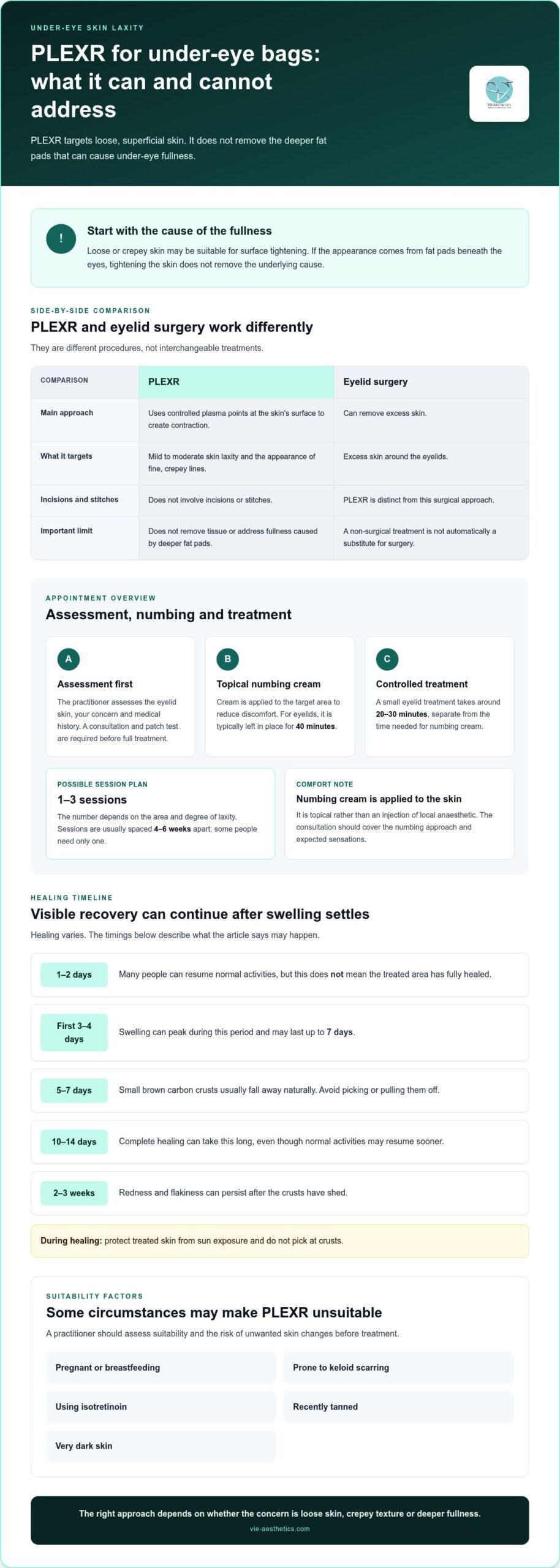
Recovery after under-eye PLEXR includes swelling and visible crusts, followed by gradual skin healing. Many patients can resume normal activities within 1-2 days, but that doesn’t mean the treated area has fully healed. Crusts usually remain visible for five to seven days, while complete healing can take 10-14 days.
Swelling can peak during the first 3-4 days and may last up to 7 days. Mild soreness, redness or flakiness can also occur as the skin responds to the energy used during treatment. The eyelid area is delicate, so allow time for swelling to settle before judging the appearance of the result.
PLEXR creates tiny brown carbon crusts across the treated area. These protect the new skin as it forms, then fall away naturally; don’t pick or pull them off. Once they have shed, the skin may still look pink or feel dry. Redness and flakiness can persist for 2-3 weeks, even after the crusts have gone.
During early healing, cleanse the area gently twice daily. Daily SPF 40 or higher is advised for a minimum of 3 months after treatment, because sun exposure can increase the risk of pigmentation changes. Avoiding direct sun and following aftercare instructions helps protect the recovering skin. Pigmentation changes are described as rare, but they are more likely without sun protection.
Visible crusts can be difficult to conceal around the eyes. Liquid foundation may be used to cover them while they remain, but camouflage doesn’t shorten the healing period. Plan work, social events or photographs around the first week, when crusts may still be present. Strenuous exercise is generally suitable again after 7-10 days.
Results develop as collagen forms in the treated skin. Improvement can continue over 3-6 months, so the final appearance may take time to emerge. PLEXR results can last up to 1-2 years; skin type, age and lifestyle influence how long they remain. Natural ageing continues, so eyelid skin can change again over time. This differs from surgical blepharoplasty, which removes excess skin rather than creating controlled surface points.
Factor recovery into your decision, not just the appointment itself. If swelling worsens, crusting changes unexpectedly or you have concerns during healing, contact the treating clinic for advice. Protect the treated area from sunlight and let crusts shed naturally throughout recovery.
PLEXR, laser treatments and microneedling work in different ways and suit different concerns. Unlike lower blepharoplasty, PLEXR treats the skin surface without surgical incisions; it does not remove fat pads or excess tissue.
For under-eye skin laxity, PLEXR creates controlled plasma points that contract the skin’s surface. Lasers use light energy, while microneedling uses fine needles to create tiny channels in the skin. The right approach depends on whether the main concern is excess skin, texture or another feature beneath the eyes.
| Approach | How it works | Considerations around the eyes |
|---|---|---|
| PLEXR | Uses plasma energy at the skin surface to create controlled points and encourage tightening. | Can target mild to moderate skin laxity; carbon crusts form during healing. |
| Laser treatment | Uses light energy. The method and intended effect vary between laser treatments. | Suitability depends on the specific concern and the laser method selected. |
| Microneedling | Uses fine needles to create small channels in the skin. | Often considered for skin texture; it does not remove under-eye fat pads. |
| Lower blepharoplasty | Is surgical eyelid treatment involving cuts and stitches. | It differs from non-surgical surface treatments and involves surgery. |
The key difference is what each method targets. PLEXR focuses on surface tightening, while microneedling uses a different method to stimulate the skin. “Laser” describes a broad category, not one uniform treatment, so the wavelength and purpose matter. Compare specific procedures rather than relying on treatment labels alone.
For example, crepey lower-eyelid skin may prompt a discussion about treatments directed at the skin. A visible bulge caused by fat pads is different: PLEXR does not remove that fullness. Lower blepharoplasty is surgery; PLEXR avoids incisions but cannot remove tissue as surgery can. Understanding this distinction helps set realistic expectations for improvement.
Healing also differs. PLEXR can leave visible carbon crusts for five to seven days, while microneedling and laser recovery depend on the technique used. PLEXR swelling can last up to seven days, and complete healing may take 10-14 days. Compare expected recovery alongside the treatment target, rather than choosing solely by the method’s name.
An assessment can establish whether laxity, texture or fat-pad fullness is most prominent, then help match the concern to an appropriate approach. The most useful comparison takes your under-eye anatomy and each treatment’s intended effect into account.
Arrange an under-eye assessment with Vie Aesthetics to discuss which approach aligns with your priorities.
Endolift Laser Treatment is a laser-based option to discuss if you’re exploring non-surgical approaches to facial ageing and skin concerns. It differs from Soft Surgery (Plexr), which uses plasma energy to target skin laxity at the surface.
If your main concern is under-eye skin, an assessment can help clarify whether it relates to loose skin, crepey texture or fullness beneath the area. That distinction matters when considering whether Endolift Laser Treatment or Plexr is the more relevant option to discuss. The treatments aren’t interchangeable, and suitability depends on the concern and treatment area.
Contact Vie Aesthetics to discuss your under-eye concerns and the treatment options that may suit you.
Start by deciding what change would feel meaningful to you. Is your priority a smoother-looking skin surface, a more rested appearance or understanding why the area looks fuller? Being clear about your goal can make the treatment discussion more focused and personal.
Before deciding whether Plexr for under-eye bags suits you, consider whether you’re comfortable with a gradual treatment journey and visible healing. An assessment can help you explore whether the approach fits your preferences, facial features and desired outcome, rather than choosing by treatment name alone. You can also discuss your key questions and make an informed, unhurried decision.
Taking time to make a considered choice is a positive step. Your plan should feel right for you.
PLEXR is a device-based aesthetic treatment that uses plasma energy on selected areas of skin. “Fibroblast” refers to a type of skin cell involved in producing collagen, the protein that supports skin structure. For under-eye concerns, the key point is that PLEXR targets the skin’s surface. It does not remove fat beneath the eyes or replace every type of eyelid procedure.
Temporary skin changes can include swelling, redness, soreness and small crusts. Mild pigmentation changes are also possible, particularly if the healing skin is exposed to sun without protection. Follow-up reviews may take place every 2-3 days during the week after treatment, giving the practitioner an opportunity to assess how the skin is settling. Report changes that concern you during recovery rather than attempting to treat them yourself.
Changes continue to develop as collagen forms, so the appearance can evolve after the initial healing period. Follow-up appointments at 2 weeks and 4 weeks can help assess progress at different stages. These reviews are not the same as a final-results date: the skin’s response continues to mature, and the degree of visible change depends on the treated concern and individual healing.
Recovery includes both the visible skin changes and the time needed for the treated area to settle. Exercise is generally suitable again after 7-10 days, which can help with planning if your routine includes regular training. Build this pause into your schedule, particularly if you have an event or activity planned. Your practitioner’s aftercare instructions should guide your return to exercise and usual skincare.
PLEXR may be considered for mild to moderate eyelid skin laxity. Skin type is also relevant: treatment is described for Fitzpatrick skin types I-IV, while darker skin types have a higher risk of pigmentation changes. The Fitzpatrick scale classifies skin by its response to sun exposure. A consultation and patch test help assess suitability before full treatment.
No. PLEXR and eyelid surgery are different procedures with different aims. PLEXR is a non-surgical option for selected skin concerns; surgery can address tissue that a surface treatment cannot remove. This distinction is especially important if under-eye fullness is mainly caused by fat pads or there is more substantial excess tissue. The cause of the concern should guide which options are considered.

Under-eye bags can be caused by loose skin or deeper fat pads. PLEXR targets skin laxity rather than removing fat. Plexr for under eye bags may be considered when loose skin contributes to the appearance, but it will not address every cause of under-eye fullness.
This guide explains how PLEXR works, the role of topical anaesthetic and what healing can involve. It also compares PLEXR with lasers and microneedling, so you can understand the differences before deciding on a next step.
Myth vs Reality: A non-surgical treatment is not automatically a substitute for surgery. What this treatment WILL and WON’T do: PLEXR may address some skin laxity, but it has clear limits.
PLEXR uses a microbeam of ionised gas, known as plasma, to create controlled points on the skin. The energy targets superficial skin cells without affecting deeper tissues, causing the surface to contract. This can tighten mild to moderate skin laxity and soften the appearance of fine, crepey lines.
Can Plexr treat under-eye bags caused by fat pads, or only loose skin? PLEXR targets loose, lax skin, not the deeper fat pads that can create bulging beneath the eyes. If fullness comes from fat rather than excess skin, tightening the surface does not remove its underlying cause.
If you’re considering Plexr for under eye bags, the first step is distinguishing loose skin from fullness caused by fat pads. PLEXR may address lower-eyelid skin redundancy, meaning excess loose skin, and crepey texture. A trained practitioner applies small, controlled points to the selected area, aiming to tighten the skin’s appearance rather than remove tissue or reposition fat.
PLEXR may also be used around sagging upper eyelids when lax skin contributes to a heavier appearance. Unlike traditional eyelid surgery, it does not involve incisions or stitches. Surgery can remove excess skin; PLEXR works at the skin’s surface. They are different procedures, not interchangeable treatments.
Swelling is part of the early healing response around the delicate eyelids. It can peak during the first 3-4 days and may last up to 7 days. Small brown crusts, also called carbon crusts, form at treatment points and usually fall away naturally within 5-7 days. Complete healing can take 10-14 days, so visible recovery lasts beyond the initial swelling.
During healing, avoid picking at crusts and protect the treated skin from sun exposure. PLEXR may be performed as a one-off treatment, but the plan depends on the degree of laxity and the area involved. A consultation can help distinguish loose skin from fat-pad fullness or crepey texture and establish whether surface tightening suits your concern.
In short, Plexr for under eye bags is relevant when loose skin contributes to the appearance, not when fullness is caused by fat pads. Identifying the cause helps set a realistic treatment aim and supports an informed choice between non-surgical skin tightening and other approaches.
A PLEXR appointment begins with an assessment of the eyelid skin and a discussion of the area you want treated. Suitability, comfort measures and session planning depend on your skin concern and medical history.
Topical anaesthetic cream is applied to the target area before treatment to reduce discomfort. For eyelids, the cream is typically left in place for 40 minutes before the procedure begins. This is numbing cream applied to the skin, rather than an injection of local anaesthetic. The consultation should cover how the area will be numbed and what sensations to expect during treatment.
Once the skin is prepared, the practitioner uses controlled plasma points on the selected area. A small eyelid treatment takes around 20-30 minutes, separate from the time needed for numbing cream. The method targets the skin’s surface; it does not remove tissue as surgical blepharoplasty does. Small crusts develop afterwards, so allow for visible healing following the appointment.
A consultation and patch test are required before full treatment. The assessment considers whether the concern is mild to moderate skin laxity, wrinkles or another cause of eyelid heaviness. PLEXR is not recommended for people who are pregnant or breastfeeding, prone to keloid scarring, using isotretinoin, recently tanned or with very dark skin. These factors can affect suitability and the risk of unwanted skin changes.
The number of sessions depends on the area and degree of laxity. Treatment may involve one to three sessions, usually spaced four to six weeks apart. Some people need only one session; others may benefit from a staged plan. After assessing the eyelids, the practitioner can explain the proposed number and spacing, without assuming repeat treatment is necessary.
Combining PLEXR with another treatment is not automatic. Consider whether each procedure addresses a distinct concern, such as surface laxity and another change in appearance. A consultation can clarify priorities and sequencing, taking healing time between procedures into account. This matters particularly around the delicate eyelid area.
Vie Aesthetics offers Plexr Soft Surgery. Arrange a consultation to discuss suitability and review your treatment plan before proceeding.
Topical anaesthesia is used for Plexr Plus treatment, while Plexr is also described as using topical numbing cream before treatment. Over-the-counter painkillers may be taken before PLEXR Eye Lift treatment for reassurance. The London clinic says Plexr treatment typically involves 1-3 sessions. Session planning can be discussed alongside the numbing approach and the intended treatment area, rather than assuming that every appointment has the same requirements.
The London clinic lists a Plexr treatment duration of 90 minutes. Plexr treatment of larger areas such as the neck or abdomen may take up to 45 minutes. These duration details sit alongside the shorter timing for a small eyelid treatment described above, so the expected appointment length can be clarified for the area being treated.
Recovery after under-eye PLEXR includes swelling and visible crusts, followed by gradual skin healing. Many patients can resume normal activities within 1-2 days, but that doesn’t mean the treated area has fully healed. Crusts usually remain visible for five to seven days, while complete healing can take 10-14 days.
Swelling can peak during the first 3-4 days and may last up to 7 days. Mild soreness, redness or flakiness can also occur as the skin responds to the energy used during treatment. The eyelid area is delicate, so allow time for swelling to settle before judging the appearance of the result.
PLEXR creates tiny brown carbon crusts across the treated area. These protect the new skin as it forms, then fall away naturally; don’t pick or pull them off. Once they have shed, the skin may still look pink or feel dry. Redness and flakiness can persist for 2-3 weeks, even after the crusts have gone.
During early healing, cleanse the area gently twice daily. Daily SPF 40 or higher is advised for a minimum of 3 months after treatment, because sun exposure can increase the risk of pigmentation changes. Avoiding direct sun and following aftercare instructions helps protect the recovering skin. Pigmentation changes are described as rare, but they are more likely without sun protection.
Visible crusts can be difficult to conceal around the eyes. Liquid foundation may be used to cover them while they remain, but camouflage doesn’t shorten the healing period. Plan work, social events or photographs around the first week, when crusts may still be present. Strenuous exercise is generally suitable again after 7-10 days.
Results develop as collagen forms in the treated skin. Improvement can continue over 3-6 months, so the final appearance may take time to emerge. PLEXR results can last up to 1-2 years; skin type, age and lifestyle influence how long they remain. Natural ageing continues, so eyelid skin can change again over time. This differs from surgical blepharoplasty, which removes excess skin rather than creating controlled surface points.
Factor recovery into your decision, not just the appointment itself. If swelling worsens, crusting changes unexpectedly or you have concerns during healing, contact the treating clinic for advice. Protect the treated area from sunlight and let crusts shed naturally throughout recovery.
PLEXR, laser treatments and microneedling work in different ways and suit different concerns. Unlike lower blepharoplasty, PLEXR treats the skin surface without surgical incisions; it does not remove fat pads or excess tissue.
For under-eye skin laxity, PLEXR creates controlled plasma points that contract the skin’s surface. Lasers use light energy, while microneedling uses fine needles to create tiny channels in the skin. The right approach depends on whether the main concern is excess skin, texture or another feature beneath the eyes.
| Approach | How it works | Considerations around the eyes |
|---|---|---|
| PLEXR | Uses plasma energy at the skin surface to create controlled points and encourage tightening. | Can target mild to moderate skin laxity; carbon crusts form during healing. |
| Laser treatment | Uses light energy. The method and intended effect vary between laser treatments. | Suitability depends on the specific concern and the laser method selected. |
| Microneedling | Uses fine needles to create small channels in the skin. | Often considered for skin texture; it does not remove under-eye fat pads. |
| Lower blepharoplasty | Is surgical eyelid treatment involving cuts and stitches. | It differs from non-surgical surface treatments and involves surgery. |
The key difference is what each method targets. PLEXR focuses on surface tightening, while microneedling uses a different method to stimulate the skin. “Laser” describes a broad category, not one uniform treatment, so the wavelength and purpose matter. Compare specific procedures rather than relying on treatment labels alone.
For example, crepey lower-eyelid skin may prompt a discussion about treatments directed at the skin. A visible bulge caused by fat pads is different: PLEXR does not remove that fullness. Lower blepharoplasty is surgery; PLEXR avoids incisions but cannot remove tissue as surgery can. Understanding this distinction helps set realistic expectations for improvement.
Healing also differs. PLEXR can leave visible carbon crusts for five to seven days, while microneedling and laser recovery depend on the technique used. PLEXR swelling can last up to seven days, and complete healing may take 10-14 days. Compare expected recovery alongside the treatment target, rather than choosing solely by the method’s name.
An assessment can establish whether laxity, texture or fat-pad fullness is most prominent, then help match the concern to an appropriate approach. The most useful comparison takes your under-eye anatomy and each treatment’s intended effect into account.
Arrange an under-eye assessment with Vie Aesthetics to discuss which approach aligns with your priorities.
Endolift Laser Treatment is a laser-based option to discuss if you’re exploring non-surgical approaches to facial ageing and skin concerns. It differs from Soft Surgery (Plexr), which uses plasma energy to target skin laxity at the surface.
If your main concern is under-eye skin, an assessment can help clarify whether it relates to loose skin, crepey texture or fullness beneath the area. That distinction matters when considering whether Endolift Laser Treatment or Plexr is the more relevant option to discuss. The treatments aren’t interchangeable, and suitability depends on the concern and treatment area.
Contact Vie Aesthetics to discuss your under-eye concerns and the treatment options that may suit you.
Start by deciding what change would feel meaningful to you. Is your priority a smoother-looking skin surface, a more rested appearance or understanding why the area looks fuller? Being clear about your goal can make the treatment discussion more focused and personal.
Before deciding whether Plexr for under-eye bags suits you, consider whether you’re comfortable with a gradual treatment journey and visible healing. An assessment can help you explore whether the approach fits your preferences, facial features and desired outcome, rather than choosing by treatment name alone. You can also discuss your key questions and make an informed, unhurried decision.
Taking time to make a considered choice is a positive step. Your plan should feel right for you.
PLEXR is a device-based aesthetic treatment that uses plasma energy on selected areas of skin. “Fibroblast” refers to a type of skin cell involved in producing collagen, the protein that supports skin structure. For under-eye concerns, the key point is that PLEXR targets the skin’s surface. It does not remove fat beneath the eyes or replace every type of eyelid procedure.
Temporary skin changes can include swelling, redness, soreness and small crusts. Mild pigmentation changes are also possible, particularly if the healing skin is exposed to sun without protection. Follow-up reviews may take place every 2-3 days during the week after treatment, giving the practitioner an opportunity to assess how the skin is settling. Report changes that concern you during recovery rather than attempting to treat them yourself.
Changes continue to develop as collagen forms, so the appearance can evolve after the initial healing period. Follow-up appointments at 2 weeks and 4 weeks can help assess progress at different stages. These reviews are not the same as a final-results date: the skin’s response continues to mature, and the degree of visible change depends on the treated concern and individual healing.
Recovery includes both the visible skin changes and the time needed for the treated area to settle. Exercise is generally suitable again after 7-10 days, which can help with planning if your routine includes regular training. Build this pause into your schedule, particularly if you have an event or activity planned. Your practitioner’s aftercare instructions should guide your return to exercise and usual skincare.
PLEXR may be considered for mild to moderate eyelid skin laxity. Skin type is also relevant: treatment is described for Fitzpatrick skin types I-IV, while darker skin types have a higher risk of pigmentation changes. The Fitzpatrick scale classifies skin by its response to sun exposure. A consultation and patch test help assess suitability before full treatment.
No. PLEXR and eyelid surgery are different procedures with different aims. PLEXR is a non-surgical option for selected skin concerns; surgery can address tissue that a surface treatment cannot remove. This distinction is especially important if under-eye fullness is mainly caused by fat pads or there is more substantial excess tissue. The cause of the concern should guide which options are considered.