What if the first step towards treating sun-related redness or pigmentation isn’t choosing a device, but understanding what your skin needs? Lumecca IPL UK uses intense pulsed light to target selected skin concerns, but whether Lumecca IPL UK is appropriate for you depends on an individual assessment.
It’s understandable to want clear answers about how IPL differs from laser treatment, how it may feel and what recovery involves. IPL uses a range of light wavelengths, while laser treatment uses a more concentrated wavelength; the right option depends on the concern being assessed and your circumstances.
This guide explains how Lumecca IPL works and the concerns it may help address, including sun damage, pigmentation and redness. You’ll also learn what personal factors to discuss with a qualified clinician, so you can make an informed decision about whether to book an assessment.
Lumecca is an intense pulsed light (IPL) treatment. IPL uses brief flashes of light across a range of wavelengths, rather than a single laser beam, and may be considered for concerns such as sun-related pigmentation and visible redness. It’s a treatment approach, not a promise of a particular result.
People often ask about IPL after noticing uneven-looking skin tone, freckles or persistent redness. These concerns can have different causes, so a clinician needs to assess the skin and relevant history before deciding whether Lumecca is an appropriate option. The name of a concern alone can’t determine suitability.
Lumecca is intended to target selected visible skin concerns, which may include certain forms of pigmentation and redness. The aim is to improve the appearance of the assessed concern. The likely response and treatment plan vary between individuals, so identical results can’t be assumed.
It won’t assess or diagnose the cause of a skin change by itself, nor can it promise to address every mark or type of redness. An assessment may lead to a different suitable treatment, or to no treatment if IPL isn’t appropriate. That is a considered part of care, not a failed consultation.
For Lumecca IPL UK, the useful question is not simply whether a concern appears on a list of possible uses. It’s whether the specific concern, your skin and your circumstances make this approach suitable.
Myth: IPL and laser are two names for the same treatment. Reality: both use light, but they deliver it differently. IPL emits pulses across a broader range of wavelengths; laser treatment uses a more focused wavelength. In plain terms, IPL is broad-spectrum pulsed light, while a laser concentrates light more narrowly. Read a general overview of Intense Pulsed Light (IPL).
That distinction doesn’t mean every IPL device or treatment plan works in the same way. Devices and settings can differ, and the selected approach should reflect the clinical assessment. Vie Aesthetics offers face treatments within a wider range of options, but the right choice depends on the individual concern.
Lumecca uses pulses of light that may be absorbed by selected targets in the skin. This interaction can produce heat in those targets. IPL is a broad-spectrum light treatment, not a single-wavelength laser, as described in this overview of Intense Pulsed Light (IPL). This explains the treatment mechanism, but it does not establish suitability or predict an individual response.
For concerns involving pigmentation or redness, the light is intended to interact with different skin components. A clinician’s assessment helps determine whether the concern is appropriate to consider for treatment and what next steps make sense.
Melanin is the pigment that contributes to the colour of skin and brown marks. In selected cases, light may be absorbed by melanin in pigmented areas. Haemoglobin is a protein in red blood cells that carries oxygen; it contributes to the red colour of blood and is relevant when considering visible redness associated with blood vessels.
These are simplified descriptions of how light may interact with skin. They do not mean every brown mark or red area has the same cause, or that each will respond alike. A clinician needs to assess the appearance and context of the concern before considering treatment.
A mechanism describes how a device is intended to work. It is not, on its own, evidence that a particular concern will respond or that a specific outcome will follow. Skin characteristics, the nature of the concern and relevant personal history all inform whether treatment is appropriate and how a plan is considered.
Dr Ioannis Liakas, Medical Director: “Understanding the specific characteristics of your skin is essential when using Lumecca IPL in the UK to target pigmentation and redness effectively.”
For Lumecca IPL UK, an individual assessment is more informative than a general claim based on a device’s mechanism. If you would like to explore whether Lumecca could suit your concern, you can book an assessment with Vie Aesthetics.
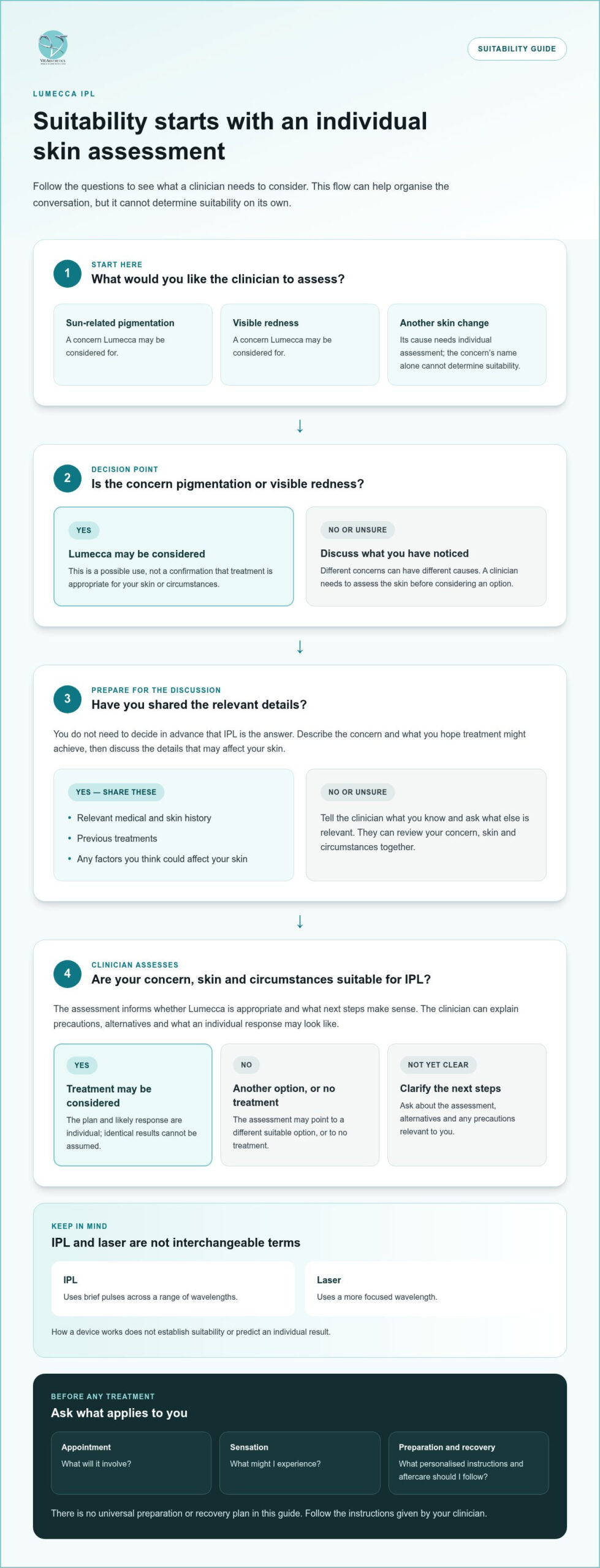
Suitability for Lumecca IPL is decided through an individual clinical assessment, not a checklist that applies to everyone. The clinician will discuss your concern, review relevant history, assess your skin and explain the next steps, which may include treatment, another option or no treatment.
To make the conversation useful, describe what you’d like assessed and what you hope treatment might achieve. Share relevant medical and skin history, including previous treatments and any factors you think could affect your skin. You don’t need to decide in advance that IPL is the answer.
The clinician will consider the concern alongside your skin and circumstances. They can explain any precautions that apply to you, discuss alternatives and clarify what an individual response may look like. Session planning and expectations are clinical decisions, not fixed outcomes that can be assumed for every person.
There isn’t a universal preparation or recovery plan to rely on here. Follow the personalised instructions given by your clinician, and ask what applies to you before making plans around treatment. It’s also reasonable to ask what the appointment involves, what sensations you might experience and what aftercare guidance you’ll receive.
Your assessment pathway
This is a guide to the assessment conversation, not a treatment protocol. The information you receive should be specific to your circumstances. For anyone considering Lumecca IPL UK, a careful assessment helps turn general information into a considered next step, without assuming treatment is appropriate.
A useful next step is an assessment, rather than assuming IPL is right for you. Vie Aesthetics offers Lumecca IPL Skin Rejuvenation, and a clinical discussion can help you consider whether it fits your goals and circumstances.
Separate information about how a treatment works from claims about what you’ll experience. General guidance can explain an intended treatment role, but it can’t predict your individual response. If you’re weighing options, the guide to non-surgical aesthetic treatments can help you consider the wider context before speaking with a clinician.
A consultation gives you space to discuss your goals, share relevant circumstances and ask questions. It supports an informed decision; it doesn’t oblige you to proceed. Dr Ioannis Liakas, Medical Director: “[Insert approved, verbatim quotation here.]”
Bring the questions that matter to you, then take time to consider the information. The decision about treatment remains yours.
Choosing whether to explore Lumecca IPL UK is a personal decision. You don’t need to arrive with a treatment plan already in mind. Bring your questions, explain what you hope to address and allow the assessment to guide the conversation.
A considered discussion can help you understand how the available options relate to your circumstances, what questions remain and whether you’d like to proceed. You’re entitled to take time to weigh that information before making a decision.
Whatever you decide, feeling informed is a valuable place to begin. Take the next step at a pace that feels right for you.
No. Lumecca uses intense pulsed light, or IPL, which delivers pulses containing a range of light wavelengths; laser treatments use a more focused wavelength. Both use light, but the terms aren’t interchangeable. The general overview of IPL explains this technology and its applications. The distinction matters because the appropriate approach depends on the skin concern and an individual clinical assessment, not simply on whether a treatment uses light.
Lumecca may be considered for selected concerns involving sun-related pigmentation and visible redness, including some vascular marks. These are potential treatment aims, not a promise that every mark or area of redness will respond. Similar-looking skin changes can have different causes, so an assessment helps establish what the concern is and whether IPL is suitable. Your clinician can also discuss whether another approach would better match your goals.
No single answer applies to everyone. Skin tone is one factor a clinician considers when assessing suitability, alongside the specific concern and relevant personal history. Don’t assume that a treatment is appropriate solely because it has been used by someone with a similar concern. During an assessment, discuss your natural skin tone, any recent changes in its appearance and your treatment history so the clinician can consider appropriate next steps.
People may experience treatment differently, so a universal discomfort rating wouldn’t be reliable. The sensation can depend on the individual and the treatment plan being considered. At your assessment, ask the clinician to explain what you may feel during your planned treatment and what support or adjustments may be appropriate. This gives you information relevant to your circumstances, rather than relying on another person’s account of their experience.
There isn’t a set number that can be recommended for everyone. Session planning depends on the concern being assessed, your skin and how it responds, so the clinician should discuss a plan with you individually. Before agreeing to treatment, ask what the proposed plan is intended to address and how progress will be reviewed. Lumecca IPL UK treatment planning should reflect your assessment, rather than an assumed standard course.
Follow the aftercare instructions your clinician gives you for your treatment. Recovery and skin response can differ, so avoid relying on a fixed timeline or another person’s experience as a prediction. Before treatment, ask what changes you might notice, which aftercare steps apply to you and who to contact if you’re concerned about your skin. Personalised guidance is more useful than a generic recovery schedule.

What if the first step towards treating sun-related redness or pigmentation isn’t choosing a device, but understanding what your skin needs? Lumecca IPL UK uses intense pulsed light to target selected skin concerns, but whether Lumecca IPL UK is appropriate for you depends on an individual assessment.
It’s understandable to want clear answers about how IPL differs from laser treatment, how it may feel and what recovery involves. IPL uses a range of light wavelengths, while laser treatment uses a more concentrated wavelength; the right option depends on the concern being assessed and your circumstances.
This guide explains how Lumecca IPL works and the concerns it may help address, including sun damage, pigmentation and redness. You’ll also learn what personal factors to discuss with a qualified clinician, so you can make an informed decision about whether to book an assessment.
Lumecca is an intense pulsed light (IPL) treatment. IPL uses brief flashes of light across a range of wavelengths, rather than a single laser beam, and may be considered for concerns such as sun-related pigmentation and visible redness. It’s a treatment approach, not a promise of a particular result.
People often ask about IPL after noticing uneven-looking skin tone, freckles or persistent redness. These concerns can have different causes, so a clinician needs to assess the skin and relevant history before deciding whether Lumecca is an appropriate option. The name of a concern alone can’t determine suitability.
Lumecca is intended to target selected visible skin concerns, which may include certain forms of pigmentation and redness. The aim is to improve the appearance of the assessed concern. The likely response and treatment plan vary between individuals, so identical results can’t be assumed.
It won’t assess or diagnose the cause of a skin change by itself, nor can it promise to address every mark or type of redness. An assessment may lead to a different suitable treatment, or to no treatment if IPL isn’t appropriate. That is a considered part of care, not a failed consultation.
For Lumecca IPL UK, the useful question is not simply whether a concern appears on a list of possible uses. It’s whether the specific concern, your skin and your circumstances make this approach suitable.
Myth: IPL and laser are two names for the same treatment. Reality: both use light, but they deliver it differently. IPL emits pulses across a broader range of wavelengths; laser treatment uses a more focused wavelength. In plain terms, IPL is broad-spectrum pulsed light, while a laser concentrates light more narrowly. Read a general overview of Intense Pulsed Light (IPL).
That distinction doesn’t mean every IPL device or treatment plan works in the same way. Devices and settings can differ, and the selected approach should reflect the clinical assessment. Vie Aesthetics offers face treatments within a wider range of options, but the right choice depends on the individual concern.
Lumecca uses pulses of light that may be absorbed by selected targets in the skin. This interaction can produce heat in those targets. IPL is a broad-spectrum light treatment, not a single-wavelength laser, as described in this overview of Intense Pulsed Light (IPL). This explains the treatment mechanism, but it does not establish suitability or predict an individual response.
For concerns involving pigmentation or redness, the light is intended to interact with different skin components. A clinician’s assessment helps determine whether the concern is appropriate to consider for treatment and what next steps make sense.
Melanin is the pigment that contributes to the colour of skin and brown marks. In selected cases, light may be absorbed by melanin in pigmented areas. Haemoglobin is a protein in red blood cells that carries oxygen; it contributes to the red colour of blood and is relevant when considering visible redness associated with blood vessels.
These are simplified descriptions of how light may interact with skin. They do not mean every brown mark or red area has the same cause, or that each will respond alike. A clinician needs to assess the appearance and context of the concern before considering treatment.
A mechanism describes how a device is intended to work. It is not, on its own, evidence that a particular concern will respond or that a specific outcome will follow. Skin characteristics, the nature of the concern and relevant personal history all inform whether treatment is appropriate and how a plan is considered.
Dr Ioannis Liakas, Medical Director: “Understanding the specific characteristics of your skin is essential when using Lumecca IPL in the UK to target pigmentation and redness effectively.”
For Lumecca IPL UK, an individual assessment is more informative than a general claim based on a device’s mechanism. If you would like to explore whether Lumecca could suit your concern, you can book an assessment with Vie Aesthetics.
Suitability for Lumecca IPL is decided through an individual clinical assessment, not a checklist that applies to everyone. The clinician will discuss your concern, review relevant history, assess your skin and explain the next steps, which may include treatment, another option or no treatment.
To make the conversation useful, describe what you’d like assessed and what you hope treatment might achieve. Share relevant medical and skin history, including previous treatments and any factors you think could affect your skin. You don’t need to decide in advance that IPL is the answer.
The clinician will consider the concern alongside your skin and circumstances. They can explain any precautions that apply to you, discuss alternatives and clarify what an individual response may look like. Session planning and expectations are clinical decisions, not fixed outcomes that can be assumed for every person.
There isn’t a universal preparation or recovery plan to rely on here. Follow the personalised instructions given by your clinician, and ask what applies to you before making plans around treatment. It’s also reasonable to ask what the appointment involves, what sensations you might experience and what aftercare guidance you’ll receive.
Your assessment pathway
This is a guide to the assessment conversation, not a treatment protocol. The information you receive should be specific to your circumstances. For anyone considering Lumecca IPL UK, a careful assessment helps turn general information into a considered next step, without assuming treatment is appropriate.
A useful next step is an assessment, rather than assuming IPL is right for you. Vie Aesthetics offers Lumecca IPL Skin Rejuvenation, and a clinical discussion can help you consider whether it fits your goals and circumstances.
Separate information about how a treatment works from claims about what you’ll experience. General guidance can explain an intended treatment role, but it can’t predict your individual response. If you’re weighing options, the guide to non-surgical aesthetic treatments can help you consider the wider context before speaking with a clinician.
A consultation gives you space to discuss your goals, share relevant circumstances and ask questions. It supports an informed decision; it doesn’t oblige you to proceed. Dr Ioannis Liakas, Medical Director: “[Insert approved, verbatim quotation here.]”
Bring the questions that matter to you, then take time to consider the information. The decision about treatment remains yours.
Choosing whether to explore Lumecca IPL UK is a personal decision. You don’t need to arrive with a treatment plan already in mind. Bring your questions, explain what you hope to address and allow the assessment to guide the conversation.
A considered discussion can help you understand how the available options relate to your circumstances, what questions remain and whether you’d like to proceed. You’re entitled to take time to weigh that information before making a decision.
Whatever you decide, feeling informed is a valuable place to begin. Take the next step at a pace that feels right for you.
No. Lumecca uses intense pulsed light, or IPL, which delivers pulses containing a range of light wavelengths; laser treatments use a more focused wavelength. Both use light, but the terms aren’t interchangeable. The general overview of IPL explains this technology and its applications. The distinction matters because the appropriate approach depends on the skin concern and an individual clinical assessment, not simply on whether a treatment uses light.
Lumecca may be considered for selected concerns involving sun-related pigmentation and visible redness, including some vascular marks. These are potential treatment aims, not a promise that every mark or area of redness will respond. Similar-looking skin changes can have different causes, so an assessment helps establish what the concern is and whether IPL is suitable. Your clinician can also discuss whether another approach would better match your goals.
No single answer applies to everyone. Skin tone is one factor a clinician considers when assessing suitability, alongside the specific concern and relevant personal history. Don’t assume that a treatment is appropriate solely because it has been used by someone with a similar concern. During an assessment, discuss your natural skin tone, any recent changes in its appearance and your treatment history so the clinician can consider appropriate next steps.
People may experience treatment differently, so a universal discomfort rating wouldn’t be reliable. The sensation can depend on the individual and the treatment plan being considered. At your assessment, ask the clinician to explain what you may feel during your planned treatment and what support or adjustments may be appropriate. This gives you information relevant to your circumstances, rather than relying on another person’s account of their experience.
There isn’t a set number that can be recommended for everyone. Session planning depends on the concern being assessed, your skin and how it responds, so the clinician should discuss a plan with you individually. Before agreeing to treatment, ask what the proposed plan is intended to address and how progress will be reviewed. Lumecca IPL UK treatment planning should reflect your assessment, rather than an assumed standard course.
Follow the aftercare instructions your clinician gives you for your treatment. Recovery and skin response can differ, so avoid relying on a fixed timeline or another person’s experience as a prediction. Before treatment, ask what changes you might notice, which aftercare steps apply to you and who to contact if you’re concerned about your skin. Personalised guidance is more useful than a generic recovery schedule.

 Read this article
 Read this article