Stem cells are regenerative cells that can support the activity of other cells. Stem cell hair restoration in the UK uses processed cells or cell-rich tissue injected into areas of thinning, with the aim of supporting hair follicles. The method matters: some approaches use scalp tissue, while others use fat-derived cells.
It’s understandable to want to know whether this treatment can do more than sound promising. This guide explains how samples are collected and prepared, how injections are given, and what the evidence says about hair regrowth and possible results over time.
It also explains how the treatment compares with other approaches to hair loss, helping you decide what to discuss during an assessment at Vie Aesthetics.
By Medical Editorial Team | Professional Profile
Dr Ioannis Liakas: “Regenerative approaches represent a significant step forward in modern aesthetic medicine, offering patients a natural way to support follicular health and encourage lasting hair revitalisation.”
Stem cell hair treatment uses regenerative cells or cell-rich tissue, processed and placed into areas of scalp thinning. For stem cell hair restoration in the UK, the method depends on the source material and whether other hair-loss treatments are part of the plan.
StemVita options for male and female hair loss should be compared by their stated protocol, not their name alone. Consider whether the method uses scalp tissue, fat-derived cells or platelet-rich plasma (PRP), and how the plan relates to the pattern of thinning. These details clarify what is actually being proposed.
Hair-loss patterns vary from person to person. A plan should identify the areas being treated and explain why the technique suits the person’s goals. The term “StemVita” alone doesn’t specify the sample source, preparation or injection method.
Stem cell treatment may be considered alongside hair-loss medicines or a hair transplant, but each has a different role. Medicines can help manage hair loss, a transplant relocates hair follicles, and regenerative techniques introduce processed tissue into the scalp. If you’re considering stem cell hair restoration in the UK, understand how each part fits into the overall plan.
Don’t stop or change prescribed medication because you’re considering injections. Discuss your current medicines as part of treatment planning, especially if you’re weighing more than one approach. A transplant and regenerative injections aren’t interchangeable: one moves grafts, while the other places prepared material into selected scalp areas.
With a scalp micrograft technique, a clinician collects small tissue samples from the scalp, processes them and injects the prepared material into thinning areas. Fat-derived procedures instead collect fatty tissue, process it and inject the resulting cell-rich material. The source determines the harvesting and preparation steps.
PRP, or platelet-rich plasma, is a prepared blood component containing concentrated platelets. It’s distinct from stem cell treatment, though it may be used in hair-related procedures. Before treatment, establish whether the plan uses PRP, micrografts, fat-derived cells or a combination, and ask what each step involves.
Stem cell hair treatment is different from therapies discussed for Lyme disease or joint arthritis. Those relate to different health conditions and treatment aims; a hair procedure targets the scalp and follicles, not infection or joint symptoms. Hair loss alongside other symptoms requires a separate assessment of its cause.
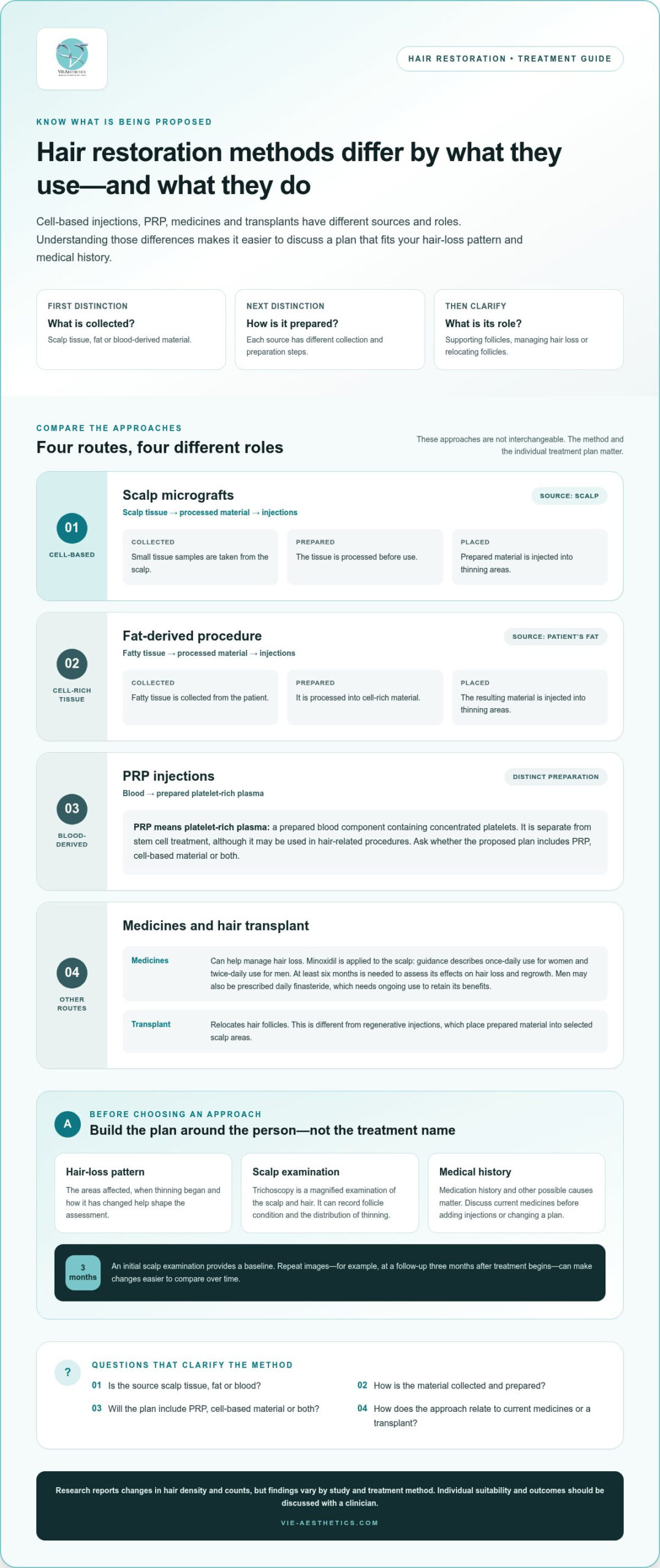
Cell-based hair-loss treatments focus on the follicle environment, but planning starts by identifying the pattern of hair loss. Trichoscopy, medication history and when the thinning began all help shape the assessment.
Stem cells can develop into different cell types, while progenitor cells are more specialised cells with a narrower role. In hair treatment, the aim is to use regenerative cells to support activity around follicles and encourage hair growth. The label “stem cell treatment” doesn’t describe one uniform technique, so ask which cells are used and how they’re prepared.
Injection-based treatment places processed regenerative material into selected scalp areas. The source may be scalp tissue or fat, and preparation varies accordingly. Platelet-rich plasma, or PRP, is a separate blood-derived preparation containing concentrated platelets. Knowing whether a plan uses cells, PRP or both clarifies what the injections involve.
Trichoscopy is a magnified examination of the scalp and hair. It helps record follicle condition and the distribution of thinning before treatment. An initial examination provides a baseline; repeat images, for example at a follow-up three months after treatment begins, make changes easier to compare over time.
The pattern and onset of hair loss offer useful clues, but they don’t identify every cause. Male pattern hair loss often affects the temples or crown, while female pattern thinning commonly appears across the top of the scalp and tends to develop later, often in the 40s or 50s. Hair loss can also have causes that need separate medical attention, so a GP assessment before treatment helps identify and address them.
Hair loss affects both men and women: market estimates say almost a third of men over 25 and 40% of women over 25 experience it in some form. These figures describe hair loss broadly, not the suitability of a particular treatment. The distribution, speed of change and scalp findings matter more when planning an individual approach.
Medication is another treatment route. Minoxidil is applied to the scalp, with guidance describing once-daily use for women and twice-daily use for men; at least six months is needed to assess its effects on hair loss and regrowth. Men may also be prescribed finasteride, a daily medicine that needs ongoing use to retain its benefits. Discuss your current medicines before adding injections or changing your treatment plan.
A medical consultation can bring together scalp findings, hair-loss history and current medicines before you consider an injection-based approach. Book a medical consultation to discuss the factors shaping your hair-restoration plan.
Fat-derived procedures use a patient’s own tissue: it is collected, processed and then injected into thinning areas as cell-rich material. The harvesting method and preparation distinguish this approach from scalp micrografts.
In a Kerastem-style procedure, fat is collected from the patient, processed to concentrate regenerative material, then injected into selected scalp areas. “Enriched fat” describes tissue prepared for reinjection, not simply untreated fat transferred elsewhere. The plan should specify which areas will be treated and what the prepared material contains.
The injections target the scalp rather than moving follicles from one area to another, as a hair transplant does. This distinction matters: the procedure introduces processed tissue, while a transplant relocates hair-bearing grafts. The methods involve different steps and aren’t interchangeable.
Fat harvesting for the described procedure uses one or two small cuts, each 5 mm, to collect tissue. Local anaesthesia may be used during harvesting and injection. The collected material is then processed before being placed into the scalp, so the treatment includes a donor-site procedure as well as injections.
A scalp-biopsy micrograft takes tissue directly from the scalp; an adipose-derived method takes it from fatty tissue. These sources require different collection and preparation steps. In the described comparison, 10 ml of fat tissue is needed to obtain a quantity of progenitor cells comparable to three 2 mm scalp punches. That difference helps explain why the source tissue affects the procedure.
Stem cells can develop into different cell types, while progenitor cells have a more limited capacity. Growth factors are signalling molecules involved in cellular activity. In regenerative hair procedures, these components are intended to support the local follicle environment; they are not transplanted hair follicles.
Processed tissue is injected into selected areas, rather than applied uniformly across the scalp. The collection site, preparation process and injection pattern all shape the technique. Ask for a clear explanation of each step: how the tissue is collected, how it is processed and where it will be injected.
Harvesting and injection carry procedural risks. Possible complications include pain, infection or serious tissue injury, so the treatment plan should explain how these risks relate to the procedure. A regenerative-cell injection is not a hair transplant operation: it doesn’t involve placing individual hair grafts into the scalp.
Research on regenerative hair procedures reports changes in hair density and counts over time. Results vary between studies, so the technique and measurement used matter when interpreting claims about alopecia or baldness.
One Italian study followed 11 people aged 38 to 61 after stem cell treatment. It reported a 29% increase in hair density within six months of the final treatment session. Hair density measures how many hairs grow within a defined scalp area, rather than describing overall coverage.
A separate cited study reported an average increase of 31 hairs per square centimetre within 24 weeks. Other reported figures include 23% extra hair growth over six months and hair-count increases of up to 53%. These are study findings, not an expected result for every person or every treatment technique.
Micrograft treatment uses small tissue samples containing regenerative cells, which are processed and introduced into areas of thinning. Consider evidence in relation to the exact method studied, the number of participants and the outcome measured. Hair density, hair count and visible coverage are related, but describe different changes.
A placebo comparison study included 22 participants, with equal numbers of men and women. That provides a comparison group, but the participant count remains limited. Study size and follow-up length affect how confidently results can be applied to people with different patterns of hair loss.
Hair follicles move through growth cycles, so changes can take time to become visible. Reported timelines vary: some treatment information describes early changes from the first month, while new hair growth may become noticeable around six months. Improvements can continue over several months, so an early photograph may not show the full outcome.
For a useful comparison, photograph the same scalp areas under consistent lighting and from the same angles before treatment and at follow-up. Trichoscopy, a magnified scalp examination, can help assess follicle changes alongside photographs. Consistent records help distinguish measurable density changes from differences caused by styling, lighting or hair length.
These findings support further assessment of regenerative therapy, but they don’t establish one success rate for every form of hair loss. A study of micrografts cannot automatically predict the effects of fat-derived injections or platelet-rich plasma. The cause of thinning, treatment method and measured outcome all affect how the evidence applies to an individual.
Endolift Laser Treatment is a non-surgical option for people seeking support with skin concerns, not scalp hair loss. It doesn’t replace regenerative injections or a hair transplant, so it isn’t the relevant treatment if your main goal is to address thinning or encourage hair regrowth.
For hair-related concerns, Vie Aesthetics offers Stem Cell Hair Restoration. A consultation can help clarify your goals: Endolift addresses skin, while hair restoration focuses on the scalp. Choose based on the area you want treated and the outcome you’re seeking, rather than assuming one procedure addresses both.
If you’d like to discuss which option suits your needs, contact Vie Aesthetics for further information.
Choosing stem cell hair restoration in the UK is a personal treatment decision, not a trend to follow. Before moving forward, consider what you most want to understand: the treatment method, how progress will be assessed, or how it fits alongside your current care.
Use those priorities to guide a focused conversation. Discuss your aims, the approach being considered and the follow-up involved, then decide whether it feels right for you. Hair-loss causes and treatment responses vary, so suitability and potential benefit are individual.
Taking time to make an informed choice is a positive step. To explore your options with Vie Aesthetics, arrange a consultation.
Whatever you decide, understanding your options can help you move forward with confidence.
Stem cells can develop into different specialised cell types. In hair treatment, the term refers to biological material used in a procedure, not ready-made replacement hairs. Progenitor cells are more specialised and have a narrower capacity to develop. The material depends on the technique, so ask whether the proposed procedure uses scalp-derived tissue, fat-derived material or another preparation.
Possible complications include pain, infection and serious tissue injury. Risks vary by procedure: fat-derived treatment involves tissue harvesting as well as scalp injections, while micrograft treatment takes samples from the scalp. Share relevant health conditions and medicines during your assessment. Make sure you understand the aftercare instructions and what to do if you notice a concerning change after treatment.
Regenera Activa is generally described as a single treatment, with a top-up considered if hair loss progresses. Other methods may follow a different schedule. Follow-up helps assess changes and determine whether another session is appropriate. Ask how progress will be recorded, for example through consistent photographs or repeat scalp examinations, so you can compare like with like.
Regenerative injections don’t place new hair follicles into areas where hair is absent. A transplant moves hair-bearing grafts, so it serves a different purpose. The extent and distribution of thinning, along with scalp examination findings, help assess whether an injection-based approach aligns with your goals. Book a hair consultation to discuss your treatment aims.
Use Vie Aesthetics’ online booking system to arrange a consultation about hair loss. The booking process is available to clients nationwide across the United Kingdom. Note your hair-loss history and current medicines beforehand, so you can use the appointment to discuss what matters most to you.
Regenera Activa is a non-surgical procedure described as taking about 45 minutes. A hair transplant is a different operation and may take 6-8 hours, depending on graft numbers and processing time. These timings refer to different treatments. Discuss treatment options if you’re comparing appointment plans.
Myth vs Reality
Myth: Every procedure called a stem cell treatment uses the same material. Reality: Techniques can use different tissue sources and preparation methods. The name alone doesn’t tell you which procedure is involved, so ask what material the treatment uses and what happens during the appointment.
What this treatment WILL and WON’T do
It may: introduce processed regenerative material into selected scalp areas. It won’t: move hair-bearing grafts as a transplant does or address every cause of hair loss. Understanding the distinction helps you match the procedure to your goals and discuss alternatives clearly.

Stem cells are regenerative cells that can support the activity of other cells. Stem cell hair restoration in the UK uses processed cells or cell-rich tissue injected into areas of thinning, with the aim of supporting hair follicles. The method matters: some approaches use scalp tissue, while others use fat-derived cells.
It’s understandable to want to know whether this treatment can do more than sound promising. This guide explains how samples are collected and prepared, how injections are given, and what the evidence says about hair regrowth and possible results over time.
It also explains how the treatment compares with other approaches to hair loss, helping you decide what to discuss during an assessment at Vie Aesthetics.
By Medical Editorial Team | Professional Profile
Dr Ioannis Liakas: “Regenerative approaches represent a significant step forward in modern aesthetic medicine, offering patients a natural way to support follicular health and encourage lasting hair revitalisation.”
Stem cell hair treatment uses regenerative cells or cell-rich tissue, processed and placed into areas of scalp thinning. For stem cell hair restoration in the UK, the method depends on the source material and whether other hair-loss treatments are part of the plan.
StemVita options for male and female hair loss should be compared by their stated protocol, not their name alone. Consider whether the method uses scalp tissue, fat-derived cells or platelet-rich plasma (PRP), and how the plan relates to the pattern of thinning. These details clarify what is actually being proposed.
Hair-loss patterns vary from person to person. A plan should identify the areas being treated and explain why the technique suits the person’s goals. The term “StemVita” alone doesn’t specify the sample source, preparation or injection method.
Stem cell treatment may be considered alongside hair-loss medicines or a hair transplant, but each has a different role. Medicines can help manage hair loss, a transplant relocates hair follicles, and regenerative techniques introduce processed tissue into the scalp. If you’re considering stem cell hair restoration in the UK, understand how each part fits into the overall plan.
Don’t stop or change prescribed medication because you’re considering injections. Discuss your current medicines as part of treatment planning, especially if you’re weighing more than one approach. A transplant and regenerative injections aren’t interchangeable: one moves grafts, while the other places prepared material into selected scalp areas.
With a scalp micrograft technique, a clinician collects small tissue samples from the scalp, processes them and injects the prepared material into thinning areas. Fat-derived procedures instead collect fatty tissue, process it and inject the resulting cell-rich material. The source determines the harvesting and preparation steps.
PRP, or platelet-rich plasma, is a prepared blood component containing concentrated platelets. It’s distinct from stem cell treatment, though it may be used in hair-related procedures. Before treatment, establish whether the plan uses PRP, micrografts, fat-derived cells or a combination, and ask what each step involves.
Stem cell hair treatment is different from therapies discussed for Lyme disease or joint arthritis. Those relate to different health conditions and treatment aims; a hair procedure targets the scalp and follicles, not infection or joint symptoms. Hair loss alongside other symptoms requires a separate assessment of its cause.
Cell-based hair-loss treatments focus on the follicle environment, but planning starts by identifying the pattern of hair loss. Trichoscopy, medication history and when the thinning began all help shape the assessment.
Stem cells can develop into different cell types, while progenitor cells are more specialised cells with a narrower role. In hair treatment, the aim is to use regenerative cells to support activity around follicles and encourage hair growth. The label “stem cell treatment” doesn’t describe one uniform technique, so ask which cells are used and how they’re prepared.
Injection-based treatment places processed regenerative material into selected scalp areas. The source may be scalp tissue or fat, and preparation varies accordingly. Platelet-rich plasma, or PRP, is a separate blood-derived preparation containing concentrated platelets. Knowing whether a plan uses cells, PRP or both clarifies what the injections involve.
Trichoscopy is a magnified examination of the scalp and hair. It helps record follicle condition and the distribution of thinning before treatment. An initial examination provides a baseline; repeat images, for example at a follow-up three months after treatment begins, make changes easier to compare over time.
The pattern and onset of hair loss offer useful clues, but they don’t identify every cause. Male pattern hair loss often affects the temples or crown, while female pattern thinning commonly appears across the top of the scalp and tends to develop later, often in the 40s or 50s. Hair loss can also have causes that need separate medical attention, so a GP assessment before treatment helps identify and address them.
Hair loss affects both men and women: market estimates say almost a third of men over 25 and 40% of women over 25 experience it in some form. These figures describe hair loss broadly, not the suitability of a particular treatment. The distribution, speed of change and scalp findings matter more when planning an individual approach.
Medication is another treatment route. Minoxidil is applied to the scalp, with guidance describing once-daily use for women and twice-daily use for men; at least six months is needed to assess its effects on hair loss and regrowth. Men may also be prescribed finasteride, a daily medicine that needs ongoing use to retain its benefits. Discuss your current medicines before adding injections or changing your treatment plan.
A medical consultation can bring together scalp findings, hair-loss history and current medicines before you consider an injection-based approach. Book a medical consultation to discuss the factors shaping your hair-restoration plan.
Fat-derived procedures use a patient’s own tissue: it is collected, processed and then injected into thinning areas as cell-rich material. The harvesting method and preparation distinguish this approach from scalp micrografts.
In a Kerastem-style procedure, fat is collected from the patient, processed to concentrate regenerative material, then injected into selected scalp areas. “Enriched fat” describes tissue prepared for reinjection, not simply untreated fat transferred elsewhere. The plan should specify which areas will be treated and what the prepared material contains.
The injections target the scalp rather than moving follicles from one area to another, as a hair transplant does. This distinction matters: the procedure introduces processed tissue, while a transplant relocates hair-bearing grafts. The methods involve different steps and aren’t interchangeable.
Fat harvesting for the described procedure uses one or two small cuts, each 5 mm, to collect tissue. Local anaesthesia may be used during harvesting and injection. The collected material is then processed before being placed into the scalp, so the treatment includes a donor-site procedure as well as injections.
A scalp-biopsy micrograft takes tissue directly from the scalp; an adipose-derived method takes it from fatty tissue. These sources require different collection and preparation steps. In the described comparison, 10 ml of fat tissue is needed to obtain a quantity of progenitor cells comparable to three 2 mm scalp punches. That difference helps explain why the source tissue affects the procedure.
Stem cells can develop into different cell types, while progenitor cells have a more limited capacity. Growth factors are signalling molecules involved in cellular activity. In regenerative hair procedures, these components are intended to support the local follicle environment; they are not transplanted hair follicles.
Processed tissue is injected into selected areas, rather than applied uniformly across the scalp. The collection site, preparation process and injection pattern all shape the technique. Ask for a clear explanation of each step: how the tissue is collected, how it is processed and where it will be injected.
Harvesting and injection carry procedural risks. Possible complications include pain, infection or serious tissue injury, so the treatment plan should explain how these risks relate to the procedure. A regenerative-cell injection is not a hair transplant operation: it doesn’t involve placing individual hair grafts into the scalp.
Research on regenerative hair procedures reports changes in hair density and counts over time. Results vary between studies, so the technique and measurement used matter when interpreting claims about alopecia or baldness.
One Italian study followed 11 people aged 38 to 61 after stem cell treatment. It reported a 29% increase in hair density within six months of the final treatment session. Hair density measures how many hairs grow within a defined scalp area, rather than describing overall coverage.
A separate cited study reported an average increase of 31 hairs per square centimetre within 24 weeks. Other reported figures include 23% extra hair growth over six months and hair-count increases of up to 53%. These are study findings, not an expected result for every person or every treatment technique.
Micrograft treatment uses small tissue samples containing regenerative cells, which are processed and introduced into areas of thinning. Consider evidence in relation to the exact method studied, the number of participants and the outcome measured. Hair density, hair count and visible coverage are related, but describe different changes.
A placebo comparison study included 22 participants, with equal numbers of men and women. That provides a comparison group, but the participant count remains limited. Study size and follow-up length affect how confidently results can be applied to people with different patterns of hair loss.
Hair follicles move through growth cycles, so changes can take time to become visible. Reported timelines vary: some treatment information describes early changes from the first month, while new hair growth may become noticeable around six months. Improvements can continue over several months, so an early photograph may not show the full outcome.
For a useful comparison, photograph the same scalp areas under consistent lighting and from the same angles before treatment and at follow-up. Trichoscopy, a magnified scalp examination, can help assess follicle changes alongside photographs. Consistent records help distinguish measurable density changes from differences caused by styling, lighting or hair length.
These findings support further assessment of regenerative therapy, but they don’t establish one success rate for every form of hair loss. A study of micrografts cannot automatically predict the effects of fat-derived injections or platelet-rich plasma. The cause of thinning, treatment method and measured outcome all affect how the evidence applies to an individual.
Endolift Laser Treatment is a non-surgical option for people seeking support with skin concerns, not scalp hair loss. It doesn’t replace regenerative injections or a hair transplant, so it isn’t the relevant treatment if your main goal is to address thinning or encourage hair regrowth.
For hair-related concerns, Vie Aesthetics offers Stem Cell Hair Restoration. A consultation can help clarify your goals: Endolift addresses skin, while hair restoration focuses on the scalp. Choose based on the area you want treated and the outcome you’re seeking, rather than assuming one procedure addresses both.
If you’d like to discuss which option suits your needs, contact Vie Aesthetics for further information.
Choosing stem cell hair restoration in the UK is a personal treatment decision, not a trend to follow. Before moving forward, consider what you most want to understand: the treatment method, how progress will be assessed, or how it fits alongside your current care.
Use those priorities to guide a focused conversation. Discuss your aims, the approach being considered and the follow-up involved, then decide whether it feels right for you. Hair-loss causes and treatment responses vary, so suitability and potential benefit are individual.
Taking time to make an informed choice is a positive step. To explore your options with Vie Aesthetics, arrange a consultation.
Whatever you decide, understanding your options can help you move forward with confidence.
Stem cells can develop into different specialised cell types. In hair treatment, the term refers to biological material used in a procedure, not ready-made replacement hairs. Progenitor cells are more specialised and have a narrower capacity to develop. The material depends on the technique, so ask whether the proposed procedure uses scalp-derived tissue, fat-derived material or another preparation.
Possible complications include pain, infection and serious tissue injury. Risks vary by procedure: fat-derived treatment involves tissue harvesting as well as scalp injections, while micrograft treatment takes samples from the scalp. Share relevant health conditions and medicines during your assessment. Make sure you understand the aftercare instructions and what to do if you notice a concerning change after treatment.
Regenera Activa is generally described as a single treatment, with a top-up considered if hair loss progresses. Other methods may follow a different schedule. Follow-up helps assess changes and determine whether another session is appropriate. Ask how progress will be recorded, for example through consistent photographs or repeat scalp examinations, so you can compare like with like.
Regenerative injections don’t place new hair follicles into areas where hair is absent. A transplant moves hair-bearing grafts, so it serves a different purpose. The extent and distribution of thinning, along with scalp examination findings, help assess whether an injection-based approach aligns with your goals. Book a hair consultation to discuss your treatment aims.
Use Vie Aesthetics’ online booking system to arrange a consultation about hair loss. The booking process is available to clients nationwide across the United Kingdom. Note your hair-loss history and current medicines beforehand, so you can use the appointment to discuss what matters most to you.
Regenera Activa is a non-surgical procedure described as taking about 45 minutes. A hair transplant is a different operation and may take 6-8 hours, depending on graft numbers and processing time. These timings refer to different treatments. Discuss treatment options if you’re comparing appointment plans.
Myth vs Reality
Myth: Every procedure called a stem cell treatment uses the same material. Reality: Techniques can use different tissue sources and preparation methods. The name alone doesn’t tell you which procedure is involved, so ask what material the treatment uses and what happens during the appointment.
What this treatment WILL and WON’T do
It may: introduce processed regenerative material into selected scalp areas. It won’t: move hair-bearing grafts as a transplant does or address every cause of hair loss. Understanding the distinction helps you match the procedure to your goals and discuss alternatives clearly.