The most intensive laser setting isn’t automatically the best choice for every skin concern or skin tone. CO2 laser resurfacing removes damaged outer skin layers and stimulates collagen as the skin heals. CO2 laser resurfacing may improve concerns such as uneven texture, sun damage and some scars, with early changes appearing during healing and fuller results developing over time.
It’s understandable to want a clear idea of what CO₂ laser resurfacing involves, how long recovery takes and whether your skin tone affects pigmentation risk. The treatment approach and your skin’s response both matter when weighing potential benefits against downtime and the possibility of pigment changes.
This guide explains how CO₂ laser resurfacing works, which concerns it may address and how results can develop. It also covers skin tone and pigmentation risk, helping you prepare for an informed discussion about suitability and your treatment goals.
CO₂ laser resurfacing may improve acne or surgical scars, sun damage, uneven skin tone and texture irregularities. It can also address concerns such as age spots, lines and wrinkles, pigmentation, and certain skin tags, moles or lesions. Common treatment areas include the face, neck, chest and backs of the hands. The intended outcome is specific to the concern and area being treated, rather than a change to every feature of the skin.
A clinical assessment links your concern with a suitable treatment plan. The practitioner considers skin tone, the area and depth involved, previous procedures and relevant medical history. For example, a small area of sun damage may need a different approach from broader texture changes. Localised psoriasis is described as more suitable for treatment than widespread psoriasis.
When choosing a practitioner or clinic in the UK, look for relevant medical training and experience with ablative laser procedures. Ask how the assessment accounts for your skin tone, pigmentation risk, treatment depth and recovery plan. A useful discussion should explain why the proposed approach suits your concern, such as acne scarring, and what aftercare involves.
During treatment, the practitioner directs the laser over the agreed area. Anaesthesia may be topical, local or general, depending on treatment depth. A partial-face procedure takes 30 to 45 minutes; a full-face procedure takes one-and-a-half to two hours. Preparation includes avoiding sun exposure for four weeks before treatment and sharing relevant medical history and medicines during assessment.
Myth: One laser setting suits every concern and skin tone. Reality: The treatment area, concern, skin tone and depth all inform the plan. A scar and uneven pigmentation, for example, are different targets, so the assessment should clarify what the treatment is intended to address.
WILL: Resurface selected skin and may improve concerns such as sun damage, scars and uneven texture. WON’T: Address every skin concern or deliver identical results for everyone. This is a targeted procedure, and the treatment plan defines the area and concern being addressed.
Combining laser resurfacing with another cosmetic treatment requires a sequence that accounts for treatment areas, depth and healing needs. Different procedures may address different concerns, but that does not mean they should be performed together. Ask how each step fits the overall plan and recovery.
After healing, use facial sunscreen with at least SPF 30. This practical step supports sun protection following the procedure.
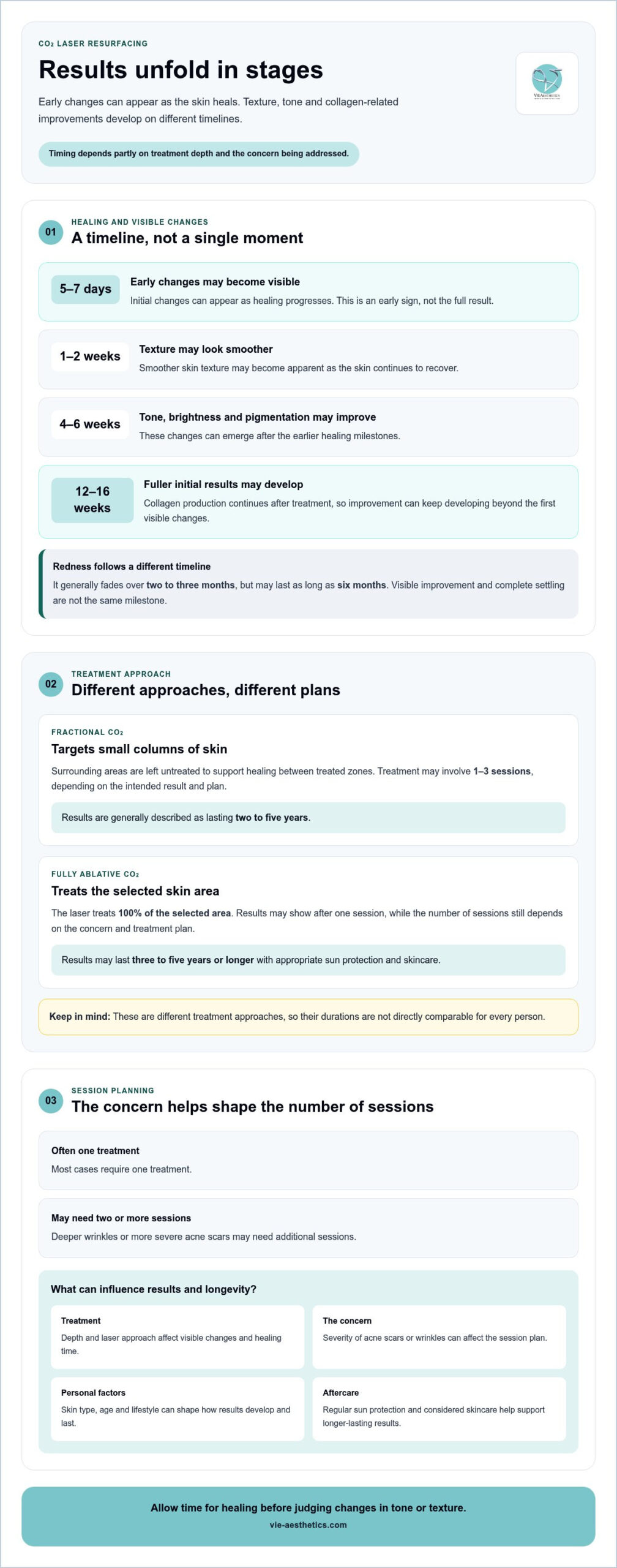
Some changes may become visible as the skin heals, but results continue to develop over time. The timeline, number of sessions and longevity depend partly on treatment depth and the concern being addressed.
Initial changes may be visible within 5 to 7 days, as healing progresses. Smoother skin texture may become apparent after 1-2 weeks, whilst improvements in tone, brightness and pigmentation may emerge after 4-6 weeks.
These early changes aren’t the whole picture. Collagen production continues after treatment, so fuller initial results may develop over 12-16 weeks. Redness can take longer to settle: it generally fades over two to three months, though it may last as long as six months. This means visible improvement and complete settling aren’t the same milestone.
CO2 laser treatment can improve the appearance of fine lines, wrinkles, acne scars, pigmentation and uneven skin texture. Most cases require one treatment, while deeper wrinkles or more severe acne scars may need two or more sessions. Fractional CO2 treatment may involve 1-3 sessions, depending on the intended result and treatment plan.
Results may last for several years, with longevity influenced by skin type, age and lifestyle. Fractional CO2 results are generally described as lasting two to five years; full ablative results may last three to five years or longer with appropriate sun protection and skincare. These are different treatment approaches, so duration isn’t directly comparable for every person.
For a useful consultation, discuss the concern you want to address, the session plan and how your clinic will review progress. You can book a skin consultation to discuss treatment goals and suitability.
Treatment depth and laser approach influence both visible changes and healing time. Fully ablative treatment may show results after one session, while fractional treatment may require more than one. The severity of acne scars or wrinkles also affects the plan, as deeper concerns can require additional sessions.
Skin type, age and lifestyle can shape how results develop and last. Regular sun protection and considered skincare maintenance help support longer-lasting results. Recovery matters, too: allow the skin time to heal before judging changes in tone or texture. The clinic’s review of your progress should account for treatment intensity and the concern addressed, rather than relying on an early snapshot alone.
This ablative skin treatment removes damaged outer layers in a controlled way. The laser directs energy into targeted areas, creating small, precise treatment zones. As the skin heals, its repair response stimulates collagen production, which can support improvements in texture and the appearance of scarring.
In fully ablative resurfacing, the laser treats 100% of the selected skin area. It removes the epidermis and upper dermis, the outer and upper layers of skin. Fractional treatment takes a different approach: it targets small columns of skin and leaves surrounding areas untreated. Those untreated areas support healing between treated zones.
Fractional CO₂ resurfacing creates controlled micro-injuries in a pattern, rather than treating the entire surface. This changes how much skin is treated at once. Fully ablative treatment may produce visible results after one session, while fractional CO₂ may require 1-3 sessions. The chosen approach depends on the concern, treatment depth and skin assessment.
The phrase CO2 laser resurfacing describes skin treatment using carbon dioxide laser energy. Fractional describes the pattern of treatment, not a different laser wavelength. The skin’s healing response may also affect pigmentation, including post-inflammatory hyperpigmentation, meaning darker patches that can develop after inflammation. Darker skin tones need careful assessment because pigment changes are a relevant consideration.
Compared with microneedling or chemical peels, CO₂ treatment uses laser energy to resurface selected skin, rather than needles or an applied peel. Er:YAG is another laser resurfacing option. Fractional non-ablative or fractional Er:YAG treatment typically involves 2 to 4 sessions over weeks or months. The treatment method and intended depth differ, so these options aren’t interchangeable.
In the UK, the cost of CO2 laser resurfacing depends on the treatment area, depth, technique and number of sessions. The price is given after a quote request. These factors shape the treatment plan, rather than one standard price applying to every case.
For an assessment, discuss the concern you want addressed, such as acne scarring or uneven texture. Ask how the treatment pattern relates to your skin and recovery needs. A skin treatment consultation can help you understand the proposed approach and its suitability.
CO₂ fractional laser resurfacing uses a wavelength of 10,600nm. Its action is ablative: small, controlled micro burns remove the epidermis and upper dermis, while the resulting controlled micro-injuries stimulate collagen production. CO2 laser resurfacing is a non-surgical cosmetic procedure, and its purpose is to remove damaged outer skin layers and promote the growth of healthier skin. These descriptions refer to the same treatment process: controlled removal of outer skin alongside the skin’s repair response.
Skin tone is an important part of assessing CO₂ laser suitability because treatment can change pigmentation. The Fitzpatrick classification, treatment approach and healing response all inform the risk discussion.
CO₂ laser is most commonly recommended for Fitzpatrick skin types I-III, where the risk of post-inflammatory hyperpigmentation is lower. Post-inflammatory hyperpigmentation means darker patches that can appear after skin inflammation. This classification helps frame the consultation, but it is not the only consideration: laser type, treatment depth and area also shape the plan.
CO₂ laser can be used on darker skin tones, but careful assessment and an appropriately modified protocol are important. Patients with Fitzpatrick skin types IV-VI need particular consideration of pigment-change risk. The discussion should cover the concern being treated, the selected laser approach and the expected healing process, rather than relying on skin tone alone to determine suitability.
Post-inflammatory hyperpigmentation is a possible pigment change after ablative treatment. CO₂ laser is commonly recommended for types I-III partly because the risk is lower in those groups; types IV-VI require careful assessment and a modified protocol. Ask how your skin type informs treatment depth and settings, and how healing will be monitored. This makes pigmentation risk part of the treatment plan.
An ablative laser removes the outer skin layer and heats the underlying skin. This controlled injury stimulates collagen growth as the skin heals. Collagen remodelling, the process through which collagen changes over time, can continue for up to 18 months after a CO₂ session. Treatment intensity therefore matters: the skin’s healing response and pigment behaviour need consideration alongside the intended resurfacing.
During consultation, discuss any history of pigmentation changes and your Fitzpatrick skin type, especially if you’re considering non-fractional treatment. Whether non-fractional CO₂ resurfacing is appropriate depends on individual skin characteristics and should be discussed during consultation. For types IV-VI, expert assessment and an appropriately modified approach are important; the treatment pattern can affect how the skin responds.
Careful planning takes into account both the desired skin change and your individual pigment response. A consultation can clarify how skin type, laser approach and healing needs fit together before treatment.
CO2 laser can be used on darker skin tones but requires expert assessment and caution to reduce the risk of pigment changes. Ablative laser resurfacing destroys the outer layer of skin and heats the underlying skin, stimulating collagen growth.
Endolift Laser Treatment is an option to discuss with Vie Aesthetics if you’re considering a non-surgical approach alongside CO₂ resurfacing. These are distinct treatments, so the right discussion depends on your priorities: addressing resurfacing concerns such as uneven texture and sun damage, or exploring another laser treatment.
A consultation can clarify which concern you want to address and whether Endolift suits that goal. It also gives you space to discuss your skin, expectations and the approach that best fits your needs, without assuming that one procedure replaces another.
For a considered next step, contact Vie Aesthetics to discuss Endolift Laser Treatment and your skin goals.
Your next step is to decide which change matters most to you, then discuss that goal in a consultation. If you’re considering CO2 laser resurfacing, focus the conversation on your priorities, skin concerns and what you hope treatment will address. A clear goal helps make the discussion more useful and personal.
Vie Aesthetics offers Endolift Laser Treatment, Aqualyx Fat Dissolving Injections and Soft Surgery (Plexr). These are distinct options, not substitutes for laser resurfacing; the relevant choice depends on the concern you want to address. You can discuss whether one aligns with your aims, or talk through your options without rushing into a decision.
A thoughtful consultation gives you the opportunity to ask questions, share what matters to you and understand the next steps. You deserve to feel informed and comfortable with the direction you choose.
Take your time and move forward with a plan that feels right for you.
Yes, CO₂ laser can be used on darker skin tones, but pigmentation risk needs careful consideration. Fitzpatrick skin types IV-VI call for expert assessment and an appropriately modified treatment approach. During consultation, the practitioner should consider your skin tone, treatment depth and history of pigment changes. This helps determine whether the proposed approach balances the concern being treated with your skin’s likely healing response.
Recovery commonly involves several days of redness, swelling or itching, followed by peeling or crusting as the skin heals. Deeper treatments may involve 7-10 days of downtime. Follow the aftercare instructions closely: treated skin may need gentle cleansing two to five times daily, as directed. Sun protection is advised for at least four months after treatment, helping protect healing skin from further sun exposure.
Fractional CO₂ laser can improve the appearance of acne scars, although this does not mean every scar will disappear completely. The treatment creates small, targeted zones while leaving surrounding skin untreated. Scar depth, pattern and the treatment plan influence the result. A practitioner can assess whether the scars are suitable for resurfacing and explain how progress will be reviewed, rather than presenting scar removal as a guaranteed outcome.
Discomfort can occur, and anaesthesia is used to help manage it. Depending on treatment depth, this may involve topical anaesthetic cream, local anaesthetic or general anaesthetic. The appropriate option is part of treatment planning, rather than a single approach for every patient. Before the procedure, discuss any concerns about discomfort and clarify which anaesthetic method is planned for your treatment area.
CO₂ laser can improve concerns such as sun damage, uneven texture, fine lines and acne scars by resurfacing skin and stimulating collagen production. Visible changes may begin as the skin heals, while collagen remodelling continues afterwards. The treatment’s value depends on whether its purpose matches your concern and whether you can accommodate recovery. Progress is best considered against the specific skin changes discussed before treatment.
A fully ablative CO₂ laser treats 100% of the selected skin surface, whereas fractional treatment targets small columns and leaves surrounding skin untreated. The two approaches therefore differ in how much skin is treated at once. Treatment depth and pattern influence healing and the number of sessions planned. A consultation should explain why one approach suits the concern and skin characteristics being assessed.

The most intensive laser setting isn’t automatically the best choice for every skin concern or skin tone. CO2 laser resurfacing removes damaged outer skin layers and stimulates collagen as the skin heals. CO2 laser resurfacing may improve concerns such as uneven texture, sun damage and some scars, with early changes appearing during healing and fuller results developing over time.
It’s understandable to want a clear idea of what CO₂ laser resurfacing involves, how long recovery takes and whether your skin tone affects pigmentation risk. The treatment approach and your skin’s response both matter when weighing potential benefits against downtime and the possibility of pigment changes.
This guide explains how CO₂ laser resurfacing works, which concerns it may address and how results can develop. It also covers skin tone and pigmentation risk, helping you prepare for an informed discussion about suitability and your treatment goals.
CO₂ laser resurfacing may improve acne or surgical scars, sun damage, uneven skin tone and texture irregularities. It can also address concerns such as age spots, lines and wrinkles, pigmentation, and certain skin tags, moles or lesions. Common treatment areas include the face, neck, chest and backs of the hands. The intended outcome is specific to the concern and area being treated, rather than a change to every feature of the skin.
A clinical assessment links your concern with a suitable treatment plan. The practitioner considers skin tone, the area and depth involved, previous procedures and relevant medical history. For example, a small area of sun damage may need a different approach from broader texture changes. Localised psoriasis is described as more suitable for treatment than widespread psoriasis.
When choosing a practitioner or clinic in the UK, look for relevant medical training and experience with ablative laser procedures. Ask how the assessment accounts for your skin tone, pigmentation risk, treatment depth and recovery plan. A useful discussion should explain why the proposed approach suits your concern, such as acne scarring, and what aftercare involves.
During treatment, the practitioner directs the laser over the agreed area. Anaesthesia may be topical, local or general, depending on treatment depth. A partial-face procedure takes 30 to 45 minutes; a full-face procedure takes one-and-a-half to two hours. Preparation includes avoiding sun exposure for four weeks before treatment and sharing relevant medical history and medicines during assessment.
Myth: One laser setting suits every concern and skin tone. Reality: The treatment area, concern, skin tone and depth all inform the plan. A scar and uneven pigmentation, for example, are different targets, so the assessment should clarify what the treatment is intended to address.
WILL: Resurface selected skin and may improve concerns such as sun damage, scars and uneven texture. WON’T: Address every skin concern or deliver identical results for everyone. This is a targeted procedure, and the treatment plan defines the area and concern being addressed.
Combining laser resurfacing with another cosmetic treatment requires a sequence that accounts for treatment areas, depth and healing needs. Different procedures may address different concerns, but that does not mean they should be performed together. Ask how each step fits the overall plan and recovery.
After healing, use facial sunscreen with at least SPF 30. This practical step supports sun protection following the procedure.
Some changes may become visible as the skin heals, but results continue to develop over time. The timeline, number of sessions and longevity depend partly on treatment depth and the concern being addressed.
Initial changes may be visible within 5 to 7 days, as healing progresses. Smoother skin texture may become apparent after 1-2 weeks, whilst improvements in tone, brightness and pigmentation may emerge after 4-6 weeks.
These early changes aren’t the whole picture. Collagen production continues after treatment, so fuller initial results may develop over 12-16 weeks. Redness can take longer to settle: it generally fades over two to three months, though it may last as long as six months. This means visible improvement and complete settling aren’t the same milestone.
CO2 laser treatment can improve the appearance of fine lines, wrinkles, acne scars, pigmentation and uneven skin texture. Most cases require one treatment, while deeper wrinkles or more severe acne scars may need two or more sessions. Fractional CO2 treatment may involve 1-3 sessions, depending on the intended result and treatment plan.
Results may last for several years, with longevity influenced by skin type, age and lifestyle. Fractional CO2 results are generally described as lasting two to five years; full ablative results may last three to five years or longer with appropriate sun protection and skincare. These are different treatment approaches, so duration isn’t directly comparable for every person.
For a useful consultation, discuss the concern you want to address, the session plan and how your clinic will review progress. You can book a skin consultation to discuss treatment goals and suitability.
Treatment depth and laser approach influence both visible changes and healing time. Fully ablative treatment may show results after one session, while fractional treatment may require more than one. The severity of acne scars or wrinkles also affects the plan, as deeper concerns can require additional sessions.
Skin type, age and lifestyle can shape how results develop and last. Regular sun protection and considered skincare maintenance help support longer-lasting results. Recovery matters, too: allow the skin time to heal before judging changes in tone or texture. The clinic’s review of your progress should account for treatment intensity and the concern addressed, rather than relying on an early snapshot alone.
This ablative skin treatment removes damaged outer layers in a controlled way. The laser directs energy into targeted areas, creating small, precise treatment zones. As the skin heals, its repair response stimulates collagen production, which can support improvements in texture and the appearance of scarring.
In fully ablative resurfacing, the laser treats 100% of the selected skin area. It removes the epidermis and upper dermis, the outer and upper layers of skin. Fractional treatment takes a different approach: it targets small columns of skin and leaves surrounding areas untreated. Those untreated areas support healing between treated zones.
Fractional CO₂ resurfacing creates controlled micro-injuries in a pattern, rather than treating the entire surface. This changes how much skin is treated at once. Fully ablative treatment may produce visible results after one session, while fractional CO₂ may require 1-3 sessions. The chosen approach depends on the concern, treatment depth and skin assessment.
The phrase CO2 laser resurfacing describes skin treatment using carbon dioxide laser energy. Fractional describes the pattern of treatment, not a different laser wavelength. The skin’s healing response may also affect pigmentation, including post-inflammatory hyperpigmentation, meaning darker patches that can develop after inflammation. Darker skin tones need careful assessment because pigment changes are a relevant consideration.
Compared with microneedling or chemical peels, CO₂ treatment uses laser energy to resurface selected skin, rather than needles or an applied peel. Er:YAG is another laser resurfacing option. Fractional non-ablative or fractional Er:YAG treatment typically involves 2 to 4 sessions over weeks or months. The treatment method and intended depth differ, so these options aren’t interchangeable.
In the UK, the cost of CO2 laser resurfacing depends on the treatment area, depth, technique and number of sessions. The price is given after a quote request. These factors shape the treatment plan, rather than one standard price applying to every case.
For an assessment, discuss the concern you want addressed, such as acne scarring or uneven texture. Ask how the treatment pattern relates to your skin and recovery needs. A skin treatment consultation can help you understand the proposed approach and its suitability.
CO₂ fractional laser resurfacing uses a wavelength of 10,600nm. Its action is ablative: small, controlled micro burns remove the epidermis and upper dermis, while the resulting controlled micro-injuries stimulate collagen production. CO2 laser resurfacing is a non-surgical cosmetic procedure, and its purpose is to remove damaged outer skin layers and promote the growth of healthier skin. These descriptions refer to the same treatment process: controlled removal of outer skin alongside the skin’s repair response.
Skin tone is an important part of assessing CO₂ laser suitability because treatment can change pigmentation. The Fitzpatrick classification, treatment approach and healing response all inform the risk discussion.
CO₂ laser is most commonly recommended for Fitzpatrick skin types I-III, where the risk of post-inflammatory hyperpigmentation is lower. Post-inflammatory hyperpigmentation means darker patches that can appear after skin inflammation. This classification helps frame the consultation, but it is not the only consideration: laser type, treatment depth and area also shape the plan.
CO₂ laser can be used on darker skin tones, but careful assessment and an appropriately modified protocol are important. Patients with Fitzpatrick skin types IV-VI need particular consideration of pigment-change risk. The discussion should cover the concern being treated, the selected laser approach and the expected healing process, rather than relying on skin tone alone to determine suitability.
Post-inflammatory hyperpigmentation is a possible pigment change after ablative treatment. CO₂ laser is commonly recommended for types I-III partly because the risk is lower in those groups; types IV-VI require careful assessment and a modified protocol. Ask how your skin type informs treatment depth and settings, and how healing will be monitored. This makes pigmentation risk part of the treatment plan.
An ablative laser removes the outer skin layer and heats the underlying skin. This controlled injury stimulates collagen growth as the skin heals. Collagen remodelling, the process through which collagen changes over time, can continue for up to 18 months after a CO₂ session. Treatment intensity therefore matters: the skin’s healing response and pigment behaviour need consideration alongside the intended resurfacing.
During consultation, discuss any history of pigmentation changes and your Fitzpatrick skin type, especially if you’re considering non-fractional treatment. Whether non-fractional CO₂ resurfacing is appropriate depends on individual skin characteristics and should be discussed during consultation. For types IV-VI, expert assessment and an appropriately modified approach are important; the treatment pattern can affect how the skin responds.
Careful planning takes into account both the desired skin change and your individual pigment response. A consultation can clarify how skin type, laser approach and healing needs fit together before treatment.
CO2 laser can be used on darker skin tones but requires expert assessment and caution to reduce the risk of pigment changes. Ablative laser resurfacing destroys the outer layer of skin and heats the underlying skin, stimulating collagen growth.
Endolift Laser Treatment is an option to discuss with Vie Aesthetics if you’re considering a non-surgical approach alongside CO₂ resurfacing. These are distinct treatments, so the right discussion depends on your priorities: addressing resurfacing concerns such as uneven texture and sun damage, or exploring another laser treatment.
A consultation can clarify which concern you want to address and whether Endolift suits that goal. It also gives you space to discuss your skin, expectations and the approach that best fits your needs, without assuming that one procedure replaces another.
For a considered next step, contact Vie Aesthetics to discuss Endolift Laser Treatment and your skin goals.
Your next step is to decide which change matters most to you, then discuss that goal in a consultation. If you’re considering CO2 laser resurfacing, focus the conversation on your priorities, skin concerns and what you hope treatment will address. A clear goal helps make the discussion more useful and personal.
Vie Aesthetics offers Endolift Laser Treatment, Aqualyx Fat Dissolving Injections and Soft Surgery (Plexr). These are distinct options, not substitutes for laser resurfacing; the relevant choice depends on the concern you want to address. You can discuss whether one aligns with your aims, or talk through your options without rushing into a decision.
A thoughtful consultation gives you the opportunity to ask questions, share what matters to you and understand the next steps. You deserve to feel informed and comfortable with the direction you choose.
Take your time and move forward with a plan that feels right for you.
Yes, CO₂ laser can be used on darker skin tones, but pigmentation risk needs careful consideration. Fitzpatrick skin types IV-VI call for expert assessment and an appropriately modified treatment approach. During consultation, the practitioner should consider your skin tone, treatment depth and history of pigment changes. This helps determine whether the proposed approach balances the concern being treated with your skin’s likely healing response.
Recovery commonly involves several days of redness, swelling or itching, followed by peeling or crusting as the skin heals. Deeper treatments may involve 7-10 days of downtime. Follow the aftercare instructions closely: treated skin may need gentle cleansing two to five times daily, as directed. Sun protection is advised for at least four months after treatment, helping protect healing skin from further sun exposure.
Fractional CO₂ laser can improve the appearance of acne scars, although this does not mean every scar will disappear completely. The treatment creates small, targeted zones while leaving surrounding skin untreated. Scar depth, pattern and the treatment plan influence the result. A practitioner can assess whether the scars are suitable for resurfacing and explain how progress will be reviewed, rather than presenting scar removal as a guaranteed outcome.
Discomfort can occur, and anaesthesia is used to help manage it. Depending on treatment depth, this may involve topical anaesthetic cream, local anaesthetic or general anaesthetic. The appropriate option is part of treatment planning, rather than a single approach for every patient. Before the procedure, discuss any concerns about discomfort and clarify which anaesthetic method is planned for your treatment area.
CO₂ laser can improve concerns such as sun damage, uneven texture, fine lines and acne scars by resurfacing skin and stimulating collagen production. Visible changes may begin as the skin heals, while collagen remodelling continues afterwards. The treatment’s value depends on whether its purpose matches your concern and whether you can accommodate recovery. Progress is best considered against the specific skin changes discussed before treatment.
A fully ablative CO₂ laser treats 100% of the selected skin surface, whereas fractional treatment targets small columns and leaves surrounding skin untreated. The two approaches therefore differ in how much skin is treated at once. Treatment depth and pattern influence healing and the number of sessions planned. A consultation should explain why one approach suits the concern and skin characteristics being assessed.