By the Vie Aesthetics team
What to expect after Morpheus8 can include redness, swelling, warmth, tenderness or small pinpoint marks. Your response and recovery can vary, so what to expect after Morpheus8 is best understood in the context of your own treatment plan and your clinician’s guidance.
It’s natural to wonder whether recovery will affect work or everyday plans, and how to tell expected changes from signs that need clinical advice. Your personalised aftercare instructions are the most useful guide for making those decisions.
This article explains possible changes after treatment, how to approach aftercare and when to ask for advice. If you’re concerned about a change, contact your treating clinician.
What to expect after Morpheus8 depends on the area treated, your individual response and the plan agreed with your clinician. Redness, swelling, warmth, tenderness or small pinpoint marks may occur. Their appearance and how your skin feels can vary, so these possible reactions are not a fixed checklist or timetable.
Follow the instructions your treating clinician gives you for your treatment. They relate to your individual plan, so they take precedence over general online guidance. If you’re unsure whether a change is expected, or what to do next, contact your clinician for advice based on your treatment.
You may notice temporary changes in how the treated skin looks or feels, including redness, swelling, warmth, tenderness or pinpoint marks. These are possible reactions, not changes everyone will experience. The area treated and your own skin response can influence what you notice.
There isn’t one appearance or level of discomfort that applies to everyone. Avoid comparing your skin with someone else’s recovery or treating a particular reaction as proof that the treatment has or hasn’t worked. Instead, note what you’ve noticed and ask your clinician if you’re unsure how it relates to your treatment plan.
Morpheus8 is an aesthetic treatment that may be included in an individual plan for your skin goals. Your clinician can explain the intended aim and what may be realistic for you. Results vary between individuals, and treatment cannot promise a particular outcome.
Changes soon after a session are different from the treatment’s longer-term aims. An early reaction is not, by itself, proof of the final result. Keep your expectations grounded in the discussion with your clinician, rather than interpreting an immediate change as a prediction.
General recovery information can help you prepare, but it is not a substitute for personalised advice from your treating clinician.
For a small point of general background, Morpheus (mythology) is a figure associated with dreams in Greek mythology. This reference explains the name only, not the treatment.
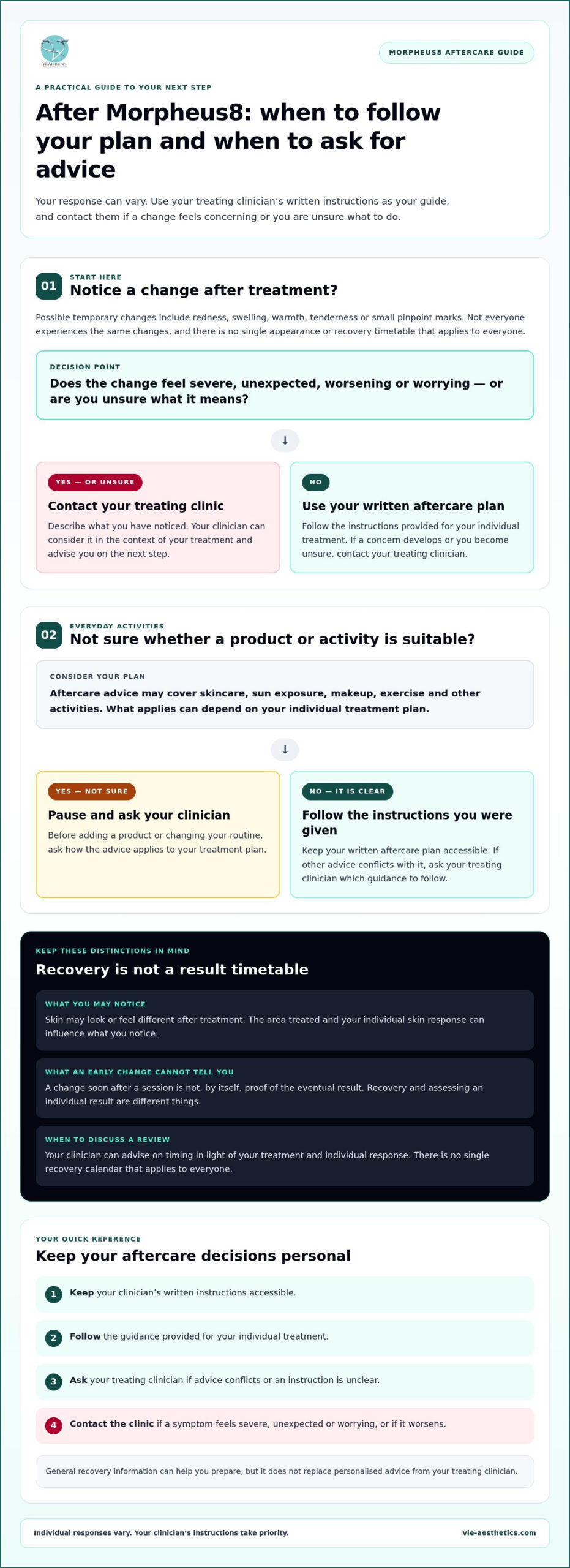
It’s more useful to think of recovery after Morpheus8 as a series of possible changes than as a day-by-day timetable. Treatment settings, the area treated and your individual skin response can all influence what you notice. There is no single recovery calendar that applies to everyone.
Immediately after treatment, you may notice temporary changes in how the skin looks or feels. These can change as recovery continues, but there is no one sequence or timeframe that can be promised for everyone. Your clinician can explain what to look out for in light of your treatment plan.
It also helps to separate visible recovery from assessing results. A change soon after a session does not necessarily show the treatment’s eventual effect. Any review should take account of your individual response and the timing advised by your clinician, rather than a general online schedule.
If you’re planning around work, social plans or exercise, raise those activities with your clinician and ask how your aftercare instructions apply. A general timeline cannot tell you exactly when you will feel ready to return to a particular activity.
Myth: once the initial visible changes begin to settle, the final result is clear. Reality: recovery and assessment of an individual result are different things. Early skin changes are part of the immediate response and should not be treated as proof of the eventual outcome.
For context, ClinicalTrials.gov Study on Morpheus8 Safety and Efficacy is an entry concerning a study of the Morpheus8 applicator. A study listing cannot predict how one person will recover or respond. Your clinician can discuss what is relevant to your treatment and when a review may be appropriate.
It’s understandable to want a clear answer about what to expect after Morpheus8, especially when you’re planning ahead. A personalised discussion can help you understand the intended aims, possible recovery changes and how your individual response will be considered.
Your treating clinician’s written aftercare instructions should guide what you do after Morpheus8. Advice about skincare, sun exposure, makeup, exercise and other activities can depend on your individual treatment plan. Use your own instructions rather than applying general recommendations to your situation.
If you’re unsure whether a product or activity is suitable, pause and ask your treating clinician for guidance. This is particularly helpful if your skin’s response differs from what you expected. Knowing what to expect after Morpheus8 also means knowing where to turn with questions: the clinician who understands your treatment.
Keep your written aftercare plan as your reference. Don’t add products or restrictions based only on advice intended for someone else. If an instruction is unclear, ask your clinic to explain how it applies to your routine before making changes.
Aftercare checklist
People can respond differently, and a general guide cannot determine whether a particular symptom is expected for you. If something feels unusual, worsens or causes concern, contact your treating clinic and describe what you’ve noticed. Your clinician can consider it in the context of your treatment and advise you on the next step.
If a symptom concerns you after Morpheus8, contact your treating clinician for advice rather than trying to diagnose it yourself.
When you get in touch, explain what you have noticed and whether it has changed. Your clinician can use those details to give advice that relates to your experience, rather than relying on a general description.
A personalised Morpheus8 consultation is a chance to discuss treatment aims, aftercare and any questions you have before making a decision.
After Morpheus8, use your clinician’s personalised aftercare instructions as your guide, allow for individual variation and raise concerns directly with the treating clinic. General advice can help you prepare, but it cannot tell you exactly how your skin should respond or whether further treatment is appropriate.
A follow-up is an opportunity to discuss your experience and goals, not a reason to assume another session is needed. Your clinician can review your response and treatment plan with you before any decisions are made.
A few clear questions can make your discussion more useful. Ask which changes are expected for your specific treatment plan, when a review would be appropriate and what to do if a symptom changes or concerns you.
Describe what you’ve noticed in your own words. For example, explain where a change appeared, when you noticed it and whether it has altered. This gives your clinician context without relying on an online timeline to label or diagnose it. If you’re exploring non-surgical aesthetic treatment options, an individual discussion can help connect those choices with your goals.
Treatment suitability depends on your aims, clinical assessment and individual circumstances. If you’re considering a broader approach to facial rejuvenation, discuss the options and how they differ with your clinician. One treatment or combination is not necessarily right for everyone.
Vie Aesthetics offers Morpheus8 as part of its non-surgical cosmetic treatments. Learn more about the people behind your care on the Vie Aesthetics team page.
Before a follow-up or further treatment, talk through what you’ve experienced, what you hope to achieve and any questions about your plan. A clinical discussion tailored to your circumstances can help you make an informed decision at a pace that feels right for you.
Understanding what to expect after Morpheus8 can help you approach your next decision with confidence. Your treatment plan and clinical guidance should shape that decision. If you’re considering treatment or have questions about recovery, a skin assessment gives you the opportunity to discuss your goals and circumstances before deciding what feels right.
Vie Aesthetics offers Morpheus8. The clinic is directed by Vicky Grammatikopoulou, with Dr Ioannis Liakas as Medical Director. A personalised conversation can help you explore whether the treatment may suit your aims and what support could be appropriate for you. Your experience and desired outcome are individual, so there’s no need to base your decision on someone else’s recovery.
Before your assessment, consider what you’d like to discuss. You might bring questions about suitability, aftercare or follow-up, and describe any changes that have concerned you. Decisions about further treatment should be part of a clinical discussion tailored to your circumstances.
Take the time you need to ask questions and make an informed choice. Clear, individual guidance can help you feel more comfortable with whichever next step you choose.
There isn’t one appearance that applies to everyone after Morpheus8. Redness, swelling, warmth, tenderness or small pinpoint marks may occur, but your response depends on your individual treatment and skin. Follow the written aftercare instructions provided for you. If you’re unsure whether a change is expected, describe it to your treating clinician and ask for advice.
There’s no single recovery duration that applies to every patient. Your treatment plan, the area treated and your individual skin response all matter, so a general online timeframe cannot reliably predict your experience. Ask your clinician which changes they expect in your case and when they recommend reviewing your progress. This gives you a personal reference point rather than a fixed schedule that may not match your treatment.
Follow your treating clinician’s instructions to determine when makeup is appropriate for you. There isn’t a universal restart time for every treatment plan. If your written instructions don’t clearly address foundation, concealer or other products, ask your clinician before applying them to the treated area. Your own guidance is more relevant than a timeline based on someone else’s experience.
Your clinician’s aftercare plan should guide when you return to exercise, rather than a blanket date. Activity advice may depend on your individual treatment, so don’t use another patient’s routine to decide whether to resume a class, run or gym session. If your written guidance doesn’t explain a particular activity, ask your treating clinician what applies to you.
Redness or swelling may occur, but your treating clinician is best placed to advise whether your symptoms fit your treatment and recovery. Contact the clinic if symptoms feel severe, unexpected or worrying, or if you’re uncertain about a change. Explain when it began, where it appears and whether it has changed so your clinician can respond to your experience.
The timing and nature of results vary between individuals, and immediate skin changes are not a reliable way to judge the eventual outcome. Recovery and assessment of results are separate parts of the treatment journey. Your clinician can discuss when to review your progress in light of your treatment plan and response. There isn’t a specific timeframe that applies to everyone, so treat online timelines as general information, not a personal prediction.
By the Vie Aesthetics team
What to expect after Morpheus8 can include redness, swelling, warmth, tenderness or small pinpoint marks. Your response and recovery can vary, so what to expect after Morpheus8 is best understood in the context of your own treatment plan and your clinician’s guidance.
It’s natural to wonder whether recovery will affect work or everyday plans, and how to tell expected changes from signs that need clinical advice. Your personalised aftercare instructions are the most useful guide for making those decisions.
This article explains possible changes after treatment, how to approach aftercare and when to ask for advice. If you’re concerned about a change, contact your treating clinician.
What to expect after Morpheus8 depends on the area treated, your individual response and the plan agreed with your clinician. Redness, swelling, warmth, tenderness or small pinpoint marks may occur. Their appearance and how your skin feels can vary, so these possible reactions are not a fixed checklist or timetable.
Follow the instructions your treating clinician gives you for your treatment. They relate to your individual plan, so they take precedence over general online guidance. If you’re unsure whether a change is expected, or what to do next, contact your clinician for advice based on your treatment.
You may notice temporary changes in how the treated skin looks or feels, including redness, swelling, warmth, tenderness or pinpoint marks. These are possible reactions, not changes everyone will experience. The area treated and your own skin response can influence what you notice.
There isn’t one appearance or level of discomfort that applies to everyone. Avoid comparing your skin with someone else’s recovery or treating a particular reaction as proof that the treatment has or hasn’t worked. Instead, note what you’ve noticed and ask your clinician if you’re unsure how it relates to your treatment plan.
Morpheus8 is an aesthetic treatment that may be included in an individual plan for your skin goals. Your clinician can explain the intended aim and what may be realistic for you. Results vary between individuals, and treatment cannot promise a particular outcome.
Changes soon after a session are different from the treatment’s longer-term aims. An early reaction is not, by itself, proof of the final result. Keep your expectations grounded in the discussion with your clinician, rather than interpreting an immediate change as a prediction.
General recovery information can help you prepare, but it is not a substitute for personalised advice from your treating clinician.
For a small point of general background, Morpheus (mythology) is a figure associated with dreams in Greek mythology. This reference explains the name only, not the treatment.
It’s more useful to think of recovery after Morpheus8 as a series of possible changes than as a day-by-day timetable. Treatment settings, the area treated and your individual skin response can all influence what you notice. There is no single recovery calendar that applies to everyone.
Immediately after treatment, you may notice temporary changes in how the skin looks or feels. These can change as recovery continues, but there is no one sequence or timeframe that can be promised for everyone. Your clinician can explain what to look out for in light of your treatment plan.
It also helps to separate visible recovery from assessing results. A change soon after a session does not necessarily show the treatment’s eventual effect. Any review should take account of your individual response and the timing advised by your clinician, rather than a general online schedule.
If you’re planning around work, social plans or exercise, raise those activities with your clinician and ask how your aftercare instructions apply. A general timeline cannot tell you exactly when you will feel ready to return to a particular activity.
Myth: once the initial visible changes begin to settle, the final result is clear. Reality: recovery and assessment of an individual result are different things. Early skin changes are part of the immediate response and should not be treated as proof of the eventual outcome.
For context, ClinicalTrials.gov Study on Morpheus8 Safety and Efficacy is an entry concerning a study of the Morpheus8 applicator. A study listing cannot predict how one person will recover or respond. Your clinician can discuss what is relevant to your treatment and when a review may be appropriate.
It’s understandable to want a clear answer about what to expect after Morpheus8, especially when you’re planning ahead. A personalised discussion can help you understand the intended aims, possible recovery changes and how your individual response will be considered.
Your treating clinician’s written aftercare instructions should guide what you do after Morpheus8. Advice about skincare, sun exposure, makeup, exercise and other activities can depend on your individual treatment plan. Use your own instructions rather than applying general recommendations to your situation.
If you’re unsure whether a product or activity is suitable, pause and ask your treating clinician for guidance. This is particularly helpful if your skin’s response differs from what you expected. Knowing what to expect after Morpheus8 also means knowing where to turn with questions: the clinician who understands your treatment.
Keep your written aftercare plan as your reference. Don’t add products or restrictions based only on advice intended for someone else. If an instruction is unclear, ask your clinic to explain how it applies to your routine before making changes.
Aftercare checklist
People can respond differently, and a general guide cannot determine whether a particular symptom is expected for you. If something feels unusual, worsens or causes concern, contact your treating clinic and describe what you’ve noticed. Your clinician can consider it in the context of your treatment and advise you on the next step.
If a symptom concerns you after Morpheus8, contact your treating clinician for advice rather than trying to diagnose it yourself.
When you get in touch, explain what you have noticed and whether it has changed. Your clinician can use those details to give advice that relates to your experience, rather than relying on a general description.
A personalised Morpheus8 consultation is a chance to discuss treatment aims, aftercare and any questions you have before making a decision.
After Morpheus8, use your clinician’s personalised aftercare instructions as your guide, allow for individual variation and raise concerns directly with the treating clinic. General advice can help you prepare, but it cannot tell you exactly how your skin should respond or whether further treatment is appropriate.
A follow-up is an opportunity to discuss your experience and goals, not a reason to assume another session is needed. Your clinician can review your response and treatment plan with you before any decisions are made.
A few clear questions can make your discussion more useful. Ask which changes are expected for your specific treatment plan, when a review would be appropriate and what to do if a symptom changes or concerns you.
Describe what you’ve noticed in your own words. For example, explain where a change appeared, when you noticed it and whether it has altered. This gives your clinician context without relying on an online timeline to label or diagnose it. If you’re exploring non-surgical aesthetic treatment options, an individual discussion can help connect those choices with your goals.
Treatment suitability depends on your aims, clinical assessment and individual circumstances. If you’re considering a broader approach to facial rejuvenation, discuss the options and how they differ with your clinician. One treatment or combination is not necessarily right for everyone.
Vie Aesthetics offers Morpheus8 as part of its non-surgical cosmetic treatments. Learn more about the people behind your care on the Vie Aesthetics team page.
Before a follow-up or further treatment, talk through what you’ve experienced, what you hope to achieve and any questions about your plan. A clinical discussion tailored to your circumstances can help you make an informed decision at a pace that feels right for you.
Understanding what to expect after Morpheus8 can help you approach your next decision with confidence. Your treatment plan and clinical guidance should shape that decision. If you’re considering treatment or have questions about recovery, a skin assessment gives you the opportunity to discuss your goals and circumstances before deciding what feels right.
Vie Aesthetics offers Morpheus8. The clinic is directed by Vicky Grammatikopoulou, with Dr Ioannis Liakas as Medical Director. A personalised conversation can help you explore whether the treatment may suit your aims and what support could be appropriate for you. Your experience and desired outcome are individual, so there’s no need to base your decision on someone else’s recovery.
Before your assessment, consider what you’d like to discuss. You might bring questions about suitability, aftercare or follow-up, and describe any changes that have concerned you. Decisions about further treatment should be part of a clinical discussion tailored to your circumstances.
Take the time you need to ask questions and make an informed choice. Clear, individual guidance can help you feel more comfortable with whichever next step you choose.
There isn’t one appearance that applies to everyone after Morpheus8. Redness, swelling, warmth, tenderness or small pinpoint marks may occur, but your response depends on your individual treatment and skin. Follow the written aftercare instructions provided for you. If you’re unsure whether a change is expected, describe it to your treating clinician and ask for advice.
There’s no single recovery duration that applies to every patient. Your treatment plan, the area treated and your individual skin response all matter, so a general online timeframe cannot reliably predict your experience. Ask your clinician which changes they expect in your case and when they recommend reviewing your progress. This gives you a personal reference point rather than a fixed schedule that may not match your treatment.
Follow your treating clinician’s instructions to determine when makeup is appropriate for you. There isn’t a universal restart time for every treatment plan. If your written instructions don’t clearly address foundation, concealer or other products, ask your clinician before applying them to the treated area. Your own guidance is more relevant than a timeline based on someone else’s experience.
Your clinician’s aftercare plan should guide when you return to exercise, rather than a blanket date. Activity advice may depend on your individual treatment, so don’t use another patient’s routine to decide whether to resume a class, run or gym session. If your written guidance doesn’t explain a particular activity, ask your treating clinician what applies to you.
Redness or swelling may occur, but your treating clinician is best placed to advise whether your symptoms fit your treatment and recovery. Contact the clinic if symptoms feel severe, unexpected or worrying, or if you’re uncertain about a change. Explain when it began, where it appears and whether it has changed so your clinician can respond to your experience.
The timing and nature of results vary between individuals, and immediate skin changes are not a reliable way to judge the eventual outcome. Recovery and assessment of results are separate parts of the treatment journey. Your clinician can discuss when to review your progress in light of your treatment plan and response. There isn’t a specific timeframe that applies to everyone, so treat online timelines as general information, not a personal prediction.