The most advanced treatment isn’t automatically the best non surgical treatment for jowls. The right option depends on what’s shaping your jawline, whether that’s skin laxity, localised fullness or changes in facial volume. To identify the best non surgical treatment for jowls, a doctor-led assessment can help distinguish these factors and set realistic expectations.
It’s understandable to feel unsure when Endolift, Morpheus8 and HIFU are often discussed together, despite working in different ways. Each may suit different concerns, and no single approach is right for everyone.
This guide compares how the three treatments are intended to address jowling and what they may, and may not, achieve. You’ll also learn what a practitioner considers when assessing your face, aims and treatment suitability, so you can have a more informed, personalised consultation without feeling pushed towards one option.
There’s no single best non-surgical option for every person or every cause of jowling. Jowls are changes to the lower-face contour around the jawline, which may reflect skin laxity, localised fullness, changes in facial volume, or a combination of these factors.
These differences matter. A treatment intended to improve skin firmness may not address fullness beneath the jaw, while adding volume may not be appropriate if the main concern is skin laxity. This guide can explain general treatment aims, but it can’t diagnose what is contributing to your jawline changes or determine an individual plan.
Skin can become less firm, and the structures that support facial contours can change. The pattern varies between individuals, so a softer jawline isn’t necessarily caused by one factor alone. Fullness beneath the jaw is a separate consideration from changes in facial volume, which can affect how defined the lower face appears.
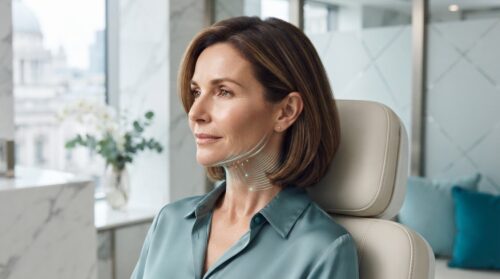
Possible contributors to a changing jawline
This is an illustration of possible contributors, not a diagnostic guide. More than one may be relevant.
Depending on assessment, a treatment plan may aim to refine contour, support skin firmness or improve skin quality. These aims are individual, and suitability depends on your facial features, concerns and expectations. For example, Endolift treatment is one option a practitioner may consider as part of a personalised plan.
Non-surgical treatments aren’t the same as a surgical facelift (rhytidectomy), which is an operation. They may offer a more subtle change in contour or skin quality, but shouldn’t be presented as a surgical lift or a substitute for one. Outcomes vary, and no universal result can be promised.
So, the best non surgical treatment for jowls is not decided by the treatment name alone. A doctor-led assessment can help identify which factors may be involved and discuss what a non-surgical approach could realistically achieve for you.
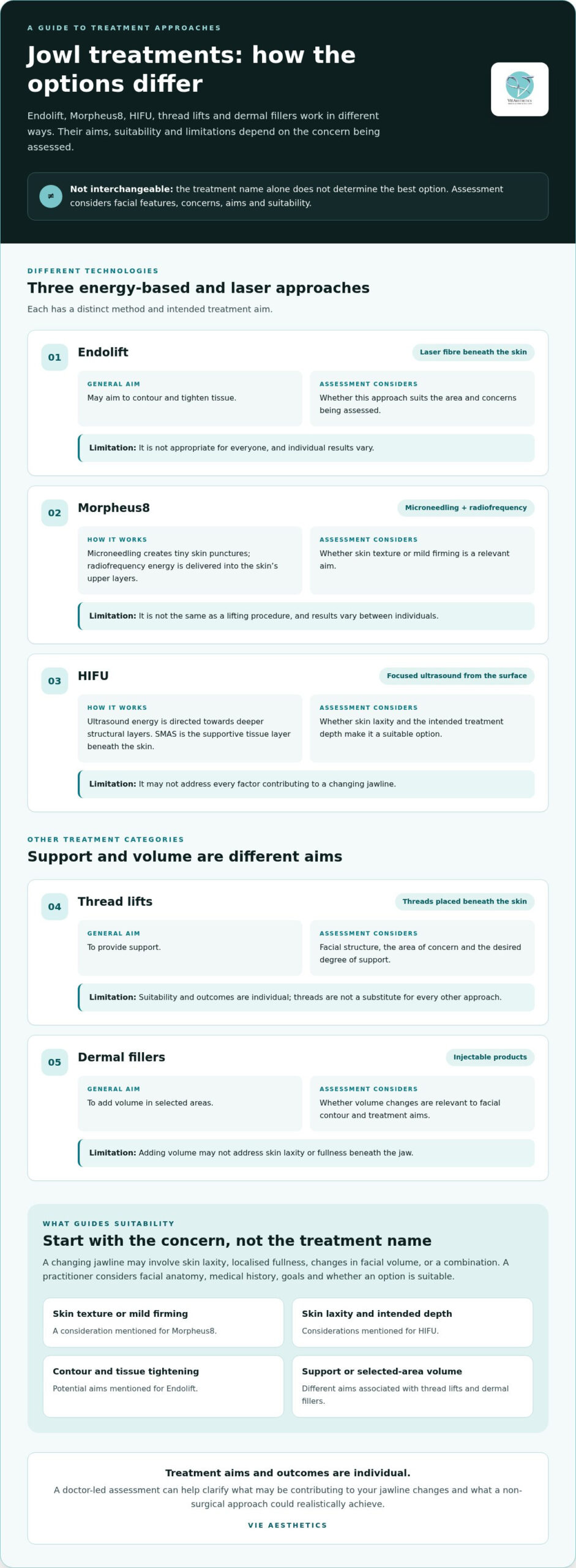
Endolift, Morpheus8 and HIFU use different technologies, while thread lifts and dermal fillers are separate treatment categories. They aren’t interchangeable: the best non surgical treatment for jowls depends on the concern being assessed, your facial structure and your aims.
| Approach | General aim | Assessment considerations | Limitations |
|---|---|---|---|
| Endolift | A minimally invasive laser approach using a fine fibre beneath the skin, with aims that may include contouring and tissue tightening. | Whether this approach is suitable for the area and concerns being assessed. | It isn’t appropriate for everyone, and individual results vary. |
| Morpheus8 | Combines microneedling, which creates tiny skin punctures, with radiofrequency energy delivered into the skin’s upper layers. | Whether skin texture or mild firming is a relevant aim. | It isn’t the same as a lifting procedure, and results vary between individuals. |
| HIFU | Focused ultrasound energy is delivered from the skin’s surface towards deeper structural layers. SMAS means the supportive tissue layer beneath the skin. | Whether skin laxity and the treatment’s intended depth make it a suitable option. | It may not address every contributor to a changing jawline. See the HIFU skin tightening treatment information for further context. |
| Thread lifts | A treatment category that uses threads placed beneath the skin to provide support. | Facial structure, the area of concern and the desired degree of support. | Suitability and outcomes are individual; threads aren’t a substitute for every other approach. |
| Dermal fillers | Injectable products used to add volume in selected areas. | Whether volume changes are relevant to the facial contour and treatment aims. | Adding volume may not address skin laxity or fullness beneath the jaw. |
Endolift uses a laser fibre beneath the skin; Morpheus8 combines microneedling and radiofrequency; HIFU delivers focused ultrasound from the surface. These distinct approaches have different treatment aims. A practitioner assesses whether the concern and intended area suit each option. A review of scientific evidence for HIFU provides further context on this technology.
Thread lifts and fillers work differently: one uses threads for support, while the other adds volume. Neither is an automatic alternative to energy-based treatments. Facial structure, desired changes and suitability all inform whether either is considered. An assessment can help you understand the options and decide on considered next steps.
A sensible treatment decision starts with an individual assessment, not a promise based on a treatment name. A practitioner considers your facial anatomy, medical history, goals and whether an option is suitable. This helps clarify what a treatment is intended to address, its relevant risks and aftercare, and what outcome may be realistic for you.
Myth: A non-surgical treatment can produce the same change as surgery, or every jowl concern needs the same treatment.
Reality: Non-surgical approaches and surgery are not equivalent. Treatments such as Endolift, Morpheus8 and HIFU use different methods and have different aims. The change that may be achievable depends on the person, the concern being assessed and the option selected. Some people may value a subtle change; others may have goals that a non-surgical approach cannot meet. That doesn’t mean surgery is necessary. It means expectations and options should be discussed openly.
A treatment may be considered to support a particular aim, such as improving skin firmness, refining contour or addressing volume. Its likely role depends on assessment. For instance, a treatment intended to improve skin quality won’t necessarily address localised fullness, and adding volume won’t directly tighten loose skin.
Non-surgical treatment won’t suit every person or deliver the same result for everyone. Individual responses vary, and no specific outcome can be promised. A practitioner should explain the relevant risks, aftercare and expected course for the option being considered before you decide whether to proceed.
Bring your questions and be clear about the change you hope to see. It can help to discuss:
The best non surgical treatment for jowls is an individual decision made with a qualified practitioner, not a universal ranking. At Vie Aesthetics, aesthetic procedures are performed only by doctors and qualified medical practitioners, with treatment planning tailored to the individual.
A consultation gives you time to explain what you’ve noticed and understand which options, if any, may suit you. At Vie Aesthetics, procedures are performed only by doctors and qualified medical practitioners, and treatment planning is personalised. Choosing no treatment is also a valid outcome.
The conversation starts with your aims: for example, whether you’re most concerned about skin looseness, fullness beneath the jaw or a change in facial contour. The practitioner will discuss relevant medical history and assess the areas you’d like considered. This helps inform suitability; a treatment shouldn’t be selected before that assessment.
You can then review relevant options, their intended aims and their limitations. The practitioner can explain how approaches such as Endolift, Morpheus8, HIFU, threads or fillers differ, and discuss any relevant risks, aftercare and expectations. For a broader overview, read the guide to non-surgical aesthetic treatments. You may also find it helpful to explore a non-surgical face-lift overview, then bring questions about how its approaches relate to your own aims.
There’s no need to decide during the consultation. Take time to consider what you’ve discussed, and ask for clarification if an expected result, limitation or aftercare point isn’t clear. A thoughtful plan should reflect your individual features and priorities, not simply follow a treatment trend.
Results vary between individuals, and no specific outcome can be promised. If you’re considering the best non surgical treatment for jowls, use your consultation to understand what a suitable option may realistically address, as well as what it may not change. You can also discuss whether waiting or choosing no treatment feels right for you.
The best non surgical treatment for jowls depends on what’s contributing to the change in your jawline and what you hope to achieve. Endolift, Morpheus8, HIFU, thread lifts and fillers work in different ways, so their aims and limitations matter as much as their names.
A doctor-led assessment can help you understand which options may suit your features, medical history and goals. It’s also an opportunity to discuss realistic expectations, relevant risks and aftercare, with no pressure to proceed if treatment doesn’t feel right for you.
Vie Aesthetics was founded in 2013. Procedures are performed only by doctors and qualified medical practitioners, with personalised treatment planning and individual results in mind. Your consultation is a chance to ask questions and agree on considered next steps.
Take the time you need to make an informed choice. A thoughtful plan should reflect you, not a one-size-fits-all promise.
There isn’t one best option for everyone. The best non surgical treatment for jowls depends on what contributes to the change in your jawline, your facial features and your goals. Endolift, Morpheus8 and HIFU use different approaches, while thread lifts and fillers are distinct treatment categories. A doctor-led assessment can help explain which options may be suitable, what they aim to address and what their limitations are.
Endolift may be considered as part of a personalised plan for someone concerned about their lower-face contour, but its suitability and potential effect depend on individual assessment. It is a laser treatment, and it isn’t the same approach as Morpheus8 or HIFU. A practitioner can discuss whether Endolift aligns with your aims, explain relevant risks and aftercare, and set realistic expectations. Results vary between individuals, so a particular outcome can’t be promised.
Neither is universally better. Dermal fillers add volume in selected areas, while thread lifts use threads placed beneath the skin to provide support. They are different treatment categories, and one may be more relevant than the other depending on your facial structure, concerns and aims. An assessment can help clarify whether either approach is suitable and what it may realistically address. Neither should be assumed to correct every change around the jawline.
There isn’t one reliable timeframe that applies to every treatment and every person. Endolift, Morpheus8, HIFU, thread lifts and fillers differ in their approach, and individual responses vary. Your practitioner can explain what is known about the expected course of a suitable option and what factors may influence your result. Ask about likely review or maintenance needs during consultation, rather than relying on a general timeframe to predict your personal outcome.
No. Suitability depends on factors such as your facial features, medical history, treatment aims and the area you want assessed. A practitioner will discuss these considerations before recommending an approach. It may be that a treatment isn’t suitable, or that its limitations don’t align with your expectations. You can take time to consider the options, and choosing no treatment is also a valid decision.
You’ll discuss what you’ve noticed, the changes you hope to see and relevant medical history. A doctor or qualified medical practitioner will assess the areas of concern, then explain suitable options, their aims and limitations, and relevant risks and aftercare. At Vie Aesthetics, procedures are performed only by doctors and qualified medical practitioners. Treatment planning is personalised, and the consultation can end with agreed next steps, including deciding not to proceed.

The most advanced treatment isn’t automatically the best non surgical treatment for jowls. The right option depends on what’s shaping your jawline, whether that’s skin laxity, localised fullness or changes in facial volume. To identify the best non surgical treatment for jowls, a doctor-led assessment can help distinguish these factors and set realistic expectations.
It’s understandable to feel unsure when Endolift, Morpheus8 and HIFU are often discussed together, despite working in different ways. Each may suit different concerns, and no single approach is right for everyone.
This guide compares how the three treatments are intended to address jowling and what they may, and may not, achieve. You’ll also learn what a practitioner considers when assessing your face, aims and treatment suitability, so you can have a more informed, personalised consultation without feeling pushed towards one option.
There’s no single best non-surgical option for every person or every cause of jowling. Jowls are changes to the lower-face contour around the jawline, which may reflect skin laxity, localised fullness, changes in facial volume, or a combination of these factors.
These differences matter. A treatment intended to improve skin firmness may not address fullness beneath the jaw, while adding volume may not be appropriate if the main concern is skin laxity. This guide can explain general treatment aims, but it can’t diagnose what is contributing to your jawline changes or determine an individual plan.
Skin can become less firm, and the structures that support facial contours can change. The pattern varies between individuals, so a softer jawline isn’t necessarily caused by one factor alone. Fullness beneath the jaw is a separate consideration from changes in facial volume, which can affect how defined the lower face appears.
Possible contributors to a changing jawline
This is an illustration of possible contributors, not a diagnostic guide. More than one may be relevant.
Depending on assessment, a treatment plan may aim to refine contour, support skin firmness or improve skin quality. These aims are individual, and suitability depends on your facial features, concerns and expectations. For example, Endolift treatment is one option a practitioner may consider as part of a personalised plan.
Non-surgical treatments aren’t the same as a surgical facelift (rhytidectomy), which is an operation. They may offer a more subtle change in contour or skin quality, but shouldn’t be presented as a surgical lift or a substitute for one. Outcomes vary, and no universal result can be promised.
So, the best non surgical treatment for jowls is not decided by the treatment name alone. A doctor-led assessment can help identify which factors may be involved and discuss what a non-surgical approach could realistically achieve for you.
Endolift, Morpheus8 and HIFU use different technologies, while thread lifts and dermal fillers are separate treatment categories. They aren’t interchangeable: the best non surgical treatment for jowls depends on the concern being assessed, your facial structure and your aims.
| Approach | General aim | Assessment considerations | Limitations |
|---|---|---|---|
| Endolift | A minimally invasive laser approach using a fine fibre beneath the skin, with aims that may include contouring and tissue tightening. | Whether this approach is suitable for the area and concerns being assessed. | It isn’t appropriate for everyone, and individual results vary. |
| Morpheus8 | Combines microneedling, which creates tiny skin punctures, with radiofrequency energy delivered into the skin’s upper layers. | Whether skin texture or mild firming is a relevant aim. | It isn’t the same as a lifting procedure, and results vary between individuals. |
| HIFU | Focused ultrasound energy is delivered from the skin’s surface towards deeper structural layers. SMAS means the supportive tissue layer beneath the skin. | Whether skin laxity and the treatment’s intended depth make it a suitable option. | It may not address every contributor to a changing jawline. See the HIFU skin tightening treatment information for further context. |
| Thread lifts | A treatment category that uses threads placed beneath the skin to provide support. | Facial structure, the area of concern and the desired degree of support. | Suitability and outcomes are individual; threads aren’t a substitute for every other approach. |
| Dermal fillers | Injectable products used to add volume in selected areas. | Whether volume changes are relevant to the facial contour and treatment aims. | Adding volume may not address skin laxity or fullness beneath the jaw. |
Endolift uses a laser fibre beneath the skin; Morpheus8 combines microneedling and radiofrequency; HIFU delivers focused ultrasound from the surface. These distinct approaches have different treatment aims. A practitioner assesses whether the concern and intended area suit each option. A review of scientific evidence for HIFU provides further context on this technology.
Thread lifts and fillers work differently: one uses threads for support, while the other adds volume. Neither is an automatic alternative to energy-based treatments. Facial structure, desired changes and suitability all inform whether either is considered. An assessment can help you understand the options and decide on considered next steps.
A sensible treatment decision starts with an individual assessment, not a promise based on a treatment name. A practitioner considers your facial anatomy, medical history, goals and whether an option is suitable. This helps clarify what a treatment is intended to address, its relevant risks and aftercare, and what outcome may be realistic for you.
Myth: A non-surgical treatment can produce the same change as surgery, or every jowl concern needs the same treatment.
Reality: Non-surgical approaches and surgery are not equivalent. Treatments such as Endolift, Morpheus8 and HIFU use different methods and have different aims. The change that may be achievable depends on the person, the concern being assessed and the option selected. Some people may value a subtle change; others may have goals that a non-surgical approach cannot meet. That doesn’t mean surgery is necessary. It means expectations and options should be discussed openly.
A treatment may be considered to support a particular aim, such as improving skin firmness, refining contour or addressing volume. Its likely role depends on assessment. For instance, a treatment intended to improve skin quality won’t necessarily address localised fullness, and adding volume won’t directly tighten loose skin.
Non-surgical treatment won’t suit every person or deliver the same result for everyone. Individual responses vary, and no specific outcome can be promised. A practitioner should explain the relevant risks, aftercare and expected course for the option being considered before you decide whether to proceed.
Bring your questions and be clear about the change you hope to see. It can help to discuss:
The best non surgical treatment for jowls is an individual decision made with a qualified practitioner, not a universal ranking. At Vie Aesthetics, aesthetic procedures are performed only by doctors and qualified medical practitioners, with treatment planning tailored to the individual.
A consultation gives you time to explain what you’ve noticed and understand which options, if any, may suit you. At Vie Aesthetics, procedures are performed only by doctors and qualified medical practitioners, and treatment planning is personalised. Choosing no treatment is also a valid outcome.
The conversation starts with your aims: for example, whether you’re most concerned about skin looseness, fullness beneath the jaw or a change in facial contour. The practitioner will discuss relevant medical history and assess the areas you’d like considered. This helps inform suitability; a treatment shouldn’t be selected before that assessment.
You can then review relevant options, their intended aims and their limitations. The practitioner can explain how approaches such as Endolift, Morpheus8, HIFU, threads or fillers differ, and discuss any relevant risks, aftercare and expectations. For a broader overview, read the guide to non-surgical aesthetic treatments. You may also find it helpful to explore a non-surgical face-lift overview, then bring questions about how its approaches relate to your own aims.
There’s no need to decide during the consultation. Take time to consider what you’ve discussed, and ask for clarification if an expected result, limitation or aftercare point isn’t clear. A thoughtful plan should reflect your individual features and priorities, not simply follow a treatment trend.
Results vary between individuals, and no specific outcome can be promised. If you’re considering the best non surgical treatment for jowls, use your consultation to understand what a suitable option may realistically address, as well as what it may not change. You can also discuss whether waiting or choosing no treatment feels right for you.
The best non surgical treatment for jowls depends on what’s contributing to the change in your jawline and what you hope to achieve. Endolift, Morpheus8, HIFU, thread lifts and fillers work in different ways, so their aims and limitations matter as much as their names.
A doctor-led assessment can help you understand which options may suit your features, medical history and goals. It’s also an opportunity to discuss realistic expectations, relevant risks and aftercare, with no pressure to proceed if treatment doesn’t feel right for you.
Vie Aesthetics was founded in 2013. Procedures are performed only by doctors and qualified medical practitioners, with personalised treatment planning and individual results in mind. Your consultation is a chance to ask questions and agree on considered next steps.
Take the time you need to make an informed choice. A thoughtful plan should reflect you, not a one-size-fits-all promise.
There isn’t one best option for everyone. The best non surgical treatment for jowls depends on what contributes to the change in your jawline, your facial features and your goals. Endolift, Morpheus8 and HIFU use different approaches, while thread lifts and fillers are distinct treatment categories. A doctor-led assessment can help explain which options may be suitable, what they aim to address and what their limitations are.
Endolift may be considered as part of a personalised plan for someone concerned about their lower-face contour, but its suitability and potential effect depend on individual assessment. It is a laser treatment, and it isn’t the same approach as Morpheus8 or HIFU. A practitioner can discuss whether Endolift aligns with your aims, explain relevant risks and aftercare, and set realistic expectations. Results vary between individuals, so a particular outcome can’t be promised.
Neither is universally better. Dermal fillers add volume in selected areas, while thread lifts use threads placed beneath the skin to provide support. They are different treatment categories, and one may be more relevant than the other depending on your facial structure, concerns and aims. An assessment can help clarify whether either approach is suitable and what it may realistically address. Neither should be assumed to correct every change around the jawline.
There isn’t one reliable timeframe that applies to every treatment and every person. Endolift, Morpheus8, HIFU, thread lifts and fillers differ in their approach, and individual responses vary. Your practitioner can explain what is known about the expected course of a suitable option and what factors may influence your result. Ask about likely review or maintenance needs during consultation, rather than relying on a general timeframe to predict your personal outcome.
No. Suitability depends on factors such as your facial features, medical history, treatment aims and the area you want assessed. A practitioner will discuss these considerations before recommending an approach. It may be that a treatment isn’t suitable, or that its limitations don’t align with your expectations. You can take time to consider the options, and choosing no treatment is also a valid decision.
You’ll discuss what you’ve noticed, the changes you hope to see and relevant medical history. A doctor or qualified medical practitioner will assess the areas of concern, then explain suitable options, their aims and limitations, and relevant risks and aftercare. At Vie Aesthetics, procedures are performed only by doctors and qualified medical practitioners. Treatment planning is personalised, and the consultation can end with agreed next steps, including deciding not to proceed.