Article by
Vicky Grammatikopoulou, BHons, MA, PGCE
Vicky Grammatikopoulou is the founder and CEO of Vie Aesthetics, a multi-award winning UK-based aesthetics business built on a philosophy of safety, excellence, education, innovation, and empowerment.
The right crepey neck treatment depends on what’s contributing to the visible changes and your individual suitability. A crepey neck treatment may focus on skin texture, laxity, or both, with options ranging from skincare and skin-quality treatments to procedures that aim to tighten tissue. If you’re unsure whether you need better skin hydration, support for texture, or a tightening approach, you’re not alone. Could the lines you notice be only part of the picture?
This guide explains common contributors to crepey-looking neck and décolletage skin, then compares treatment approaches in plain English. You’ll also learn what a doctor-led assessment may cover, including your goals, relevant medical history, suitability, possible downtime and realistic outcomes. Vie Aesthetics’ doctors and qualified medical practitioners can discuss personalised options, which may include skin-focused treatments, Morpheus8 or Endolift where appropriate.
Crepey-looking skin describes a fine, crinkled or finely folded surface, rather like lightweight fabric. It’s a description of appearance, not a diagnosis: looking at the skin alone can’t establish why it has changed or which crepey neck treatment, if any, may be suitable.
Texture and looseness are related but distinct concerns. Some people notice a delicate, uneven surface; others see folds or feel the skin looks less firm. More than one feature can be present at once, and the neck and décolletage may not show the same pattern.
Fine lines may appear as individual creases, while crepey texture describes a broader area of fine crinkling. Looseness refers to a perception of reduced firmness or more noticeable folds. These descriptions can overlap, but they don’t automatically point to the same cause or approach.
Skin naturally changes with age, and cumulative sun exposure may also influence its appearance over time. These are possible contributors, not a way to identify the cause for any one person. Skin characteristics and personal histories differ, so a similar-looking texture may have different influences.
For a general explanation of what causes wrinkles, see the overview of factors such as ageing and sun damage. It provides background, but it can’t assess an individual’s skin or determine which treatment may suit them.
If a skin change is new, changing or concerning, seek clinical assessment rather than assuming it is simply a sign of ageing. For a wider overview of treatment approaches, read Vie Aesthetics’ guide to non-surgical aesthetic treatments.
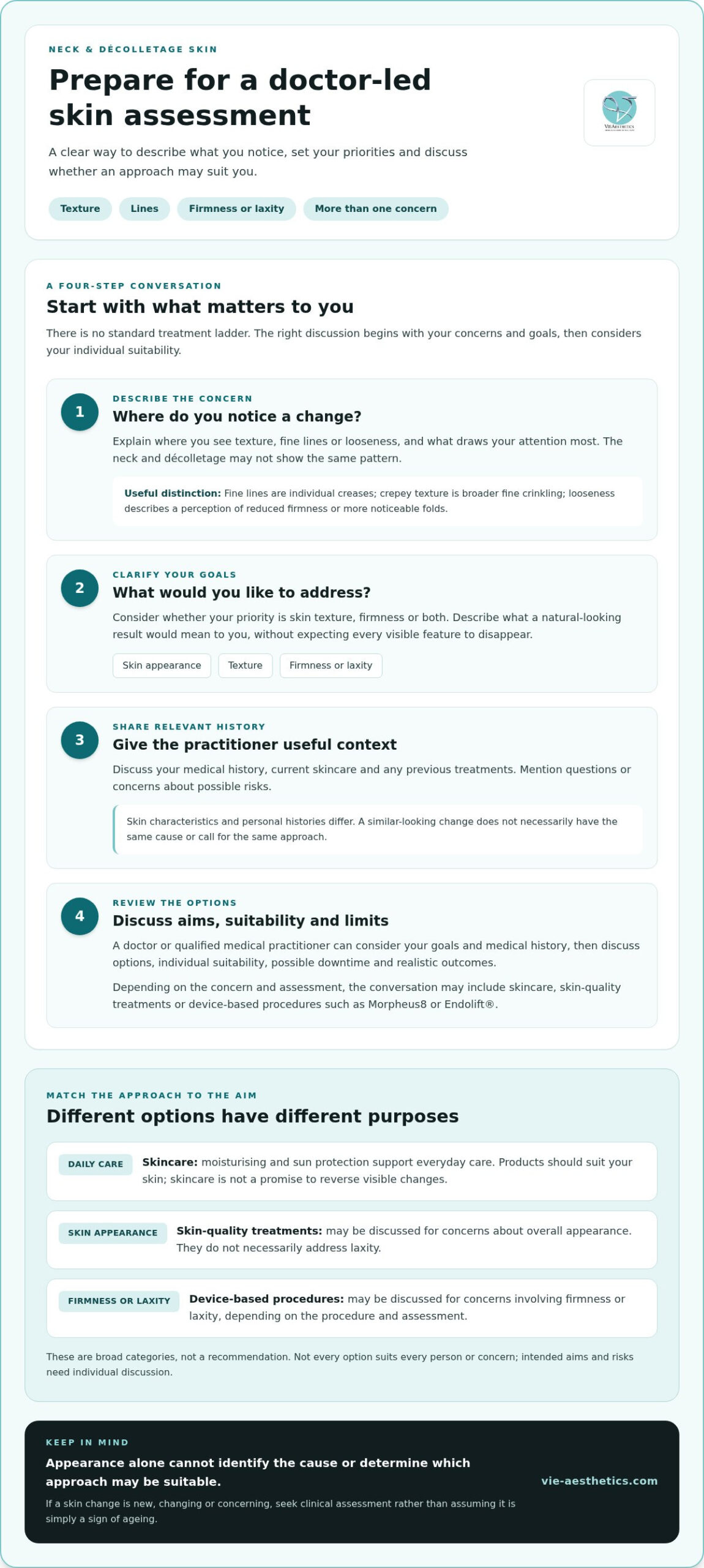
Different approaches have different aims. Skincare supports everyday care, skin-quality treatments may be discussed for concerns about the skin’s appearance, and device-based procedures may be considered for concerns involving firmness or laxity. This isn’t a standard treatment ladder: a suitable crepey neck treatment depends on your goals and individual clinical assessment.
| Approach | Intended aim | Considerations and limits |
|---|---|---|
| Topical skincare | Support routine care, including moisturising and sun protection. | Use products suited to your skin. Skincare isn’t a guaranteed substitute for a medical procedure or a promise to reverse visible changes. |
| Skin-quality treatments | Discuss concerns about the skin’s overall appearance. | A practitioner can explain suitability and limitations. These treatments don’t necessarily address laxity. |
| Device-based procedures | Discuss concerns involving firmness or laxity, depending on the procedure and assessment. | Not every device suits every person or concern. The treatment aim and risks need individual discussion. |
A consistent routine can include moisturising and sun protection on exposed neck and décolletage skin. Sun protection helps limit ongoing exposure, but shouldn’t be presented as a way to erase existing visible changes.
Endolift® and Morpheus8 are among the treatments in Vie Aesthetics’ portfolio. Neither should be assumed to suit every neck or décolletage concern; a doctor or qualified medical practitioner can discuss individual suitability, intended aims and realistic expectations. Read more about Endolift® treatment information.
Myth: One treatment is right for everyone.
Reality: The approach depends on the concern, goals and clinical assessment.
May: Be considered for a specific concern, such as skin appearance or laxity, depending on suitability.
May not: Address every visible feature or produce the same result for each person. Your practitioner can explain the limits of an option before you decide.
A suitable approach starts with your priorities, not a preset treatment sequence. An individual clinical assessment helps establish what you notice, what you hope to achieve and whether an option is appropriate. Use these steps to prepare for the discussion:
1. Describe the concern. Explain where you see texture, lines or looseness, and what draws your attention most.
2. Clarify your goals. Consider what would feel like a natural-looking result to you. It may help to say what you’d like to look more refreshed or smoother, without expecting every visible feature to disappear.
3. Share relevant history. Discuss your medical history, current skincare and any previous treatments. Mention questions or concerns about possible risks.
4. Review the options. Ask what each suggested approach aims to address, what its limitations are and why it may suit your circumstances. A practitioner can also explain when an option isn’t appropriate.
5. Consider aftercare. Talk through any treatment-specific aftercare and recovery expectations before making a decision. These details vary by treatment, so they should be explained for the option being considered.
Be open about what you notice and what outcome would feel right for you. There’s no need to arrive knowing which procedure you want. A doctor or qualified medical practitioner can consider your goals alongside your history, assess the area and talk through suitable options, potential risks and individual limitations.
A preferred outcome is a useful starting point, but it isn’t the same as what a treatment may reasonably achieve. Your practitioner should explain the intended aim and any limitations, so you can decide whether the likely approach aligns with your priorities. A personalised plan may recommend a particular option, a different approach or no procedure.
Vie Aesthetics also offers broader skin treatment options to discuss as part of your assessment. Taking time to understand suitability and expectations can help you make a considered choice about a crepey neck treatment, without pressure to proceed.
A consultation is a chance to understand your concerns and explore whether a crepey neck treatment may suit you. At Vie Aesthetics, procedures are performed only by doctors and qualified medical practitioners, who can discuss your goals, relevant history, an assessment of the area and appropriate options before you decide.
You can describe what you notice, whether that’s fine texture, visible lines or a sense of reduced firmness, and explain what would feel like a natural-looking outcome. Your practitioner can connect these priorities with the aims of relevant treatments, rather than assuming one approach suits everyone.
“Every patient has unique skin characteristics and aesthetic aspirations, which is why we always tailor our crepey neck treatment options to align precisely with your individual goals.” — Dr Ioannis Liakas
Expect an open conversation about potential benefits, limitations and risks. Ask what a proposed option is intended to address, what it may not change and what treatment-specific aftercare or recovery involves. These details depend on the option being considered, so they should be explained for your individual plan rather than generalised.
Your medical history and any previous treatments help inform the discussion. Share relevant details and raise any questions that would help you feel comfortable making an informed choice. You can take time to consider the information; you don’t need to decide during the consultation.
A consultation is a conversation, not a commitment to treatment. The practitioner can assess your concerns, explain suitable options and their individual limitations, and help you weigh them against your goals. Sometimes a considered plan may involve a different approach from the one you first had in mind.
“Thoughtful, individualised care means prioritising your safety and wellbeing above all else, ensuring you receive honest advice and a bespoke pathway tailored to your skin’s true needs.” — Dr Ioannis Liakas, Vie Aesthetics
Vie Aesthetics’ personalised treatment planning is designed around individual suitability and realistic expectations. The aim is to help you understand what an option may offer, without promising a particular result or suggesting that every visible change needs treatment.
Choosing whether to proceed is entirely personal. You can use the appointment to ask questions, reflect on the information and decide what feels right for you.
Crepey-looking skin can involve texture, looseness or a combination of both, so the most suitable approach depends on what you’d like to address. Skincare can support everyday care, while medical aesthetic treatments have different aims and require an individual assessment.
A consultation helps connect your goals and relevant history with suitable options, their limitations and realistic expectations. At Vie Aesthetics, procedures are performed only by doctors and qualified medical practitioners, with personalised treatment planning shaped around individual suitability. There’s no need to choose a crepey neck treatment before you understand what may be appropriate for you.
If you’d like to explore your options, a conversation can be a thoughtful first step, without committing to treatment.
Take the time you need to make a choice that feels informed and right for you.
Crepey-looking skin can be influenced by ageing and cumulative sun exposure, but appearance alone can’t identify its cause. Skin characteristics and personal history differ, so similar-looking texture may have different influences for different people. Fine crinkling and reduced firmness can also be separate or overlapping concerns. If a skin change is new or changing, seek clinical assessment rather than assuming it is simply an age-related change.
Skincare can support a regular neck-care routine, but it can’t promise to reverse visible changes or replace every medical treatment. Moisturising and consistent sun protection for exposed skin are practical parts of everyday care. Choose products that suit your skin, and use them as directed. If you’re considering other options, a medical assessment can help distinguish supportive skincare from treatments with different aims.
There isn’t one best option for everyone. Skincare supports daily care, skin-quality treatments are considered for concerns about the skin’s appearance, and device-based procedures may be discussed for concerns involving firmness or laxity. The most suitable crepey neck treatment depends on your goals, relevant medical history and clinical assessment. A practitioner should explain the intended aim and limitations of any option, with results understood as individual.
Endolift® may be discussed as an option, but its suitability for your neck concern can’t be determined from appearance alone. Vie Aesthetics offers Endolift® as part of its treatment portfolio, and a doctor or qualified medical practitioner can assess your goals and relevant history before discussing whether it may be appropriate. They can also explain the intended treatment aim, individual limitations, potential risks and any treatment-specific aftercare.
A practitioner can help clarify whether your main concern is surface texture, perceived reduced firmness, or a combination. Skin-quality treatments and tightening approaches have different aims, so one shouldn’t be chosen automatically based on the word “crepey”. During an assessment, describe what you notice and what you’d like to change. The practitioner can then discuss options, suitability and realistic expectations for your individual circumstances.
Expect to discuss your goals, relevant medical history and any previous treatments, followed by an assessment and conversation about appropriate options. Ask about intended benefits, limitations, potential risks and treatment-specific aftercare before deciding. At Vie Aesthetics, procedures are performed only by doctors and qualified medical practitioners. A consultation supports informed decision-making; you can take time to consider your options before choosing whether to proceed.
Back to our blogs