To understand how to check aesthetic practitioner qualified, start by checking the practitioner’s professional registration, training and experience for the treatment you’re considering. Knowing how to check aesthetic practitioner qualified also means looking beyond a title or certificate to whether the practitioner can explain your suitability, the risks and the aftercare.
It’s understandable if the checks feel confusing: a clinic’s registration and an individual practitioner’s credentials are not the same thing. A professional register can help confirm someone’s status, but it doesn’t by itself show treatment-specific competence or whether a procedure is right for you.
This guide walks you through a practical 12-point safety checklist, including which UK registers to search and what their entries do, and don’t, demonstrate. You’ll also find questions to ask about suitability, risks, consent and aftercare. At Vie Aesthetics, procedures are performed by doctors and qualified medical practitioners. You can read about the clinical team on our Meet the Team page.
Check the practitioner’s professional registration, relevant training and experience with the specific procedure you’re considering. A professional qualification tells you about someone’s education and professional background. It doesn’t guarantee a particular result or prove that a treatment is suitable for you.
To check whether an aesthetic practitioner is qualified, look at both the person and the procedure. A recognised professional qualification is one part of the picture; you’ll also want to understand how their aesthetic training relates to the treatment being discussed.
An underlying professional qualification, such as a medical, nursing or dental qualification, establishes a practitioner’s professional background. Additional aesthetic training should relate to the procedure itself, rather than only covering cosmetic treatments in general.
A certificate can show that someone completed a course, but it doesn’t tell you on its own how current their skills are, how much experience they have with the procedure or whether it suits your needs. Ask what the training covered and how the practitioner keeps their knowledge and skills up to date.
The relevant professional register depends on the practitioner’s profession. In the UK, you can search the General Medical Council (GMC) register for doctors, the Nursing and Midwifery Council (NMC) register for nurses and midwives, and the General Dental Council (GDC) register for dentists and dental care professionals. Use the relevant organisation’s current register and compare the result with the practitioner’s full name and stated role.
The Joint Council for Cosmetic Practitioners (JCCP) has a separate voluntary register for aesthetics. This is an additional check, not a substitute for verifying a doctor, nurse or dentist on their professional regulator’s register. These checks answer different questions: one relates to professional status, while the other relates to aesthetics-specific credentials.
Clinic registration, accreditation and awards relate to the organisation or premises. They don’t automatically verify every practitioner working there. In England, Care Quality Commission (CQC) registration concerns regulated health and care services; it doesn’t independently verify each practitioner’s qualifications. Check the individual’s credentials separately from the clinic’s status. Vie Aesthetics shares information about its clinical team on its Meet the Team page.
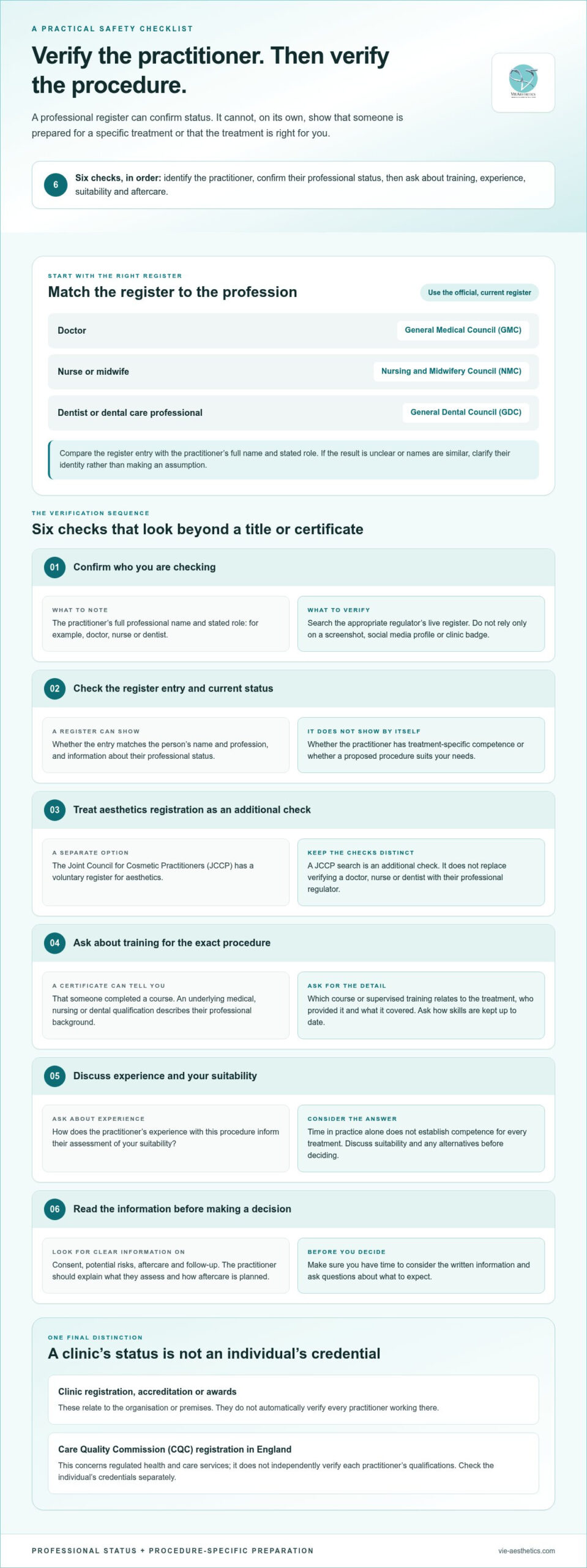
A useful check brings together identity, professional registration, preparation for the treatment and the information you receive before deciding. Registration and competence for a particular procedure are related, but they are not the same check.
Use these steps to make your review clear and focused:
Use the regulator’s own website and follow its current search instructions. Check that the entry identifies both the practitioner’s name and profession. If the result is ambiguous, clarify it rather than assuming a similar entry belongs to the person you’re considering.
Register labels and search functions can change, so check their meaning with the relevant regulator. The NHS advice on cosmetic treatments also provides general guidance on choosing a practitioner and understanding risks.
Ask the practitioner to explain how their training relates to the procedure and how their experience informs the consultation. Their answers should help you understand what they assess, which risks they discuss and how aftercare is planned.
Consider whether the discussion has answered your questions about the proposed treatment. If you’d like to talk through your aims and suitability with a qualified medical practitioner, you can book a consultation.
A professional title, course certificate, clinic badge or award can provide useful context, but none alone shows that someone is competent to perform every aesthetic procedure. Professional registration is evidence of a person’s status; it can’t tell you whether a specific treatment suits your needs or guarantee a particular result.
Knowing how to check aesthetic practitioner qualified also means paying attention to the consultation. You should be able to discuss your aims, hear balanced information and make your decision without pressure.
Informed consent means understanding the proposed treatment and agreeing to it freely. Use these questions to guide the conversation, and ask for plain-language explanations if anything is unclear:
Take time to consider the answers and any written information. A responsible consultation gives you space to ask questions and make a decision at your own pace.
Look for answers that relate to the procedure and your circumstances. A practitioner should explain uncertainty and individual variation, rather than presenting one outcome as inevitable or suitable for everyone. A clear discussion of risks and alternatives helps you weigh the decision, not just consider potential benefits.
If you’re comparing approaches, Vie Aesthetics’ guide to non-surgical aesthetic treatments explains different treatment categories. The aim is to leave understanding what is proposed, why it may suit you and what care follows.
Vie Aesthetics’ aesthetic procedures are performed only by doctors and qualified medical practitioners. That provides a clear starting point, while the individual practitioner’s role, relevant preparation and your suitability remain important parts of an informed decision.
Knowing how to check aesthetic practitioner qualified is useful alongside considering the care you receive during a consultation. Credentials tell you about a practitioner’s background; a personalised discussion helps explore whether a particular option may suit your aims and circumstances.
A consultation is an opportunity to discuss what you hope to achieve, relevant circumstances and options that may suit you. The practitioner can explain the proposed approach and answer your questions, so you can understand the considerations before deciding. An assessment doesn’t mean that treatment is right for everyone.
If you’re comparing treatment categories, Vie Aesthetics’ comprehensive guide to non-surgical aesthetic treatments can help you explore options before discussing them with a practitioner.
Use your consultation to ask about your aims, suitability, potential options and anything you’d like explained further. You don’t need to decide on a treatment before you understand the discussion and have had time to consider what feels right for you.
Any treatment decision should follow an individual assessment and a clear conversation about the proposed approach. Take the time you need to consider your options.
Knowing how to check aesthetic practitioner qualified is a useful starting point. You can also consider the quality of the conversation that follows. At Vie Aesthetics, personalised treatment planning supports a considered discussion of your aims, suitability and options.
A consultation can help clarify any questions and give you the information you need to decide whether you’re comfortable with the proposed approach. You don’t need to commit before you’ve had time to consider your individual assessment and the practitioner’s advice.
Take the time you need. A well-informed next step is one that feels right for you.
Search the official register for the practitioner’s profession using their full name, then check that the entry matches the person you’re considering. The relevant register may be the GMC for a doctor, the NMC for a nurse or midwife, or the GDC for a dentist or dental care professional. Follow the regulator’s current search guidance, as register details and terminology can change. A matching entry is one check; ask separately about training for your proposed treatment.
No. CQC registration relates to regulated health and care services in England; it doesn’t verify every practitioner’s qualifications or competence for a particular procedure. The services and settings covered can vary, so don’t assume every aesthetic treatment has the same CQC status. Check the individual’s professional registration and relevant treatment training separately. A clinic’s entry and a practitioner’s professional register answer different questions.
Not by itself. The Joint Council for Cosmetic Practitioners (JCCP) register is separate from the professional registers held by the GMC, NMC and GDC. Check the organisation’s current criteria and what the practitioner’s specific entry represents, then verify any claimed medical or dental profession with its regulator. Each register provides evidence within its own scope; one entry doesn’t replace another.
A practitioner’s professional registration and preparation for a specific procedure are different considerations. A professional title alone won’t tell you which aesthetic treatments they’ve trained to perform or how much relevant experience they have. Ask them to explain the training connected to your proposed procedure, how they assess your suitability and what aftercare is available. Training expectations can depend on the procedure and UK nation, so don’t assume one standard applies to every treatment.
There isn’t one simple answer that applies to every aesthetic procedure across the UK. Requirements can depend on the treatment, the practitioner’s role and the UK nation, and relevant rules may change. Check current official guidance before relying on a general claim about who may perform a procedure. Whatever the practitioner’s title, you can verify their professional status, ask about training for the treatment and take time to understand suitability, risks and aftercare before deciding.
A consultation should give you space to explain your aims and share health information relevant to the proposed treatment. The practitioner should discuss whether it may suit your circumstances, possible benefits, relevant risks, alternatives and aftercare in language you understand. Ask for clarification or written information if needed. You don’t have to decide during the discussion; take time to consider the plan and make sure your questions have been answered.

To understand how to check aesthetic practitioner qualified, start by checking the practitioner’s professional registration, training and experience for the treatment you’re considering. Knowing how to check aesthetic practitioner qualified also means looking beyond a title or certificate to whether the practitioner can explain your suitability, the risks and the aftercare.
It’s understandable if the checks feel confusing: a clinic’s registration and an individual practitioner’s credentials are not the same thing. A professional register can help confirm someone’s status, but it doesn’t by itself show treatment-specific competence or whether a procedure is right for you.
This guide walks you through a practical 12-point safety checklist, including which UK registers to search and what their entries do, and don’t, demonstrate. You’ll also find questions to ask about suitability, risks, consent and aftercare. At Vie Aesthetics, procedures are performed by doctors and qualified medical practitioners. You can read about the clinical team on our Meet the Team page.
Check the practitioner’s professional registration, relevant training and experience with the specific procedure you’re considering. A professional qualification tells you about someone’s education and professional background. It doesn’t guarantee a particular result or prove that a treatment is suitable for you.
To check whether an aesthetic practitioner is qualified, look at both the person and the procedure. A recognised professional qualification is one part of the picture; you’ll also want to understand how their aesthetic training relates to the treatment being discussed.
An underlying professional qualification, such as a medical, nursing or dental qualification, establishes a practitioner’s professional background. Additional aesthetic training should relate to the procedure itself, rather than only covering cosmetic treatments in general.
A certificate can show that someone completed a course, but it doesn’t tell you on its own how current their skills are, how much experience they have with the procedure or whether it suits your needs. Ask what the training covered and how the practitioner keeps their knowledge and skills up to date.
The relevant professional register depends on the practitioner’s profession. In the UK, you can search the General Medical Council (GMC) register for doctors, the Nursing and Midwifery Council (NMC) register for nurses and midwives, and the General Dental Council (GDC) register for dentists and dental care professionals. Use the relevant organisation’s current register and compare the result with the practitioner’s full name and stated role.
The Joint Council for Cosmetic Practitioners (JCCP) has a separate voluntary register for aesthetics. This is an additional check, not a substitute for verifying a doctor, nurse or dentist on their professional regulator’s register. These checks answer different questions: one relates to professional status, while the other relates to aesthetics-specific credentials.
Clinic registration, accreditation and awards relate to the organisation or premises. They don’t automatically verify every practitioner working there. In England, Care Quality Commission (CQC) registration concerns regulated health and care services; it doesn’t independently verify each practitioner’s qualifications. Check the individual’s credentials separately from the clinic’s status. Vie Aesthetics shares information about its clinical team on its Meet the Team page.
A useful check brings together identity, professional registration, preparation for the treatment and the information you receive before deciding. Registration and competence for a particular procedure are related, but they are not the same check.
Use these steps to make your review clear and focused:
Use the regulator’s own website and follow its current search instructions. Check that the entry identifies both the practitioner’s name and profession. If the result is ambiguous, clarify it rather than assuming a similar entry belongs to the person you’re considering.
Register labels and search functions can change, so check their meaning with the relevant regulator. The NHS advice on cosmetic treatments also provides general guidance on choosing a practitioner and understanding risks.
Ask the practitioner to explain how their training relates to the procedure and how their experience informs the consultation. Their answers should help you understand what they assess, which risks they discuss and how aftercare is planned.
Consider whether the discussion has answered your questions about the proposed treatment. If you’d like to talk through your aims and suitability with a qualified medical practitioner, you can book a consultation.
A professional title, course certificate, clinic badge or award can provide useful context, but none alone shows that someone is competent to perform every aesthetic procedure. Professional registration is evidence of a person’s status; it can’t tell you whether a specific treatment suits your needs or guarantee a particular result.
Knowing how to check aesthetic practitioner qualified also means paying attention to the consultation. You should be able to discuss your aims, hear balanced information and make your decision without pressure.
Informed consent means understanding the proposed treatment and agreeing to it freely. Use these questions to guide the conversation, and ask for plain-language explanations if anything is unclear:
Take time to consider the answers and any written information. A responsible consultation gives you space to ask questions and make a decision at your own pace.
Look for answers that relate to the procedure and your circumstances. A practitioner should explain uncertainty and individual variation, rather than presenting one outcome as inevitable or suitable for everyone. A clear discussion of risks and alternatives helps you weigh the decision, not just consider potential benefits.
If you’re comparing approaches, Vie Aesthetics’ guide to non-surgical aesthetic treatments explains different treatment categories. The aim is to leave understanding what is proposed, why it may suit you and what care follows.
Vie Aesthetics’ aesthetic procedures are performed only by doctors and qualified medical practitioners. That provides a clear starting point, while the individual practitioner’s role, relevant preparation and your suitability remain important parts of an informed decision.
Knowing how to check aesthetic practitioner qualified is useful alongside considering the care you receive during a consultation. Credentials tell you about a practitioner’s background; a personalised discussion helps explore whether a particular option may suit your aims and circumstances.
A consultation is an opportunity to discuss what you hope to achieve, relevant circumstances and options that may suit you. The practitioner can explain the proposed approach and answer your questions, so you can understand the considerations before deciding. An assessment doesn’t mean that treatment is right for everyone.
If you’re comparing treatment categories, Vie Aesthetics’ comprehensive guide to non-surgical aesthetic treatments can help you explore options before discussing them with a practitioner.
Use your consultation to ask about your aims, suitability, potential options and anything you’d like explained further. You don’t need to decide on a treatment before you understand the discussion and have had time to consider what feels right for you.
Any treatment decision should follow an individual assessment and a clear conversation about the proposed approach. Take the time you need to consider your options.
Knowing how to check aesthetic practitioner qualified is a useful starting point. You can also consider the quality of the conversation that follows. At Vie Aesthetics, personalised treatment planning supports a considered discussion of your aims, suitability and options.
A consultation can help clarify any questions and give you the information you need to decide whether you’re comfortable with the proposed approach. You don’t need to commit before you’ve had time to consider your individual assessment and the practitioner’s advice.
Take the time you need. A well-informed next step is one that feels right for you.
Search the official register for the practitioner’s profession using their full name, then check that the entry matches the person you’re considering. The relevant register may be the GMC for a doctor, the NMC for a nurse or midwife, or the GDC for a dentist or dental care professional. Follow the regulator’s current search guidance, as register details and terminology can change. A matching entry is one check; ask separately about training for your proposed treatment.
No. CQC registration relates to regulated health and care services in England; it doesn’t verify every practitioner’s qualifications or competence for a particular procedure. The services and settings covered can vary, so don’t assume every aesthetic treatment has the same CQC status. Check the individual’s professional registration and relevant treatment training separately. A clinic’s entry and a practitioner’s professional register answer different questions.
Not by itself. The Joint Council for Cosmetic Practitioners (JCCP) register is separate from the professional registers held by the GMC, NMC and GDC. Check the organisation’s current criteria and what the practitioner’s specific entry represents, then verify any claimed medical or dental profession with its regulator. Each register provides evidence within its own scope; one entry doesn’t replace another.
A practitioner’s professional registration and preparation for a specific procedure are different considerations. A professional title alone won’t tell you which aesthetic treatments they’ve trained to perform or how much relevant experience they have. Ask them to explain the training connected to your proposed procedure, how they assess your suitability and what aftercare is available. Training expectations can depend on the procedure and UK nation, so don’t assume one standard applies to every treatment.
There isn’t one simple answer that applies to every aesthetic procedure across the UK. Requirements can depend on the treatment, the practitioner’s role and the UK nation, and relevant rules may change. Check current official guidance before relying on a general claim about who may perform a procedure. Whatever the practitioner’s title, you can verify their professional status, ask about training for the treatment and take time to understand suitability, risks and aftercare before deciding.
A consultation should give you space to explain your aims and share health information relevant to the proposed treatment. The practitioner should discuss whether it may suit your circumstances, possible benefits, relevant risks, alternatives and aftercare in language you understand. Ask for clarification or written information if needed. You don’t have to decide during the discussion; take time to consider the plan and make sure your questions have been answered.
 Read this article
 Read this article