Download our brochure Download our app
0 Items £0.00
Book Consultation
profhilo rayleigh

Blog

What London and Essex Patients Asked For in 2026: Vie Aesthetics Treatment Trends Report

02-10-2026 | Posted in: Blogs
Vicky Grammatikopoulou, BHons, MA, PGCE

Article by

Vicky Grammatikopoulou, BHons, MA, PGCE

Vicky Grammatikopoulou is the founder and CEO of Vie Aesthetics, a multi-award winning UK-based aesthetics business built on a philosophy of safety, excellence, education, innovation, and empowerment.

What if the most important aesthetic treatment trends UK 2026 aren’t about choosing the newest procedure, but about choosing thoughtfully? The conversation includes regenerative approaches, skin quality and personalised treatment combinations, but a trend alone can’t tell you whether an option is suitable for you.

It’s understandable to feel unsure when emerging treatments are discussed alongside established options. A popular topic isn’t proof of effectiveness, safety or suitability for your individual needs. This report explores the themes appearing in UK aesthetics coverage and how to consider them with realistic expectations.

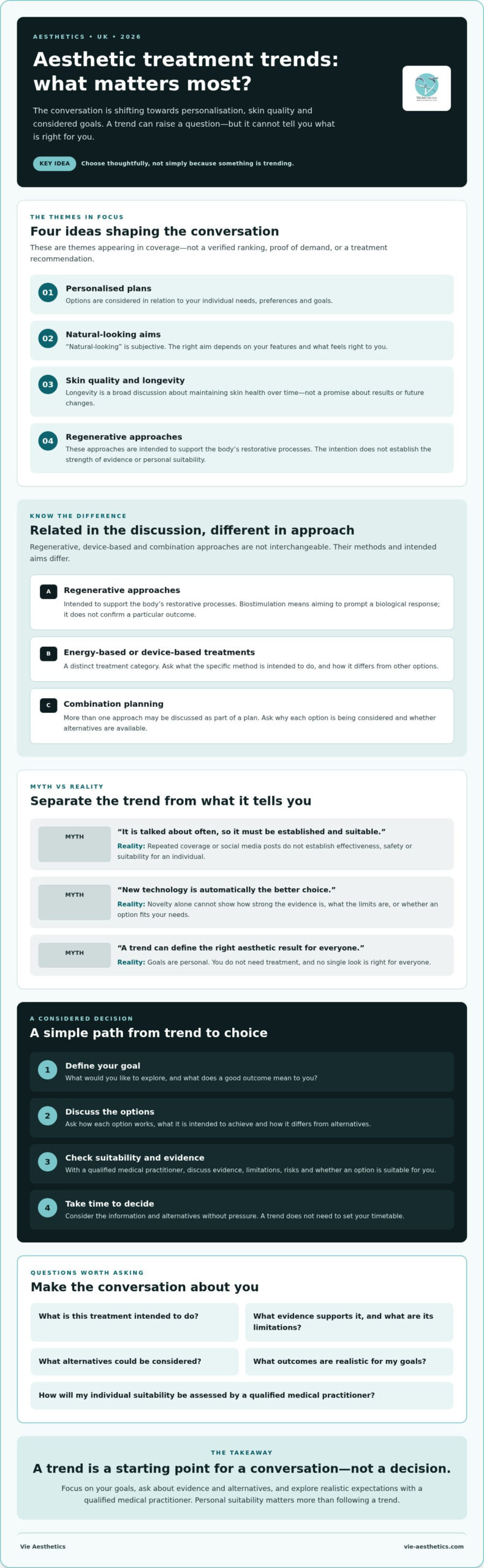
Infographic: themes appearing in 2026 aesthetics coverage.

Dr Ioannis Liakas, Medical Director

You’ll learn how to think about regenerative approaches, subtle treatment aims and combination plans, and why personalisation matters more than following a trend. We’ll also share questions to raise with a qualified medical practitioner, from how a treatment works to what alternatives and realistic outcomes to discuss.

Infographic: questions to take into a treatment discussion.
Photo: a consultation focused on individual goals and options.

Dr Ioannis Liakas, Medical Director

Key Takeaways

  • The aesthetic treatment trends UK 2026 coverage highlights personalisation, natural-looking aims, skin quality and regenerative approaches, not a definitive ranking of treatments.
  • Learn how regenerative approaches, energy-based treatments and combination planning differ, and why they aren’t interchangeable.
  • Use the Myth vs Reality guide to separate emerging ideas from evidence and ask what a treatment may realistically achieve for you.
  • Follow a simple decision path: define your goal, discuss options, check suitability and take time to decide without pressure.
  • Discover how a personalised consultation with a qualified medical practitioner can help you explore options and expectations.

The aesthetic treatment trends UK 2026 coverage points towards personalisation, natural-looking aims, skin quality and regenerative approaches. These are visible themes in industry conversation, not verified rankings, proof of rising demand or guidance on what any one person should choose.

Social media can make a treatment seem widely established through repeated posts, while new technology may sound persuasive simply because it is novel. For a general background to the field, read this overview of aesthetic medicine. A trend can prompt a question, but it can’t establish individual suitability.

For another perspective on how the conversation around aesthetics is evolving, watch this video:

From dramatic change to considered, natural-looking goals

Coverage often describes a move towards subtle, individualised aims rather than a dramatic change in appearance. “Natural-looking” is subjective: what feels right depends on your features, preferences and goals, so no practitioner can promise that one particular look will suit everyone.

You don’t need treatment to look your best. If you’re considering an option, focus on what you hope to achieve and ask what changes are realistic for you.

Why longevity, skin quality and regeneration are in the conversation

Longevity is a broad way of talking about maintaining skin health over time, not a guarantee that a treatment will extend results or prevent future changes. Regenerative aesthetics refers to approaches intended to support the body’s restorative processes. Biostimulation, for example, describes an intended biological response, not a guaranteed increase in collagen.

Sector interest signals what people are discussing, not how strong the evidence is for a treatment or whether it’s suitable for you. Ask about the evidence, limitations and alternatives. Vie Aesthetics’ qualified medical practitioners can discuss options during a personalised consultation; you can find the Vie Aesthetics consultation booking page online.
What London and Essex Patients Asked For in 2026: Vie Aesthetics Treatment Trends Report

How regenerative and combination aesthetic treatments are being discussed

Regenerative approaches, device-based treatments and combination plans are often grouped together in coverage of aesthetic treatment trends UK 2026. They aren’t interchangeable: each uses a different method and has a different intended aim. Biostimulation means aiming to prompt a biological response; it doesn’t guarantee collagen production or a particular result.

Polynucleotides and skin boosters are discussed in relation to skin quality, whilst some injectable products are intended to add volume. The purpose depends on the specific treatment and product. Read Vie Aesthetics’ polynucleotide treatment overview for information about that treatment category.

Different approaches, different questions

Approach Broad aim Consultation question Evidence to verify
Regenerative approaches Intended to support restorative processes or address skin quality. What is this option intended to do for my concern? Evidence for the specific product, use and proposed outcome.
Energy-based treatments Use a device-based method to address a defined concern. Endolift® and Morpheus8 are examples in Vie Aesthetics’ range, but they differ and aren’t suitable for everyone. Why is this treatment being considered for me? Evidence, risks and limitations for the proposed treatment.
Combination planning Consider more than one treatment as part of an individual plan. What does each element contribute, and why this sequence? The rationale, suitability and evidence for the combined approach.

A combination isn’t automatically more effective. A qualified practitioner should assess your goals and suitability, explain the rationale for each step, and discuss sequencing, alternatives and possible risks. The General Medical Council’s professional standards for cosmetic interventions offer further guidance on doctors’ responsibilities.

If you’d like to explore options without assuming a particular treatment is right for you, you can arrange a consultation with Vie Aesthetics.

The aesthetic treatment trends UK 2026 conversation can help you identify questions to ask, but it can’t tell you what treatment to choose. Consider the evidence for the specific procedure, its limitations and your own circumstances, rather than relying on novelty or popularity.

Myth vs Reality: a trend is not a treatment recommendation

Myth: A treatment that’s widely discussed or new must be the best option.

Reality: Suitability depends on your goals, assessment, health history and the treatment’s potential risks and limitations. Results can vary between individuals, so be cautious of universal claims or fixed timelines. The UK Parliament’s Health and Social Care Committee report provides wider context on scrutiny of the cosmetic procedures sector; it doesn’t establish that a particular treatment is right for you.

What this treatment WILL and WON’T do

Take skin boosters as one example. A practitioner may discuss them in relation to skin quality, depending on your needs and the specific treatment being considered. They won’t address every concern or necessarily provide the same kind of structural volume as a filler. Ask the practitioner to explain the intended use and evidence for the precise option they’re proposing.

Before deciding, ask about risks, possible recovery, aftercare and how to seek clinical advice if you have concerns. A clear explanation should help you understand both potential benefits and limitations without pressure.

Four checks to make during a consultation

  • 1. Practitioner: Ask about relevant qualifications, experience and the credentials you can verify through reliable sources.
  • 2. Rationale: Ask why this option is being considered for your goals, and what evidence supports its intended use.
  • 3. Alternatives: Ask what other approaches, including no treatment, could be considered and how their aims differ.
  • 4. Aftercare: Check what support and guidance are provided, what recovery may involve and when to seek clinical advice.

Take time to consider the answers. A qualified medical practitioner should be able to discuss suitability and realistic expectations in a personalised assessment.

Arrange a personalised consultation

Choosing a 2026 aesthetic treatment plan that fits your goals

The most useful way to approach aesthetic treatment trends UK 2026 is to treat them as a starting point for a conversation, not a ready-made plan. Define what you’d like to address, discuss options with a qualified practitioner, check suitability and take time to decide without pressure.

Questions to take into a consultation

A good consultation should make space for your priorities and relevant medical history. Consider asking:

  • What have you understood about my goals and health history?
  • Why might this option suit me, and what alternatives could I consider?
  • What are the treatment’s limitations and potential risks?
  • What aftercare may I need, and how might my results vary from another person’s?
  • What should I do if I have a concern after treatment?

You don’t need to arrive knowing which procedure you want. It’s reasonable to ask for more information, consider alternatives or decide not to proceed.

Book a personalised aesthetic consultation

How Vie Aesthetics can support an informed next step

Vie Aesthetics says its aesthetic procedures are performed by doctors and qualified medical practitioners. A personalised consultation can help clarify your goals, discuss suitable options and explain realistic expectations, without treating a popular procedure as the automatic answer.

Depending on your individual assessment, options such as Endolift®, Morpheus8 or skin boosters may be discussed. Each has a different purpose, and none should be assumed suitable without assessment. For broader context, read the non-surgical aesthetic treatment guide.

Choose a next step when you feel informed, not because a treatment is trending. A consultation can help you explore whether an option aligns with your preferences.

Discuss your treatment goals
Arrange a treatment consultation

Make your next step a considered one

The aesthetic treatment trends UK 2026 coverage highlights personalisation, skin quality and regenerative approaches, but a trend is a conversation starter, not a recommendation. Your goals, health history and the evidence for a specific option matter more than its visibility. Ask about suitability, alternatives, limitations, risks and aftercare before deciding.

Vie Aesthetics says its procedures are performed only by doctors and qualified medical practitioners, with personalised planning across a range of medical aesthetic services. The practice also holds Investors in People Gold status and lists a Global Best Aesthetic Practice award from MyFaceMyBody Awards 2020/21. These are useful points of context, whilst an individual consultation remains the place to explore what may be appropriate for you.

If you’d like to talk through your goals and options with a practitioner, you can arrange a personalised consultation.

Book a personalised aesthetic consultation

Take your time, ask questions and choose the next step that feels informed and right for you.

Frequently Asked Questions

What are the biggest aesthetic treatment trends in the UK for 2026?

Visible themes in aesthetic treatment trends UK 2026 coverage include personalised plans, natural-looking aims, attention to skin quality and regenerative approaches. Combination planning and energy-based treatments are also part of the conversation. These are themes, not a verified ranking or proof that demand is increasing. They don’t show which treatment is most effective or suitable for you. A qualified practitioner can discuss options in light of your goals and circumstances.

Are regenerative aesthetic treatments better than dermal fillers?

No single approach is better for everyone; regenerative treatments and dermal fillers have different intended purposes. Regenerative approaches are generally discussed in relation to supporting restorative processes or skin quality, whilst fillers are commonly used to add volume. The exact purpose depends on the treatment and product. Ask a practitioner to explain the evidence, risks and limitations for the specific option being considered, and whether it matches your goals.

Can aesthetic treatments be combined in one treatment plan?

Yes, a practitioner may consider more than one treatment in a personalised plan, but combining procedures isn’t automatically appropriate or more effective. For example, a plan might involve an energy-based treatment and another modality, depending on the individual assessment. Ask what each treatment is intended to contribute, why the proposed sequence is appropriate, what risks may apply and what alternatives are available. You should have time to consider the plan before deciding.

How do I know whether a 2026 treatment trend is right for me?

A trend alone can’t determine suitability. Start by describing your goals and relevant health history, then ask a qualified practitioner to explain why a particular treatment may or may not suit you. Discuss its evidence, potential risks, limitations, alternatives and aftercare. You can also ask how outcomes vary between individuals. A clear consultation should help you make an informed decision, including choosing not to proceed or taking more time to consider.

Do aesthetic treatment trends guarantee natural-looking results?

No. “Natural-looking” is subjective, and a trend can’t guarantee how a treatment will look or feel for you. Outcomes vary between individuals and depend on factors such as the treatment chosen and your personal circumstances. Before proceeding, explain what a natural-looking result means to you and ask what may realistically be achievable, what the treatment won’t address and what risks or aftercare to consider. Be cautious of claims that promise the same result for everyone.

Who should perform aesthetic treatments in the UK?

Choose a practitioner with relevant qualifications, training and experience for the specific treatment, and take time to verify their credentials through reliable sources. Before agreeing, make sure they assess your circumstances, explain potential risks and alternatives, and discuss aftercare and how to seek advice if you have concerns. Requirements can depend on the procedure and location, so check current official guidance rather than relying on social media claims. Vie Aesthetics states that its procedures are performed only by doctors and qualified medical practitioners.


What London and Essex Patients Asked For in 2026: Vie Aesthetics Treatment Trends Report

Vicky Grammatikopoulou, BHons, MA, PGCE

Article by

Vicky Grammatikopoulou, BHons, MA, PGCE

Vicky Grammatikopoulou is the founder and CEO of Vie Aesthetics, a multi-award winning UK-based aesthetics business built on a philosophy of safety, excellence, education, innovation, and empowerment.

What if the most important aesthetic treatment trends UK 2026 aren’t about choosing the newest procedure, but about choosing thoughtfully? The conversation includes regenerative approaches, skin quality and personalised treatment combinations, but a trend alone can’t tell you whether an option is suitable for you.

It’s understandable to feel unsure when emerging treatments are discussed alongside established options. A popular topic isn’t proof of effectiveness, safety or suitability for your individual needs. This report explores the themes appearing in UK aesthetics coverage and how to consider them with realistic expectations.

Infographic: themes appearing in 2026 aesthetics coverage.

Dr Ioannis Liakas, Medical Director

You’ll learn how to think about regenerative approaches, subtle treatment aims and combination plans, and why personalisation matters more than following a trend. We’ll also share questions to raise with a qualified medical practitioner, from how a treatment works to what alternatives and realistic outcomes to discuss.

Infographic: questions to take into a treatment discussion.
Photo: a consultation focused on individual goals and options.

Dr Ioannis Liakas, Medical Director

Key Takeaways

  • The aesthetic treatment trends UK 2026 coverage highlights personalisation, natural-looking aims, skin quality and regenerative approaches, not a definitive ranking of treatments.
  • Learn how regenerative approaches, energy-based treatments and combination planning differ, and why they aren’t interchangeable.
  • Use the Myth vs Reality guide to separate emerging ideas from evidence and ask what a treatment may realistically achieve for you.
  • Follow a simple decision path: define your goal, discuss options, check suitability and take time to decide without pressure.
  • Discover how a personalised consultation with a qualified medical practitioner can help you explore options and expectations.

The aesthetic treatment trends UK 2026 coverage points towards personalisation, natural-looking aims, skin quality and regenerative approaches. These are visible themes in industry conversation, not verified rankings, proof of rising demand or guidance on what any one person should choose.

Social media can make a treatment seem widely established through repeated posts, while new technology may sound persuasive simply because it is novel. For a general background to the field, read this overview of aesthetic medicine. A trend can prompt a question, but it can’t establish individual suitability.

For another perspective on how the conversation around aesthetics is evolving, watch this video:

From dramatic change to considered, natural-looking goals

Coverage often describes a move towards subtle, individualised aims rather than a dramatic change in appearance. “Natural-looking” is subjective: what feels right depends on your features, preferences and goals, so no practitioner can promise that one particular look will suit everyone.

You don’t need treatment to look your best. If you’re considering an option, focus on what you hope to achieve and ask what changes are realistic for you.

Why longevity, skin quality and regeneration are in the conversation

Longevity is a broad way of talking about maintaining skin health over time, not a guarantee that a treatment will extend results or prevent future changes. Regenerative aesthetics refers to approaches intended to support the body’s restorative processes. Biostimulation, for example, describes an intended biological response, not a guaranteed increase in collagen.

Sector interest signals what people are discussing, not how strong the evidence is for a treatment or whether it’s suitable for you. Ask about the evidence, limitations and alternatives. Vie Aesthetics’ qualified medical practitioners can discuss options during a personalised consultation; you can find the Vie Aesthetics consultation booking page online.

How regenerative and combination aesthetic treatments are being discussed

Regenerative approaches, device-based treatments and combination plans are often grouped together in coverage of aesthetic treatment trends UK 2026. They aren’t interchangeable: each uses a different method and has a different intended aim. Biostimulation means aiming to prompt a biological response; it doesn’t guarantee collagen production or a particular result.

Polynucleotides and skin boosters are discussed in relation to skin quality, whilst some injectable products are intended to add volume. The purpose depends on the specific treatment and product. Read Vie Aesthetics’ polynucleotide treatment overview for information about that treatment category.

Different approaches, different questions

Approach Broad aim Consultation question Evidence to verify
Regenerative approaches Intended to support restorative processes or address skin quality. What is this option intended to do for my concern? Evidence for the specific product, use and proposed outcome.
Energy-based treatments Use a device-based method to address a defined concern. Endolift® and Morpheus8 are examples in Vie Aesthetics’ range, but they differ and aren’t suitable for everyone. Why is this treatment being considered for me? Evidence, risks and limitations for the proposed treatment.
Combination planning Consider more than one treatment as part of an individual plan. What does each element contribute, and why this sequence? The rationale, suitability and evidence for the combined approach.

A combination isn’t automatically more effective. A qualified practitioner should assess your goals and suitability, explain the rationale for each step, and discuss sequencing, alternatives and possible risks. The General Medical Council’s professional standards for cosmetic interventions offer further guidance on doctors’ responsibilities.

If you’d like to explore options without assuming a particular treatment is right for you, you can arrange a consultation with Vie Aesthetics.

The aesthetic treatment trends UK 2026 conversation can help you identify questions to ask, but it can’t tell you what treatment to choose. Consider the evidence for the specific procedure, its limitations and your own circumstances, rather than relying on novelty or popularity.

Myth vs Reality: a trend is not a treatment recommendation

Myth: A treatment that’s widely discussed or new must be the best option.

Reality: Suitability depends on your goals, assessment, health history and the treatment’s potential risks and limitations. Results can vary between individuals, so be cautious of universal claims or fixed timelines. The UK Parliament’s Health and Social Care Committee report provides wider context on scrutiny of the cosmetic procedures sector; it doesn’t establish that a particular treatment is right for you.

What this treatment WILL and WON’T do

Take skin boosters as one example. A practitioner may discuss them in relation to skin quality, depending on your needs and the specific treatment being considered. They won’t address every concern or necessarily provide the same kind of structural volume as a filler. Ask the practitioner to explain the intended use and evidence for the precise option they’re proposing.

Before deciding, ask about risks, possible recovery, aftercare and how to seek clinical advice if you have concerns. A clear explanation should help you understand both potential benefits and limitations without pressure.

Four checks to make during a consultation

  • 1. Practitioner: Ask about relevant qualifications, experience and the credentials you can verify through reliable sources.
  • 2. Rationale: Ask why this option is being considered for your goals, and what evidence supports its intended use.
  • 3. Alternatives: Ask what other approaches, including no treatment, could be considered and how their aims differ.
  • 4. Aftercare: Check what support and guidance are provided, what recovery may involve and when to seek clinical advice.

Take time to consider the answers. A qualified medical practitioner should be able to discuss suitability and realistic expectations in a personalised assessment.

Choosing a 2026 aesthetic treatment plan that fits your goals

The most useful way to approach aesthetic treatment trends UK 2026 is to treat them as a starting point for a conversation, not a ready-made plan. Define what you’d like to address, discuss options with a qualified practitioner, check suitability and take time to decide without pressure.

Questions to take into a consultation

A good consultation should make space for your priorities and relevant medical history. Consider asking:

  • What have you understood about my goals and health history?
  • Why might this option suit me, and what alternatives could I consider?
  • What are the treatment’s limitations and potential risks?
  • What aftercare may I need, and how might my results vary from another person’s?
  • What should I do if I have a concern after treatment?

You don’t need to arrive knowing which procedure you want. It’s reasonable to ask for more information, consider alternatives or decide not to proceed.

How Vie Aesthetics can support an informed next step

Vie Aesthetics says its aesthetic procedures are performed by doctors and qualified medical practitioners. A personalised consultation can help clarify your goals, discuss suitable options and explain realistic expectations, without treating a popular procedure as the automatic answer.

Depending on your individual assessment, options such as Endolift®, Morpheus8 or skin boosters may be discussed. Each has a different purpose, and none should be assumed suitable without assessment. For broader context, read the non-surgical aesthetic treatment guide.

Choose a next step when you feel informed, not because a treatment is trending. A consultation can help you explore whether an option aligns with your preferences.

Make your next step a considered one

The aesthetic treatment trends UK 2026 coverage highlights personalisation, skin quality and regenerative approaches, but a trend is a conversation starter, not a recommendation. Your goals, health history and the evidence for a specific option matter more than its visibility. Ask about suitability, alternatives, limitations, risks and aftercare before deciding.

Vie Aesthetics says its procedures are performed only by doctors and qualified medical practitioners, with personalised planning across a range of medical aesthetic services. The practice also holds Investors in People Gold status and lists a Global Best Aesthetic Practice award from MyFaceMyBody Awards 2020/21. These are useful points of context, whilst an individual consultation remains the place to explore what may be appropriate for you.

If you’d like to talk through your goals and options with a practitioner, you can arrange a personalised consultation.

Take your time, ask questions and choose the next step that feels informed and right for you.

Frequently Asked Questions

What are the biggest aesthetic treatment trends in the UK for 2026?

Visible themes in aesthetic treatment trends UK 2026 coverage include personalised plans, natural-looking aims, attention to skin quality and regenerative approaches. Combination planning and energy-based treatments are also part of the conversation. These are themes, not a verified ranking or proof that demand is increasing. They don’t show which treatment is most effective or suitable for you. A qualified practitioner can discuss options in light of your goals and circumstances.

Are regenerative aesthetic treatments better than dermal fillers?

No single approach is better for everyone; regenerative treatments and dermal fillers have different intended purposes. Regenerative approaches are generally discussed in relation to supporting restorative processes or skin quality, whilst fillers are commonly used to add volume. The exact purpose depends on the treatment and product. Ask a practitioner to explain the evidence, risks and limitations for the specific option being considered, and whether it matches your goals.

Can aesthetic treatments be combined in one treatment plan?

Yes, a practitioner may consider more than one treatment in a personalised plan, but combining procedures isn’t automatically appropriate or more effective. For example, a plan might involve an energy-based treatment and another modality, depending on the individual assessment. Ask what each treatment is intended to contribute, why the proposed sequence is appropriate, what risks may apply and what alternatives are available. You should have time to consider the plan before deciding.

How do I know whether a 2026 treatment trend is right for me?

A trend alone can’t determine suitability. Start by describing your goals and relevant health history, then ask a qualified practitioner to explain why a particular treatment may or may not suit you. Discuss its evidence, potential risks, limitations, alternatives and aftercare. You can also ask how outcomes vary between individuals. A clear consultation should help you make an informed decision, including choosing not to proceed or taking more time to consider.

Do aesthetic treatment trends guarantee natural-looking results?

No. “Natural-looking” is subjective, and a trend can’t guarantee how a treatment will look or feel for you. Outcomes vary between individuals and depend on factors such as the treatment chosen and your personal circumstances. Before proceeding, explain what a natural-looking result means to you and ask what may realistically be achievable, what the treatment won’t address and what risks or aftercare to consider. Be cautious of claims that promise the same result for everyone.

Who should perform aesthetic treatments in the UK?

Choose a practitioner with relevant qualifications, training and experience for the specific treatment, and take time to verify their credentials through reliable sources. Before agreeing, make sure they assess your circumstances, explain potential risks and alternatives, and discuss aftercare and how to seek advice if you have concerns. Requirements can depend on the procedure and location, so check current official guidance rather than relying on social media claims. Vie Aesthetics states that its procedures are performed only by doctors and qualified medical practitioners.

Back to our blogs
Have any questions?
Submit Enquiry
Vie Aesthetics Clinics
Holborn

95 Gray’s Inn Rd,
Holborn,
London,
WC1X 8TX

///simply.void.saying

Rayleigh

78 London Hill Road,
Rayleigh,
Essex,
SS6 7HP

///stores.weds.joke

Accreditations

What London and Essex Patients Asked For in 2026: Vie Aesthetics Treatment Trends Report