Article by
Vicky Grammatikopoulou, BHons, MA, PGCE
Vicky Grammatikopoulou is the founder and CEO of Vie Aesthetics, a multi-award winning UK-based aesthetics business built on a philosophy of safety, excellence, education, innovation, and empowerment.
Choosing between an fue hair transplant and a non-surgical alternative depends entirely on your specific hair loss pattern and how much downtime you can afford. An fue hair transplant is a surgical procedure for permanent restoration, whilst regenerative treatments use your own cells to boost density without scalpels. Both paths offer effective ways to regain your confidence under expert medical care.
We know that the thought of surgery can be daunting, especially with concerns about scarring or conflicting advice online. You deserve a clear, honest comparison that helps you make a decision without the pressure of a hard sell. It’s about finding a safe, doctor-led path that fits your lifestyle and restores your hair naturally.
In this guide, you’ll discover the clinical differences between surgical FUE and innovative regenerative alternatives. We will break down the science of stem cell therapy, compare recovery times, and explain how a personalised approach ensures the most natural-looking results. We’ll provide the clinical insight you need to move forward with total confidence.
Follicular Unit Excision, widely known as Follicular Unit Extraction (FUE), is a surgical technique where individual hair follicles are harvested from a “donor area”. This donor area is typically located at the back or sides of the scalp, where hair is genetically programmed to resist thinning. Unlike older “strip” methods, an fue hair transplant involves removing each follicle individually using specialised micro-punches. These tools range from 0.7mm to 1.2mm in diameter, creating tiny circular wounds that heal into nearly invisible white dots.
It is important to remember that this is an invasive procedure. Whilst it is performed as an outpatient service, it requires local anaesthesia to ensure your comfort throughout the day. Because the skin is physically breached hundreds or even thousands of times, you must plan for a recovery period to allow the scalp to heal and the new grafts to “take” or secure themselves in their new position.
The surgery follows a strict, three stage process: harvesting, site preparation, and placement. First, the doctor carefully extracts the follicles from the donor site. Once harvested, the physician prepares the recipient area by making microscopic incisions at the correct angle and depth to mimic natural hair growth. Finally, the grafts are meticulously placed into these sites.
Depending on the number of grafts required, the process usually takes between 4 and 8 hours. Precision is everything. We always advise patients to ensure their procedure is physician-led. Relying on “black market” clinics or unlicensed technicians significantly increases the risk of graft failure and scalp infections, which can permanently damage your donor area.
The ideal candidate for a surgical fue hair transplant is someone with stable, permanent pattern baldness. Stability is key; if you are still losing hair rapidly, the transplanted hair may eventually look like isolated patches as the surrounding natural hair continues to fall away. A thorough medical consultation is necessary to determine if your hair loss has reached a point where surgery is the most logical step.
However, surgery is not suitable for everyone. Patients with active alopecia areata, which is an autoimmune condition, are generally advised against transplants because the body may attack the newly placed follicles. Many of our clients now choose to explore regenerative treatments, such as Regenera Activa, to stimulate their own natural growth before considering the surgical route.
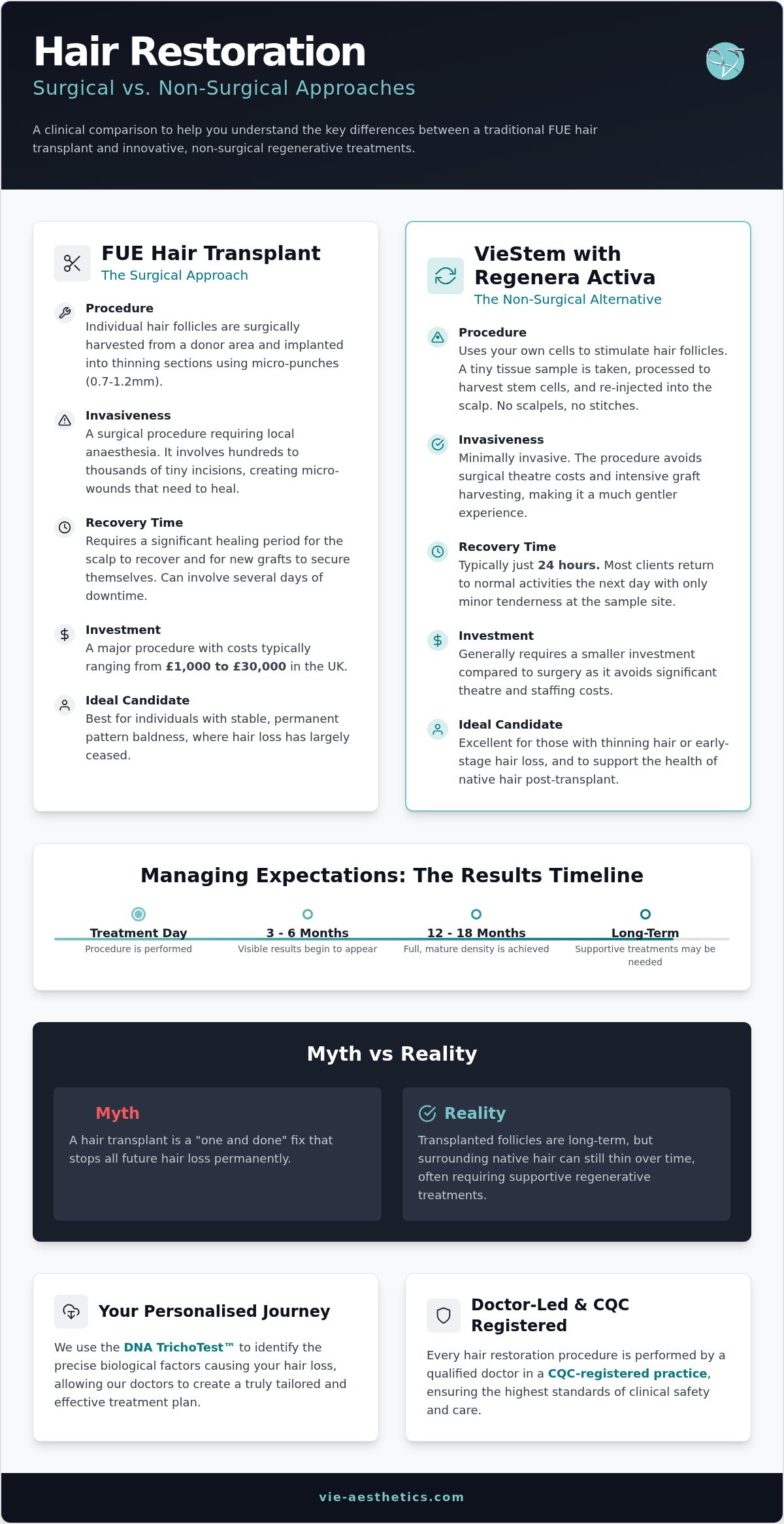
Whilst an fue hair transplant focuses on the “harvest and move” logic, physically relocating follicles from one area to another, regenerative medicine operates on a “stimulate and grow” philosophy. At Vie Aesthetics, we offer VieStem Hair with Regenera Activa as a sophisticated non-surgical alternative. This treatment doesn’t rely on redistribution. Instead, it utilises your body’s own progenitor cells. These are specialised “repair” cells that act as a biological backup system to regenerate damaged or thinning tissue. By concentrating these cells, we can revitalise existing hair that has begun to thin. According to the leading industry authority on hair restoration, surgical excision remains a cornerstone for many, but the shift towards cellular therapy offers a new path for those hesitant about invasive surgery.
| Feature | FUE Hair Transplant | Regenerative (VieStem Hair) |
|---|---|---|
| Nature of Procedure | Surgical excision | Non-surgical injection |
| Downtime | 7 to 10 days | 24 hours |
| Scarring | Micro-dot scarring | No linear or dot scarring |
The procedure is remarkably efficient and typically takes only 30 minutes to complete. Our doctors take a tiny tissue sample from the hairline, which is then processed through a patented system. This isolates high concentrations of progenitor cells and growth factors. Growth factors are natural proteins that signal your body to repair and grow new tissue. These are then injected back into the thinning areas to kickstart the body’s natural repair mechanisms. Unlike many aesthetic treatments, this is often a one-off session; it provides a long-term boost to hair density without a series of repetitive appointments.
Choosing a non-surgical route allows you to preserve your natural hair density without the risks associated with surgery. There is no danger of graft rejection or donor area depletion, which can be a concern with a traditional fue hair transplant if too many follicles are extracted. By thickening your own existing hair, the results appear exceptionally natural. Many clients find that starting with the VieStem Hair / Regenera Activa page provides the education they need to make an informed choice. If you’re unsure which path is right for you, we recommend you book a consultation to discuss your options with our medical team.
Many believe that a hair restoration procedure is a “one and done” permanent resolution. Whilst the follicles relocated during an fue hair transplant are usually resistant to thinning, your surrounding native hair continues to follow its genetic path. This means that without a proactive plan, your results could lose their harmony as natural thinning progresses elsewhere on the scalp.
“It’s vital to understand that hair restoration is a journey, not a destination,” says Dr Ioannis Liakas, Medical Director at Vie Aesthetics. “Whilst an fue hair transplant can produce life-changing results, we must also address the health of the scalp and the surrounding native hair to ensure longevity.” We often recommend supportive therapies such as carboxytherapy, which involves tiny injections of medical-grade carbon dioxide to boost blood flow and oxygen to the follicles.
“Science allows us to restore density, but we cannot entirely stop the biological clock of ageing,” Dr Liakas explains. “We empower our clients to understand that ongoing scalp health is the foundation for maintaining their new, natural look for years to come.” This holistic approach might include medical-grade LED (Light Emitting Diode) therapy to stimulate cellular energy and promote healing.
Having clear expectations is the key to a happy outcome. These treatments are designed to improve your profile, but they have specific limits:
The recovery experience depends on whether you choose a surgical or non-surgical route. Following an FUE procedure, you will likely see scabbing and swelling, and you’ll experience a temporary “ugly duckling” phase where transplanted hairs shed before growing back. This usually requires at least a week of downtime to allow the scalp to heal properly.
Non-surgical regenerative treatments offer a much faster return to normal life. You might feel minor tenderness at the sample site, but most clients return to work the very next day. Regardless of the path you choose, following a doctor-led aftercare plan is essential to protect your investment and ensure the best possible growth.
At Vie Aesthetics, we believe that hair restoration is a deeply personal process that requires more than just a standard procedure. Our philosophy is built on three essential pillars: Listen, Advise, and Empower. We don’t believe in one-size-fits-all packages or high-pressure sales tactics. Instead, every journey begins with a comprehensive medical consultation. This ensures that whether you are considering an fue hair transplant or a non-surgical alternative, your plan is based on clinical necessity and your unique biological needs.
We provide a calm, unhurried environment where you can discuss your concerns with an expert. Our doctors look beyond the surface to understand the underlying drivers of your hair loss.
To truly personalise your care, we utilise the DNA TrichoTest™. This advanced genetic test identifies exactly how your body metabolises different active ingredients. By analysing your unique genetic markers, we can determine which supplements and topical treatments will actually be effective for your specific scalp chemistry. This removes the frustrating “trial and error” approach that many people experience when trying to manage hair loss with over-the-counter products.
This data-driven approach allows us to create a bespoke restoration programme tailored to you. It ensures that every product or treatment you use is scientifically selected to support your journey. This level of precision is invaluable, whether you are preparing for a future fue hair transplant or looking to enhance the results of regenerative therapies like VieStem Hair. You’ll feel confident knowing your treatment is backed by your own DNA.
Before committing to an invasive surgical procedure, it’s vital to seek a professional medical opinion. Our award-winning clinics are CQC-registered, and all clinical procedures are performed exclusively by qualified doctors. We invite you to experience our doctor-led care and discover the most effective, safest path for your hair restoration journey. Our team is here to guide you with transparency and integrity at every stage.
Deciding between a surgical fue hair transplant and a non-surgical alternative is a significant milestone in your restoration journey. We’ve explored how regenerative therapies like VieStem Hair offer a path to increased density with minimal downtime, whilst surgical options provide a traditional route for stable pattern baldness. The most effective strategy always begins with clinical evidence, using tools like the DNA TrichoTest™ to ensure your treatment plan is tailored to your unique biology.
At Vie Aesthetics, your safety and satisfaction are our absolute priorities. Our CQC-registered clinics provide an award-winning environment where all procedures are performed by qualified doctors. We also offer interest-free finance for treatments over £280, ensuring that premium, medical-grade care remains accessible. You don’t have to navigate hair loss alone; expert guidance is available to help you regain your confidence.
We look forward to welcoming you and helping you discover the most effective path for your hair restoration journey.
A hair transplant in the UK typically costs between £1,000 and £30,000 depending on the extent of hair loss and the reputation of the clinic. Non-surgical regenerative treatments generally require a smaller financial investment because they avoid the high overheads of surgical theatre time and intensive graft harvesting. We provide interest-free finance for all treatments over £280 to help make our doctor-led care more accessible.
An fue hair transplant is considered a long-term solution because the follicles moved to the thinning areas are genetically resistant to the hormones that cause loss. However, your surrounding native hair is still susceptible to thinning over time. Many patients find they need supportive regenerative treatments or a second procedure years later to maintain a consistent, natural-looking density across their entire scalp.
You can certainly have Regenera Activa if you have already undergone surgery. It is often recommended as a way to support the health of the native hair that remains around your transplanted grafts. This helps to prevent the “patchy” look that can occur if your original hair continues to thin whilst the transplanted hair remains, ensuring a seamless and thick result.
The recovery time for non-surgical stem cell restoration is typically just 24 hours. Unlike a traditional fue hair transplant, there is no extensive scabbing or significant swelling to manage. Most of our clients return to their professional and social lives the very next day. You might feel a slight tenderness where the small tissue sample was taken, but this usually fades quickly.
Every hair restoration procedure at our clinics is performed by a qualified, experienced doctor. We are a CQC-registered practice, which means we adhere to the highest standards of clinical safety and professional integrity. You won’t be treated by technicians or unlicensed staff; your journey is managed from start to finish by a medical professional dedicated to your care.
Visible results from any hair restoration procedure generally take between 3 and 6 months to appear. This timeline reflects the natural growth cycle of the hair follicle as it enters the growth phase. Whilst initial changes are encouraging, you should expect to see the full, mature density of your results approximately 12 to 18 months after your treatment session.
Article by
Vicky Grammatikopoulou, BHons, MA, PGCE
Vicky Grammatikopoulou is the founder and CEO of Vie Aesthetics, a multi-award winning UK-based aesthetics business built on a philosophy of safety, excellence, education, innovation, and empowerment.
Choosing between an fue hair transplant and a non-surgical alternative depends entirely on your specific hair loss pattern and how much downtime you can afford. An fue hair transplant is a surgical procedure for permanent restoration, whilst regenerative treatments use your own cells to boost density without scalpels. Both paths offer effective ways to regain your confidence under expert medical care.
We know that the thought of surgery can be daunting, especially with concerns about scarring or conflicting advice online. You deserve a clear, honest comparison that helps you make a decision without the pressure of a hard sell. It’s about finding a safe, doctor-led path that fits your lifestyle and restores your hair naturally.
In this guide, you’ll discover the clinical differences between surgical FUE and innovative regenerative alternatives. We will break down the science of stem cell therapy, compare recovery times, and explain how a personalised approach ensures the most natural-looking results. We’ll provide the clinical insight you need to move forward with total confidence.
Follicular Unit Excision, widely known as Follicular Unit Extraction (FUE), is a surgical technique where individual hair follicles are harvested from a “donor area”. This donor area is typically located at the back or sides of the scalp, where hair is genetically programmed to resist thinning. Unlike older “strip” methods, an fue hair transplant involves removing each follicle individually using specialised micro-punches. These tools range from 0.7mm to 1.2mm in diameter, creating tiny circular wounds that heal into nearly invisible white dots.
It is important to remember that this is an invasive procedure. Whilst it is performed as an outpatient service, it requires local anaesthesia to ensure your comfort throughout the day. Because the skin is physically breached hundreds or even thousands of times, you must plan for a recovery period to allow the scalp to heal and the new grafts to “take” or secure themselves in their new position.
The surgery follows a strict, three stage process: harvesting, site preparation, and placement. First, the doctor carefully extracts the follicles from the donor site. Once harvested, the physician prepares the recipient area by making microscopic incisions at the correct angle and depth to mimic natural hair growth. Finally, the grafts are meticulously placed into these sites.
Depending on the number of grafts required, the process usually takes between 4 and 8 hours. Precision is everything. We always advise patients to ensure their procedure is physician-led. Relying on “black market” clinics or unlicensed technicians significantly increases the risk of graft failure and scalp infections, which can permanently damage your donor area.
The ideal candidate for a surgical fue hair transplant is someone with stable, permanent pattern baldness. Stability is key; if you are still losing hair rapidly, the transplanted hair may eventually look like isolated patches as the surrounding natural hair continues to fall away. A thorough medical consultation is necessary to determine if your hair loss has reached a point where surgery is the most logical step.
However, surgery is not suitable for everyone. Patients with active alopecia areata, which is an autoimmune condition, are generally advised against transplants because the body may attack the newly placed follicles. Many of our clients now choose to explore regenerative treatments, such as Regenera Activa, to stimulate their own natural growth before considering the surgical route.
Whilst an fue hair transplant focuses on the “harvest and move” logic, physically relocating follicles from one area to another, regenerative medicine operates on a “stimulate and grow” philosophy. At Vie Aesthetics, we offer VieStem Hair with Regenera Activa as a sophisticated non-surgical alternative. This treatment doesn’t rely on redistribution. Instead, it utilises your body’s own progenitor cells. These are specialised “repair” cells that act as a biological backup system to regenerate damaged or thinning tissue. By concentrating these cells, we can revitalise existing hair that has begun to thin. According to the leading industry authority on hair restoration, surgical excision remains a cornerstone for many, but the shift towards cellular therapy offers a new path for those hesitant about invasive surgery.
| Feature | FUE Hair Transplant | Regenerative (VieStem Hair) |
|---|---|---|
| Nature of Procedure | Surgical excision | Non-surgical injection |
| Downtime | 7 to 10 days | 24 hours |
| Scarring | Micro-dot scarring | No linear or dot scarring |
The procedure is remarkably efficient and typically takes only 30 minutes to complete. Our doctors take a tiny tissue sample from the hairline, which is then processed through a patented system. This isolates high concentrations of progenitor cells and growth factors. Growth factors are natural proteins that signal your body to repair and grow new tissue. These are then injected back into the thinning areas to kickstart the body’s natural repair mechanisms. Unlike many aesthetic treatments, this is often a one-off session; it provides a long-term boost to hair density without a series of repetitive appointments.
Choosing a non-surgical route allows you to preserve your natural hair density without the risks associated with surgery. There is no danger of graft rejection or donor area depletion, which can be a concern with a traditional fue hair transplant if too many follicles are extracted. By thickening your own existing hair, the results appear exceptionally natural. Many clients find that starting with the VieStem Hair / Regenera Activa page provides the education they need to make an informed choice. If you’re unsure which path is right for you, we recommend you book a consultation to discuss your options with our medical team.
Many believe that a hair restoration procedure is a “one and done” permanent resolution. Whilst the follicles relocated during an fue hair transplant are usually resistant to thinning, your surrounding native hair continues to follow its genetic path. This means that without a proactive plan, your results could lose their harmony as natural thinning progresses elsewhere on the scalp.
“It’s vital to understand that hair restoration is a journey, not a destination,” says Dr Ioannis Liakas, Medical Director at Vie Aesthetics. “Whilst an fue hair transplant can produce life-changing results, we must also address the health of the scalp and the surrounding native hair to ensure longevity.” We often recommend supportive therapies such as carboxytherapy, which involves tiny injections of medical-grade carbon dioxide to boost blood flow and oxygen to the follicles.
“Science allows us to restore density, but we cannot entirely stop the biological clock of ageing,” Dr Liakas explains. “We empower our clients to understand that ongoing scalp health is the foundation for maintaining their new, natural look for years to come.” This holistic approach might include medical-grade LED (Light Emitting Diode) therapy to stimulate cellular energy and promote healing.
Having clear expectations is the key to a happy outcome. These treatments are designed to improve your profile, but they have specific limits:
The recovery experience depends on whether you choose a surgical or non-surgical route. Following an FUE procedure, you will likely see scabbing and swelling, and you’ll experience a temporary “ugly duckling” phase where transplanted hairs shed before growing back. This usually requires at least a week of downtime to allow the scalp to heal properly.
Non-surgical regenerative treatments offer a much faster return to normal life. You might feel minor tenderness at the sample site, but most clients return to work the very next day. Regardless of the path you choose, following a doctor-led aftercare plan is essential to protect your investment and ensure the best possible growth.
At Vie Aesthetics, we believe that hair restoration is a deeply personal process that requires more than just a standard procedure. Our philosophy is built on three essential pillars: Listen, Advise, and Empower. We don’t believe in one-size-fits-all packages or high-pressure sales tactics. Instead, every journey begins with a comprehensive medical consultation. This ensures that whether you are considering an fue hair transplant or a non-surgical alternative, your plan is based on clinical necessity and your unique biological needs.
We provide a calm, unhurried environment where you can discuss your concerns with an expert. Our doctors look beyond the surface to understand the underlying drivers of your hair loss. To make our advanced treatments more accessible, we offer interest-free finance options for all procedures over £280. This allows you to focus on your results and well-being rather than the immediate cost of care.
To truly personalise your care, we utilise the DNA TrichoTest™. This advanced genetic test identifies exactly how your body metabolises different active ingredients. By analysing your unique genetic markers, we can determine which supplements and topical treatments will actually be effective for your specific scalp chemistry. This removes the frustrating “trial and error” approach that many people experience when trying to manage hair loss with over-the-counter products.
This data-driven approach allows us to create a bespoke restoration programme tailored to you. It ensures that every product or treatment you use is scientifically selected to support your journey. This level of precision is invaluable, whether you are preparing for a future fue hair transplant or looking to enhance the results of regenerative therapies like VieStem Hair. You’ll feel confident knowing your treatment is backed by your own DNA.
Before committing to an invasive surgical procedure, it’s vital to seek a professional medical opinion. Our award-winning clinics are CQC-registered, and all clinical procedures are performed exclusively by qualified doctors. We invite you to experience our doctor-led care and discover the most effective, safest path for your hair restoration journey. Our team is here to guide you with transparency and integrity at every stage.
Deciding between a surgical fue hair transplant and a non-surgical alternative is a significant milestone in your restoration journey. We’ve explored how regenerative therapies like VieStem Hair offer a path to increased density with minimal downtime, whilst surgical options provide a traditional route for stable pattern baldness. The most effective strategy always begins with clinical evidence, using tools like the DNA TrichoTest™ to ensure your treatment plan is tailored to your unique biology.
At Vie Aesthetics, your safety and satisfaction are our absolute priorities. Our CQC-registered clinics provide an award-winning environment where all procedures are performed by qualified doctors. We also offer interest-free finance for treatments over £280, ensuring that premium, medical-grade care remains accessible. You don’t have to navigate hair loss alone; expert guidance is available to help you regain your confidence.
We look forward to welcoming you and helping you discover the most effective path for your hair restoration journey.
A hair transplant in the UK typically costs between £1,000 and £30,000 depending on the extent of hair loss and the reputation of the clinic. Non-surgical regenerative treatments generally require a smaller financial investment because they avoid the high overheads of surgical theatre time and intensive graft harvesting. We provide interest-free finance for all treatments over £280 to help make our doctor-led care more accessible.
An fue hair transplant is considered a long-term solution because the follicles moved to the thinning areas are genetically resistant to the hormones that cause loss. However, your surrounding native hair is still susceptible to thinning over time. Many patients find they need supportive regenerative treatments or a second procedure years later to maintain a consistent, natural-looking density across their entire scalp.
You can certainly have Regenera Activa if you have already undergone surgery. It is often recommended as a way to support the health of the native hair that remains around your transplanted grafts. This helps to prevent the “patchy” look that can occur if your original hair continues to thin whilst the transplanted hair remains, ensuring a seamless and thick result.
The recovery time for non-surgical stem cell restoration is typically just 24 hours. Unlike a traditional fue hair transplant, there is no extensive scabbing or significant swelling to manage. Most of our clients return to their professional and social lives the very next day. You might feel a slight tenderness where the small tissue sample was taken, but this usually fades quickly.
Every hair restoration procedure at our clinics is performed by a qualified, experienced doctor. We are a CQC-registered practice, which means we adhere to the highest standards of clinical safety and professional integrity. You won’t be treated by technicians or unlicensed staff; your journey is managed from start to finish by a medical professional dedicated to your care.
Visible results from any hair restoration procedure generally take between 3 and 6 months to appear. This timeline reflects the natural growth cycle of the hair follicle as it enters the growth phase. Whilst initial changes are encouraging, you should expect to see the full, mature density of your results approximately 12 to 18 months after your treatment session.