Article by
Vicky Grammatikopoulou, BHons, MA, PGCE
Vicky Grammatikopoulou is the founder and CEO of Vie Aesthetics, a multi-award winning UK-based aesthetics business built on a philosophy of safety, excellence, education, innovation, and empowerment.
Before booking a skin booster treatment, it is essential to understand that this is an injectable skincare regime designed to improve hydration and skin quality, not to alter your facial structure. To ensure the best results from your skin booster, you need a clear plan covering your own suitability, the right product for your goals, a safe practitioner, and the correct pre- and post-treatment care.
The first step in any aesthetic journey is ensuring the treatment aligns with your goals. Skin boosters are exceptionally versatile, but they are designed for specific outcomes. This checklist will help you determine if they are the ideal choice for your skin.
Look closely at your skin. Do you recognise any of these common concerns? Skin boosters are specifically formulated to address them.
One of the most common concerns we hear is the fear of looking ‘overfilled’ or unnatural. Skin boosters are the answer for those who want to enhance their skin, not change their features.
Understanding the precise capabilities of skin boosters helps set realistic expectations for your results.
A skin booster treatment WILL:
A skin booster treatment WON’T:
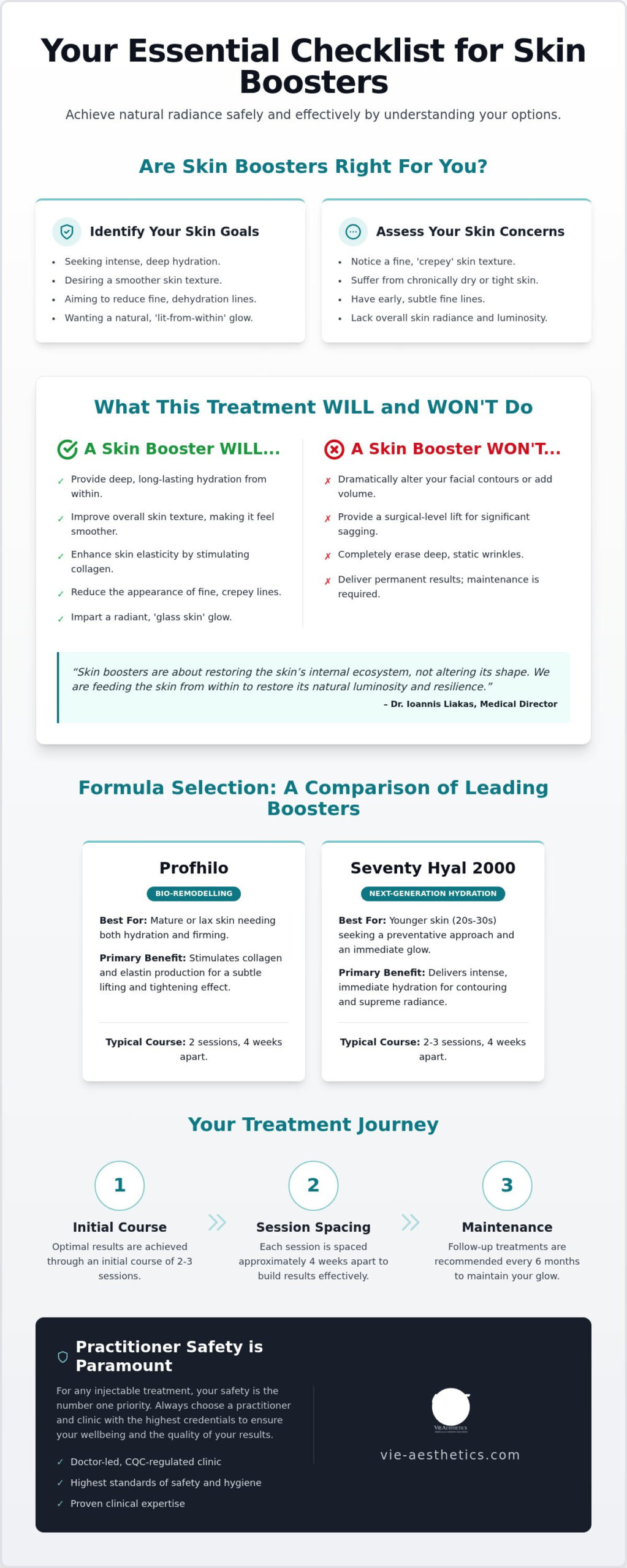
The term ‘skin booster’ covers a growing category of injectable treatments. At Vie Aesthetics, our doctor-led team selects only the most effective, clinically-proven formulas. Understanding the differences will empower you to have a more informed discussion during your consultation.
| Booster Type | Best For | Primary Benefit | Typical Course |
|---|---|---|---|
| Profhilo | Mature or lax skin needing hydration and firming. | Bio-remodelling and collagen stimulation. | 2 sessions, 4 weeks apart. |
| Seventy Hyal 2000 | Younger skin (20s-30s) seeking an immediate glow. | Intense, immediate hydration and radiance. | 2-3 sessions, 4 weeks apart. |
| Polynucleotides | Targeted repair, especially for the delicate under-eye area. | Regenerative healing and cellular repair. | 2-4 sessions, 2-3 weeks apart. |
| Viscoderm Hydrobooster | Targeting dynamic fine lines (e.g., crow’s feet, lip lines). | Hydration plus a ‘stretching’ effect on wrinkles. | 2 sessions, 8 weeks apart. |
The key difference lies in their mode of action. Hyaluronic Acid (HA) based boosters like Profhilo and Seventy Hyal 2000 are masters of hydration, acting like a sponge to draw and hold water in the skin.
Regenerative boosters, such as Polynucleotides, work on a cellular level. They send signals to your cells to repair damage, produce more collagen, and reduce inflammation. This makes them particularly effective for concerns like dark under-eye circles and improving skin health over the long term.
Injectable hydration is a process, not a single event. Your initial course builds the foundation, creating a reservoir of hydration and stimulating collagen. Maintenance sessions, typically every 6 months, are crucial for preserving that luminous quality and continuing to support your skin’s health.
The person holding the needle is infinitely more important than the product inside it. In a largely unregulated industry, it is your responsibility to choose a practitioner and clinic that prioritise your safety above all else. At Vie Aesthetics, we believe in complete transparency and a medical-led approach.
CQC regulation is the most reliable indicator of a clinic’s commitment to patient safety. It means the clinic is held to the same high standards as hospitals and GP surgeries. Vie Aesthetics is not only CQC regulated but has also been recognised with “Best Customer Service” awards during inspections, a testament to our patient-first philosophy.
Knowing that all treatments are doctor-led provides an unparalleled level of reassurance. Our medical team has the anatomical knowledge and clinical experience to deliver results that are both beautiful and safe.
A good consultation is a two-way conversation. You should feel empowered to ask questions to ensure you are completely comfortable.
Proper preparation can significantly enhance your results and minimise the risk of side effects like bruising. Following this simple 48-hour protocol will set you up for a smooth and successful treatment.
Let’s address two of the biggest anxieties surrounding injectable treatments. Our priority is always your comfort and ensuring a positive experience.
Dr. Ioannis Liakas adds, “Comfort is a priority; we use advanced techniques to ensure the process is as gentle as possible. The small papules or ‘blebs’ at the injection sites are a normal sign the product is in place, and they typically settle within 24 hours.”
Knowing the procedure step-by-step can help you feel relaxed and prepared.
[Embedded YouTube Video: A short video from the Vie Aesthetics channel showing a real patient undergoing a skin booster treatment, with commentary explaining each step of the process.]
The care you take after your appointment is just as important as the treatment itself. Following these guidelines will help you protect your investment and enjoy your radiant results for longer.
To maximise the benefits of your skin booster treatment, we developed the VieDerma range. This medical-grade skincare line is formulated to work in synergy with our clinical procedures, providing your skin with the daily support it needs to maintain its health and vibrancy.
Your at-home checklist should include a hydrating serum containing different molecular weights of hyaluronic acid, and a potent antioxidant serum to protect your skin from environmental stressors.
Think of skin boosters as part of your ongoing skin health strategy.
Explore Our Vie Membership for Your Glow Journey
After completing your initial course of 2-3 treatments, the hydrating and skin-smoothing results typically last for around 6 months. A single maintenance session every 6 months is recommended to preserve the effects.
No. Skin boosters are not designed to add volume. They use a very fluid hyaluronic acid that spreads evenly under the skin to hydrate, not to contour or fill. You will experience small, temporary bumps at the injection sites, but these usually resolve within 24 hours, leaving you with a glow, not puffiness.
The primary difference is the chemical structure of the hyaluronic acid. Dermal fillers use a cross-linked HA, which creates a thicker gel designed to stay in one place to add volume or structure. Skin boosters use a non-cross-linked HA, which acts more like a liquid, spreading out to provide widespread hydration and stimulate collagen.
Yes, absolutely. Skin boosters work on skin quality, while Botox relaxes muscles and fillers restore volume. They are excellent complementary treatments. We generally advise waiting at least 2 weeks between different injectable appointments in the same area.
For optimal results, an initial loading course is required. This typically consists of 2 sessions for Profhilo, or 2-3 sessions for brands like Seventy Hyal 2000, spaced about 4 weeks apart. This builds a lasting foundation of hydration in the skin.
The most common side effects are minor and temporary, including the small bumps at the injection sites, mild redness, and potentially some light bruising. These typically resolve within 1-3 days. Choosing a CQC-regulated, doctor-led clinic minimises risks.
Yes. Skin boosters are highly effective for improving skin quality on the neck, décolletage (chest area), and the backs of the hands—areas that often show signs of ageing and dehydration but are not suitable for traditional fillers.
There is no “right” age. Patients in their late 20s and early 30s often use boosters for preventative care and to achieve a “glass skin” glow. For patients with more mature skin, boosters are excellent for restoring hydration, improving elasticity, and softening fine lines. The treatment is tailored to your skin’s condition, not your age.
Article by
Vicky Grammatikopoulou, BHons, MA, PGCE
Vicky Grammatikopoulou is the founder and CEO of Vie Aesthetics, a multi-award winning UK-based aesthetics business built on a philosophy of safety, excellence, education, innovation, and empowerment.
Before booking a skin booster treatment, it is essential to understand that this is an injectable skincare regime designed to improve hydration and skin quality, not to alter your facial structure. To ensure the best results from your skin booster, you need a clear plan covering your own suitability, the right product for your goals, a safe practitioner, and the correct pre- and post-treatment care.
The first step in any aesthetic journey is ensuring the treatment aligns with your goals. Skin boosters are exceptionally versatile, but they are designed for specific outcomes. This checklist will help you determine if they are the ideal choice for your skin.
Look closely at your skin. Do you recognise any of these common concerns? Skin boosters are specifically formulated to address them.
One of the most common concerns we hear is the fear of looking ‘overfilled’ or unnatural. Skin boosters are the answer for those who want to enhance their skin, not change their features.
Understanding the precise capabilities of skin boosters helps set realistic expectations for your results.
A skin booster treatment WILL:
A skin booster treatment WON’T:
The term ‘skin booster’ covers a growing category of injectable treatments. At Vie Aesthetics, our doctor-led team selects only the most effective, clinically-proven formulas. Understanding the differences will empower you to have a more informed discussion during your consultation.
| Booster Type | Best For | Primary Benefit | Typical Course |
|---|---|---|---|
| Profhilo | Mature or lax skin needing hydration and firming. | Bio-remodelling and collagen stimulation. | 2 sessions, 4 weeks apart. |
| Seventy Hyal 2000 | Younger skin (20s-30s) seeking an immediate glow. | Intense, immediate hydration and radiance. | 2-3 sessions, 4 weeks apart. |
| Polynucleotides | Targeted repair, especially for the delicate under-eye area. | Regenerative healing and cellular repair. | 2-4 sessions, 2-3 weeks apart. |
| Viscoderm Hydrobooster | Targeting dynamic fine lines (e.g., crow’s feet, lip lines). | Hydration plus a ‘stretching’ effect on wrinkles. | 2 sessions, 8 weeks apart. |
The key difference lies in their mode of action. Hyaluronic Acid (HA) based boosters like Profhilo and Seventy Hyal 2000 are masters of hydration, acting like a sponge to draw and hold water in the skin.
Regenerative boosters, such as Polynucleotides, work on a cellular level. They send signals to your cells to repair damage, produce more collagen, and reduce inflammation. This makes them particularly effective for concerns like dark under-eye circles and improving skin health over the long term.
Injectable hydration is a process, not a single event. Your initial course builds the foundation, creating a reservoir of hydration and stimulating collagen. Maintenance sessions, typically every 6 months, are crucial for preserving that luminous quality and continuing to support your skin’s health.
The person holding the needle is infinitely more important than the product inside it. In a largely unregulated industry, it is your responsibility to choose a practitioner and clinic that prioritise your safety above all else. At Vie Aesthetics, we believe in complete transparency and a medical-led approach.
CQC regulation is the most reliable indicator of a clinic’s commitment to patient safety. It means the clinic is held to the same high standards as hospitals and GP surgeries. Vie Aesthetics is not only CQC regulated but has also been recognised with “Best Customer Service” awards during inspections, a testament to our patient-first philosophy.
Knowing that all treatments are doctor-led provides an unparalleled level of reassurance. Our medical team has the anatomical knowledge and clinical experience to deliver results that are both beautiful and safe.
A good consultation is a two-way conversation. You should feel empowered to ask questions to ensure you are completely comfortable.
Proper preparation can significantly enhance your results and minimise the risk of side effects like bruising. Following this simple 48-hour protocol will set you up for a smooth and successful treatment.
Let’s address two of the biggest anxieties surrounding injectable treatments. Our priority is always your comfort and ensuring a positive experience.
Dr. Ioannis Liakas adds, “Comfort is a priority; we use advanced techniques to ensure the process is as gentle as possible. The small papules or ‘blebs’ at the injection sites are a normal sign the product is in place, and they typically settle within 24 hours.”
Knowing the procedure step-by-step can help you feel relaxed and prepared.
[Embedded YouTube Video: A short video from the Vie Aesthetics channel showing a real patient undergoing a skin booster treatment, with commentary explaining each step of the process.]
The care you take after your appointment is just as important as the treatment itself. Following these guidelines will help you protect your investment and enjoy your radiant results for longer.
To maximise the benefits of your skin booster treatment, we developed the VieDerma range. This medical-grade skincare line is formulated to work in synergy with our clinical procedures, providing your skin with the daily support it needs to maintain its health and vibrancy.
Your at-home checklist should include a hydrating serum containing different molecular weights of hyaluronic acid, and a potent antioxidant serum to protect your skin from environmental stressors.
Think of skin boosters as part of your ongoing skin health strategy.
Explore Our Vie Membership for Your Glow Journey
After completing your initial course of 2-3 treatments, the hydrating and skin-smoothing results typically last for around 6 months. A single maintenance session every 6 months is recommended to preserve the effects.
No. Skin boosters are not designed to add volume. They use a very fluid hyaluronic acid that spreads evenly under the skin to hydrate, not to contour or fill. You will experience small, temporary bumps at the injection sites, but these usually resolve within 24 hours, leaving you with a glow, not puffiness.
The primary difference is the chemical structure of the hyaluronic acid. Dermal fillers use a cross-linked HA, which creates a thicker gel designed to stay in one place to add volume or structure. Skin boosters use a non-cross-linked HA, which acts more like a liquid, spreading out to provide widespread hydration and stimulate collagen.
Yes, absolutely. Skin boosters work on skin quality, while Botox relaxes muscles and fillers restore volume. They are excellent complementary treatments. We generally advise waiting at least 2 weeks between different injectable appointments in the same area.
For optimal results, an initial loading course is required. This typically consists of 2 sessions for Profhilo, or 2-3 sessions for brands like Seventy Hyal 2000, spaced about 4 weeks apart. This builds a lasting foundation of hydration in the skin.
The most common side effects are minor and temporary, including the small bumps at the injection sites, mild redness, and potentially some light bruising. These typically resolve within 1-3 days. Choosing a CQC-regulated, doctor-led clinic minimises risks.
Yes. Skin boosters are highly effective for improving skin quality on the neck, décolletage (chest area), and the backs of the hands—areas that often show signs of ageing and dehydration but are not suitable for traditional fillers.
There is no “right” age. Patients in their late 20s and early 30s often use boosters for preventative care and to achieve a “glass skin” glow. For patients with more mature skin, boosters are excellent for restoring hydration, improving elasticity, and softening fine lines. The treatment is tailored to your skin’s condition, not your age.