Article by
Vicky Grammatikopoulou, BHons, MA
Vicky Grammatikopoulou is the founder and CEO of Vie Aesthetics, a multi-award winning UK-based aesthetics business built on a philosophy of safety, excellence, education, innovation, and empowerment.
Did you know that 46% of UK adults incorrectly believe all aesthetic practitioners are already regulated by law? To verify a clinic’s safety, you must check professional registers and CQC status to ensure you are choosing medical aesthetics, qualified, clinics in the UK. Identifying medical aesthetics qualified clinics is essential for your safety and to avoid the risks associated with unregulated providers.
It’s completely natural to feel confused by the mix of doctors, nurses, and beauticians offering treatments on the high street. You’ve likely heard worrying stories about botched procedures and felt uncertain about what CQC registration actually covers for your protection. We agree that navigating this landscape is daunting, but your peace of mind shouldn’t be left to chance when it comes to your health.
In this guide, we provide a clear framework for auditing any clinic in London and Essex so you can feel confident you’re in expert medical hands. We will explore the essential steps to verify credentials, explain the impact of the new 2026 licensing scheme, and reveal why a doctor-led environment remains the gold standard for your care. By the end, you’ll have the tools to distinguish clinical excellence from cosmetic risk.
To check if a practitioner is qualified, you must verify their professional registration on the GMC, NMC, or GDC databases and ensure the clinic is CQC-regulated. Finding medical aesthetics, qualified, clinics in the London, Essex requires looking beyond aesthetics into the field of Aesthetic Medicine Overview. This discipline focuses on clinical outcomes and patient health rather than surface-level beauty therapies.
The UK market remains complex, particularly in high-competition areas where many providers operate in a “grey zone.” The distinction between a spa treatment and a medical procedure is often blurred by clever marketing. It is vital to understand the difference between a beautician and a medical professional before you book any injectable treatment.
To help you choose the right professional for your journey, watch this helpful video:
The table below outlines the fundamental differences in care you can expect between these two types of providers:
| Feature | Beautician | Medical Professional |
|---|---|---|
| Clinical Foundation | Short vocational certificates | Multi-year medical or nursing degree |
| Anatomy Knowledge | Surface-level skin training | Deep vascular and muscular study |
| Prescribing Rights | Cannot prescribe medical drugs | Can prescribe or works with a medic |
| Emergency Care | Limited to basic first aid | Trained to manage medical complications |
Injecting is a medical act. It involves bypassing the skin’s protective barrier to place substances near vital structures like nerves and blood vessels. Medical professionals understand the intricate vascular map of the face, which reduces the risk of accidental injury. They also hold the legal authority to prescribe substances like Botox, ensuring a safe and regulated chain of custody for your treatments.
Registration with the official body of British College of Aesthetic Medicine (BCAM) guarantees your doctor injector is accredited and qualified for these treatments. In combination with CQC registration of the clinic, you can be assured that medical aesthetics, qualified clinics maintain the highest standards of ethics and patient care.
When researching medical aesthetics, qualified, clinics in the London, Essex area, your first step should always be a formal audit of the individual practitioner. Transparency is the hallmark of a professional medical provider.
“Safety in aesthetics is non-negotiable; it begins with the credentials of the person holding the needle,” explains Medical Director Dr Ioannis Liakas.
To protect yourself, follow these three essential steps before any treatment.
This rigorous approach is aligned with recent UK Government Action on Cosmetic Procedure Safety. These measures aim to eliminate the risks posed by unregulated providers who lack the necessary clinical foundation.
Searching the GMC “List of Registered Medical Practitioners” is straightforward. Enter the doctor’s name or seven-digit GMC number to view their status. You must look for the phrase “Registered with a licence to practise”. This indicates they’re legally permitted to work as a doctor in the UK. Always check for any “restrictions” or “conditions” listed on their profile, as these can signal past issues with their clinical conduct or competency.
It’s vital to distinguish between a short training course and a true medical qualification. A weekend certificate in fillers doesn’t equate to the years of training required for a medical degree. Expertise is built through ongoing medical education and specialised certifications. For instance, advanced procedures like Endolift laser treatments require specific technical mastery that non-medics simply don’t possess. If you’d like to discuss your goals with our medical team, you can book your consultation online to ensure you’re in safe hands.
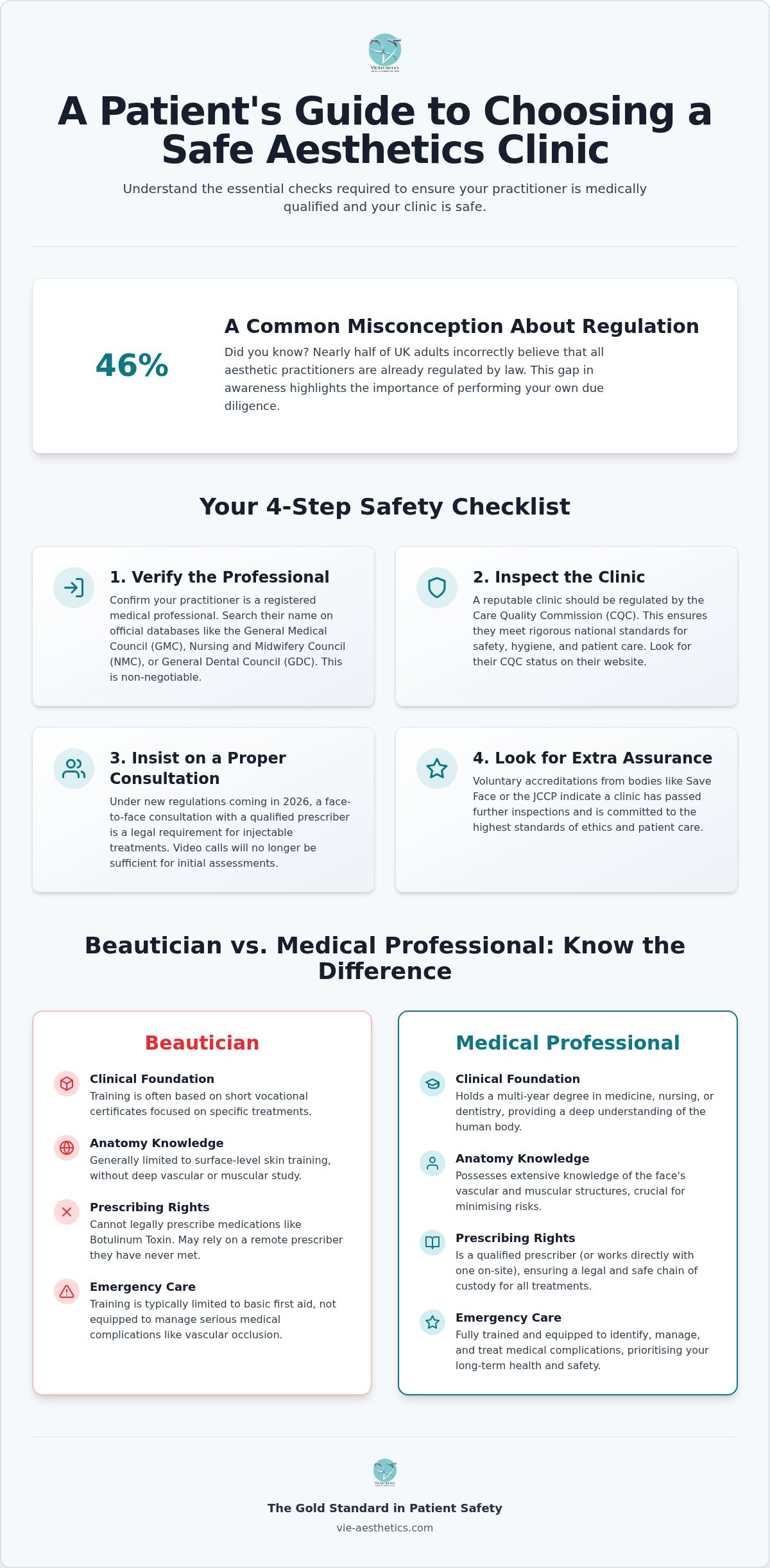
The Care Quality Commission (CQC) is the independent regulator of health and social care in England. Its primary role is to ensure that healthcare services provide people with safe, effective, and high-quality care. When evaluating medical aesthetics, qualified, clinics in the London, Essex, looking for the CQC mark is your most reliable safety check. It indicates the clinic has been formally inspected on its clinical protocols, staff training, and the way it monitors patient safety.
Myth vs Reality: Many people assume that all clinics offering injectables are legally regulated. This is a myth. In reality, CQC registration is currently only mandatory for clinics performing “regulated activities,” such as thread lifts or treating medical conditions like excessive sweating. However, under the 2026 licensing scheme, amber-tier procedures like Botox and fillers now require a local authority licence for both the practitioner and the premises, closing the gap that previously allowed unregulated “home clinics” to operate.
At Vie Aesthetics, we’ve always prioritised these standards as part of Our Story and Commitment to Excellence. This is particularly relevant when considering the distinction between inpatient surgery and “Soft Surgery.” Procedures like Plexr are non-invasive alternatives to traditional surgery. Whilst they don’t require a hospital theatre, they still demand a sterile, medical environment and expert handling that a high-street hair salon simply cannot provide.
A reputable clinic operates with a patient-first philosophy that prioritises long-term health over immediate sales. You can spot a high-standard provider by how they manage your journey from the first consultation.
During your initial visit, observe the environment closely. A CQC-regulated clinic must adhere to strict sterilisation and sharps disposal protocols to prevent cross-contamination. They also have robust systems for protecting your private data and medical records. These details might seem small, but they’re the foundation of a safe medical aesthetics, qualified, clinics in the London, Essex experience.
Choosing a clinic is about more than just finding a provider; it’s about finding a partner in your long-term health. At Vie Aesthetics, we set a high benchmark for medical aesthetics, qualified, clinics in the London, Essex area. We operate with a strict policy where all medical procedures are performed by doctors or highly qualified medical practitioners. You can Meet our team of medical experts to see the clinical expertise behind our practice.
Our Medical Director, Dr Ioannis Liakas, believes that safety is the foundation of every successful outcome. He notes,
“Our holistic approach ensures we treat the individual, not just the symptom, using the safest innovative technologies available.”
This commitment to innovation allows us to offer advanced treatments such as Endolift, Morpheus8, and Regenera Activa within a secure, clinical framework.
We avoid generic, off-the-shelf solutions. Every patient journey begins with a detailed assessment to combine medical, aesthetic, and wellness services for natural results. For those seeking hair restoration, we utilise diagnostic testing like the DNA TrichoTest to identify the specific biological factors affecting your hair health. This level of precision ensures that your treatment plan is as unique as your genetic makeup.
Our dedication to professional integrity has earned us national recognition, including the prestigious Investors in People Gold status. We are proud of our 2023 CQC inspection results, which highlighted our exceptional customer service and safety protocols. To make these regulated medical aesthetics, qualified, clinics in the London, Essex services more accessible, we offer a Vie Membership scheme that allows for consistent, high-quality care without compromising on safety.
Choosing a provider is a significant decision that deserves your full attention. By using professional registers and verifying CQC status, you move beyond marketing claims and into the realm of clinical certainty. When searching for medical aesthetics, qualified, clinics in the London, Essex, your priority must remain on safety and professional accountability. This systematic approach ensures you avoid the risks of unregulated environments and focus on restorative, natural results.
Our doctor-led clinical team is dedicated to providing this peace of mind. As a CQC inspected and approved practice, we adhere to the highest standards of medical care and hygiene. Being named Global Aesthetic Practice of the Year reflects our commitment to excellence and innovation in every bespoke treatment plan we create for our patients. You don’t have to navigate these complex choices alone.
We invite you to experience a consultation where your health and individual goals are our primary focus. Your journey towards confidence should be guided by experts who value ethics as much as outcomes. We look forward to welcoming you and helping you achieve the results you deserve in a safe, professional setting.
The most reliable way is to check the GMC register for their seven-digit registration number. Beyond basic registration, you should check if they are on the Specialist Register, which indicates higher-level training in a specific medical field. At Vie Aesthetics, our medical aesthetics, qualified, clinics in the London, Essex are led by Dr Ioannis Liakas, ensuring every treatment is overseen by a doctor with extensive clinical experience.
Currently, it is not a criminal offence, but the legal landscape is shifting rapidly with the 2026 licensing mandate. Because Botox is a Prescription Only Medicine (POM), it is illegal for a non-medic to administer it without a prior face-to-face assessment by a qualified prescriber. Using medical aesthetics, qualified, clinics in the London, Essex guarantees that your prescriber and injector are medically trained to handle the potent nature of these clinical substances.
You should ask, “Do you have a crash kit with Hyalase on-site to dissolve filler in an emergency?” and “What is your protocol for managing a vascular occlusion?” Hyalase is the essential enzyme used to reverse dermal fillers if a blood vessel becomes blocked. A qualified practitioner will explain their emergency protocols clearly. You should also ask to see the manufacturer’s packaging to verify the authenticity and expiry date of the products being used.
Medical consultation fees typically range between £50 and £150, reflecting the doctor’s diagnostic expertise and time. This fee often covers a full clinical assessment and is usually redeemable against the cost of your chosen treatment.
The most severe risks include skin necrosis, which is permanent tissue death caused by blocked blood flow, and even accidental blindness. Unqualified practitioners often lack the anatomical knowledge to avoid vital arteries or the medical training to identify early signs of complications. They also cannot legally stock the prescription-only emergency medications required to treat these events. Choosing a medical expert ensures these rare but serious risks are managed with clinical precision.
No, CQC registration is not yet universal for purely cosmetic filler or toxin treatments. However, it is a legal requirement for any clinic performing thread lifts or treating medical conditions like hyperhidrosis. Under the 2026 licensing scheme, local authorities will require a specific premises licence for all clinics offering high-risk procedures. Opting for a CQC-regulated clinic now ensures you are entering an environment already held to the highest national standards of clinical hygiene.
 Read this article
 Read this article