Article by
Vicky Grammatikopoulou, BHons, MA, PGCE
Vicky Grammatikopoulou is the founder and CEO of Vie Aesthetics, a multi-award winning UK-based aesthetics business built on a philosophy of safety, excellence, education, innovation, and empowerment.
What if the secret to your best skin ever isn’t adding more products, but using fewer, more potent ones? The best medical grade skincare routine for 2026 is a doctor-led, bespoke programme that prioritises high-stability active ingredients over complex, multi-step layering. By moving away from over-the-counter trends and focusing on a clinical medical grade skincare routine, you can achieve visible results for pigmentation and fine lines without the risk of skin barrier fatigue.
It’s common to feel exhausted by the endless cycle of new serums and viral ingredients that promise much but deliver little. You’ve likely spent a significant amount on creams that sit on the surface without creating real change. We understand that clinical terminology can feel like a different language, leaving you unsure which bottle actually supports your skin’s internal health.
This guide will help you discover the clinical science behind medical-grade protocols and how a bespoke routine can transform your skin health from the inside out. We’ll strip away the confusion to provide a simplified but potent daily programme. You’ll learn how to build a regimen that visibly reduces fine lines whilst ensuring your skin feels resilient, healthy, and truly restored.
A medical grade skincare routine is a professional-led programme using high-potency products to transform skin at a cellular level. Unlike high-street alternatives, these protocols use standardised, pharmaceutical-grade ingredients designed to reach the deeper dermal layers where true change happens. This clinical approach ensures your medical grade skincare routine delivers measurable results rather than surface-level hydration.
We categorise skincare into three distinct tiers: cosmetic, cosmeceutical, and pharmaceutical. Cosmetic products are generally restricted to the epidermis, which is the top layer of skin, and focus primarily on scent or basic moisture. What are cosmeceuticals? This term describes the bridge between cosmetics and medicine, containing bioactive ingredients that influence skin function. Pharmaceutical-grade products, such as those in our VieDerma range, contain 99% pure active ingredients and utilise advanced transdermal delivery systems to bypass the skin’s protective barrier.
Product efficacy depends heavily on pH levels. If a formula isn’t balanced at the correct acidity, it cannot penetrate the skin’s natural defences. Clinical lines feature significantly higher concentrations of Retinol and Vitamin C compared to cosmetic options. Whilst a high-street serum might only contain trace amounts of an active, medical formulations use potent, stabilised doses. This clinical stabilisation is vital; it prevents ingredients from degrading whilst sitting on your shelf, ensuring they remain effective until the very last drop.
High-potency actives are transformative but require expert handling. Mixing powerful ingredients without guidance can lead to barrier damage, resulting in sensitivity or redness. Our doctors customise every protocol based on your specific skin cell turnover rate. This bespoke care is essential because your skin’s needs change. Regular assessments allow us to evolve your routine as your skin becomes more resilient, ensuring your journey towards health is both safe and unhurried.
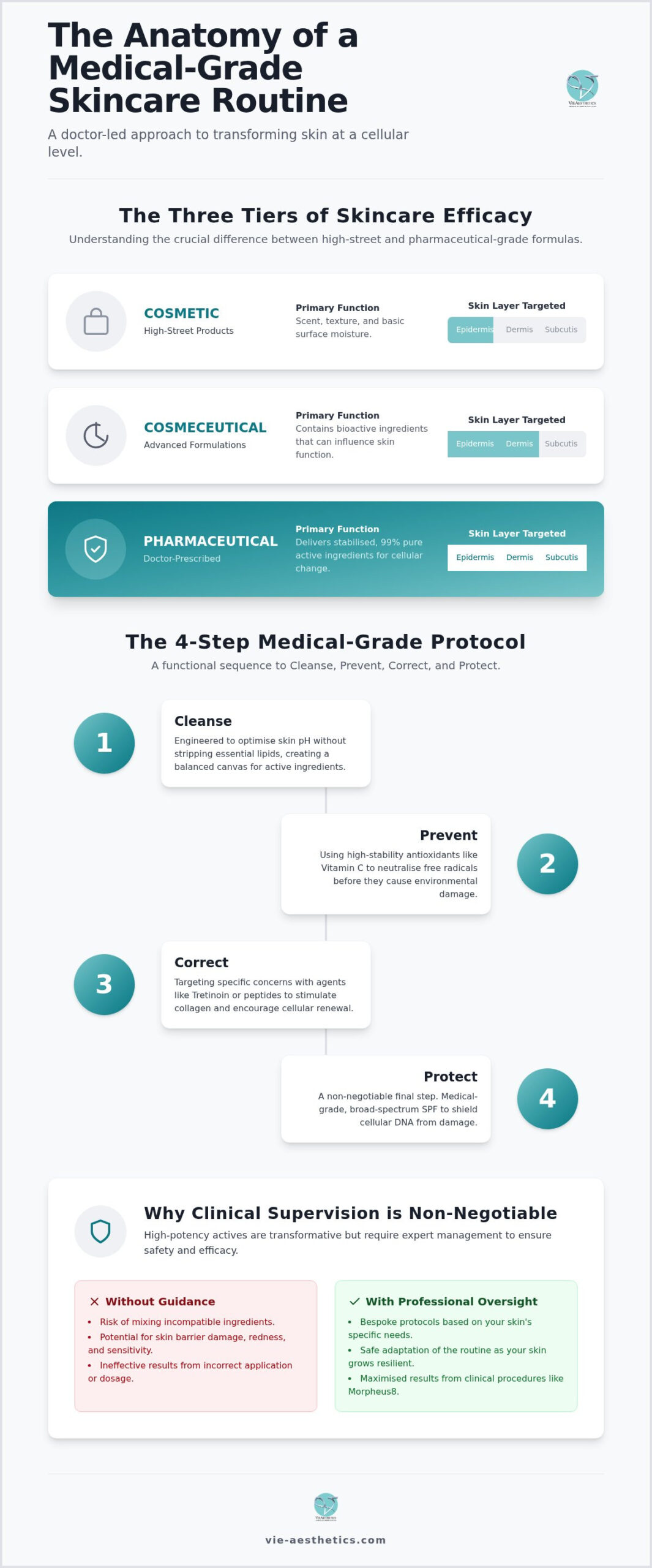
A successful medical grade skincare routine follows a logical, tiered progression. This isn’t a generic kit found on a shelf; it’s a bespoke strategy designed to maximise the absorption of every active ingredient. Dr Ioannis Liakas often reminds our clients that “Skincare is the foundation upon which all clinical results are built; without it, we are merely treating the surface.” By following a functional sequence, each product prepares the skin for the next, ensuring your investment works as hard as possible.
Medical cleansers do more than just wash away the day. They are engineered to optimise skin pH without stripping essential lipids. This is a critical distinction from many high-street soaps that can disrupt the acid mantle. Once the skin is balanced, we move to prevention. Using high-stability antioxidants like L-ascorbic acid (Vitamin C) neutralises free radicals before they cause environmental photodamage. Whilst the FDA regulation of cosmetics focuses on safety, medical-grade standards focus on bio-activity. Preventing damage is always more effective than attempting to reverse deep-seated changes later.
The “Correct” phase is where we target specific concerns. We use prescription-strength agents like Tretinoin or signal peptides to stimulate collagen and elastin production. These actives communicate directly with your cells to encourage renewal. Finally, the “Protect” mandate is non-negotiable. Medical-grade SPF offers broader protection and more stable filters than standard sun creams. Sun protection in a medical grade skincare routine acts as a daily insurance policy for your cellular DNA.
If you’re ready to move beyond guesswork, you can book a skin assessment to begin your personalised journey.
Adopting a medical grade skincare routine is a commitment to biological change rather than a quick cosmetic fix. Whilst the potency of these products is high, the results depend on a personalised approach that respects your skin’s unique threshold. We often see clients who are eager for transformation but wary of clinical strength. It’s vital to understand that a professional protocol is designed to work with your skin’s natural rhythm, not against it.
Managing expectations is a core part of our consultation process. Your medical grade skincare routine is a powerful tool, but it functions differently from in-clinic procedures. Understanding these boundaries ensures you remain confident in your progress.
For those with sensitive skin, we adjust the protocol by phasing in active ingredients slowly. This “low and slow” method allows your cells to build tolerance without compromising on the final outcome. We monitor your progress closely, ensuring your skin remains resilient and comfortable throughout the journey.
A medical grade skincare routine is most effective when it serves as a clinical support tool rather than an isolated habit. At Vie Aesthetics, we view homecare as the vital preparation phase for advanced energy-based treatments. Dr Ioannis Liakas explains that “A medical-grade routine is like a gym membership for your skin, consistency and the right equipment are non-negotiable.” By optimising your skin’s health before a procedure, you ensure that technologies like Morpheus8 can perform at their peak.
Healthy, well-hydrated skin conducts radiofrequency and laser energy more efficiently. If the epidermis is resilient, we can achieve deeper results with less downtime during “soft surgery” or non-surgical lifting. This synergy is a core component of our VieLift programme, where we combine multiple modalities to restore facial contours. Strengthening your skin barrier beforehand ensures a smoother recovery and more predictable outcomes from your Endolift session.
Our proprietary VieDerma Skincare Range was developed to bridge the gap between homecare and clinical results. These products are formulated specifically to meet the needs of our patients, particularly those undergoing regenerative treatments. Using a range that’s fully integrated into your clinical plan means every ingredient supports your specific recovery journey. To make this level of care sustainable, our Vie Membership Scheme allows you to maintain your medical grade skincare routine affordably with monthly benefits and discounts.
We’ve explored how high-stability actives and a structured four-step framework outperform high-street alternatives. A bespoke medical grade skincare routine is more than daily maintenance; it’s a strategic investment that prepares your skin for advanced regenerative treatments. By focusing on cellular health rather than surface-level trends, you ensure your skin remains resilient and vibrant through 2026 and beyond.All our protocols are prescribed by qualified medical practitioners, ensuring safety and precision at every stage. By utilising our award-winning VieDerma range, you’re accessing innovation recognised for global excellence in aesthetic practice. To support your journey, we offer interest-free finance for treatments over £280, making premium clinical care more accessible.Book your medical skincare consultation
Your journey toward healthy, restored skin starts with a single professional assessment. Our team is ready to guide you through a bespoke programme that delivers visible, unhurried results.
Medical Grade Skincare: What Is It and Is It Worth It?
Dermapen vs Traditional Microneedling: Why It Is Different?
Oily Skin Care Tips: Your Essential Guide
Botox vs Filler: 7 Myths You Shouldn’t Believe
What is male sexual wellness and how can you optimise it?
Transformation typically takes 6 to 12 weeks of consistent use. This timeframe aligns with the natural skin cell turnover cycle, which is essential for seeing structural changes. Whilst you might notice a surface glow within the first few days, deeper improvements to pigmentation and fine lines require patience. If you are also interested in specialised clinical procedures, you can visit Be-Youth to learn about professional laser spot removal. We monitor your progress at regular intervals to ensure your medical grade skincare routine is evolving alongside your skin’s health.
Whilst you can technically mix products, we generally advise against it without professional guidance. High-street formulas often contain fragrances or preservatives that can react with high-potency clinical actives. This can lead to irritation or neutralise the effectiveness of your serums. It’s much safer to let your doctor review your current cupboard to ensure your medical grade skincare routine isn’t being compromised by incompatible ingredients.
Professional guidance is essential because many potent products require a consultation to ensure they’re safe for your specific skin type. High-concentration actives, like those found in VieDerma or ZO SkinHealth, can cause damage if used incorrectly. At Vie Aesthetics, our qualified medical practitioners assess your skin first. This unhurried approach prevents barrier damage and ensures you’re using the correct strength of pharmaceutical-grade products for your needs.
Certain high-strength ingredients, such as retinoids and salicylic acid, should be avoided whilst you’re pregnant or breastfeeding. However, many other clinical actives like Vitamin C, Niacinamide, and specific peptides are perfectly safe and highly beneficial. We specialise in adapting your medical grade skincare routine to support your skin through these hormonal changes. Always consult with our medical team so we can provide a safe, bespoke protocol for you.
Initial redness or peeling, often called the acclimation phase, occurs because medical-grade products accelerate your skin’s cell turnover rate. As fresh, healthy cells rise to the surface, the older, duller layer sheds more quickly. This is a positive sign that the bioactive ingredients are successfully communicating with your skin at a cellular level. We usually manage this by introducing products slowly, allowing your skin to build resilience comfortably.
The investment is worth it because of the 99% pure active ingredients and advanced delivery systems used. You’re paying for standardised formulas that reach the deeper dermal layers rather than sitting on the surface. Because these products are more potent, you often need to use less, making them cost-effective over time. Plus, our Vie Membership scheme provides monthly benefits to help maintain your clinical results affordably.