To get rid of eye bags and dark circles, you need a bespoke medical plan that prioritises cellular regeneration through treatments such as tear trough, dark sircles, polynucleotides, skin boosters, exosomes, microneedling, endolift, HiFu. Our doctors specialise in these advanced techniques to ensure your results look natural and rested whilst addressing the specific anatomy of tear trough, dark sircles, polynucleotides, skin boosters, exosomes, microneedling, endolift, HiFu.
It’s frustrating to look tired despite a full night’s sleep, especially when you’re confused by the overwhelming number of treatment options available. You might feel a sense of hesitation regarding needles or the downtime associated with surgery, but modern aesthetics offers a far more unhurried and gentle path. You deserve a solution that respects your natural beauty and provides a refreshed appearance without the need for invasive theatre procedures.
This guide will help you discover how the latest non-surgical technologies can rejuvenate your eye area and restore lost volume whilst avoiding the “puffy” look of traditional fillers. We’ll explore the science behind these restorative treatments and explain how we create a journey tailored specifically to your long-term skin health. You’ll gain the confidence to choose a path that delivers lasting, authentic results.
The skin surrounding your eyes is remarkably delicate. At just 0.5mm thick, it’s the thinnest skin on your body, which makes it particularly vulnerable to the passage of time. When we discuss Periorbital dark circles, we’re often looking at a complex interplay of anatomy and biology. Whether you’re concerned about a hollow tear trough or persistent shadows, understanding the root cause is the first step toward a bespoke treatment plan.
To better understand the structural differences in this area, watch this helpful video:
Not all shadows are created equal. You might notice your circles look blue or purple, which usually indicates a vascular issue where blood vessels show through the thin skin. Brownish tones, however, suggest true pigmentation. You can test this at home using the pinch test. Gently lift the skin under your eye; if the colour moves with the skin, it’s pigment. If the colour seems to stay deep or improves as you lift, it’s likely a shadow caused by a hollow tear trough.
Structural hollowing happens because our facial anatomy changes as we age. Bone resorption and the migration of fat pads create a physical depression. This is often exacerbated by lifestyle factors like poor hydration or allergies, which can cause fluid retention and make the area look more prominent. Our doctors specialise in diagnosing these nuances to determine the best use of a tear trough, dark sircles, polynucleotides, skin boosters, exosomes, microneedling, endolift, or HiFu approach.
Modern aesthetic medicine is moving away from simply masking signs of ageing. We’re witnessing a significant shift toward regenerative aesthetics, focusing on repairing the skin’s architecture at a cellular level. Whilst traditional dermal fillers provide immediate volume, they aren’t always the ideal starting point for every patient. Over-filling the under-eye can sometimes lead to a heavy or puffy appearance.
Instead, we look to innovative treatments like polynucleotides, skin boosters, and exosomes to improve skin quality. These bio-stimulators encourage your body to produce its own collagen and elastin. This approach ensures your results look natural and last longer. Dr Ioannis Liakas, our Medical Director, explains our philosophy: “Our goal is to celebrate your natural beauty by restoring what time has diminished, using the body’s own regenerative powers.”
Whether we utilise microneedling to improve texture or advanced technology like endolift and HiFu to tighten lax skin, the focus remains on long-term health. Combining these modalities allows us to address the tear trough, dark sircles, polynucleotides, skin boosters, exosomes, microneedling, endolift, HiFu concerns with precision and care.
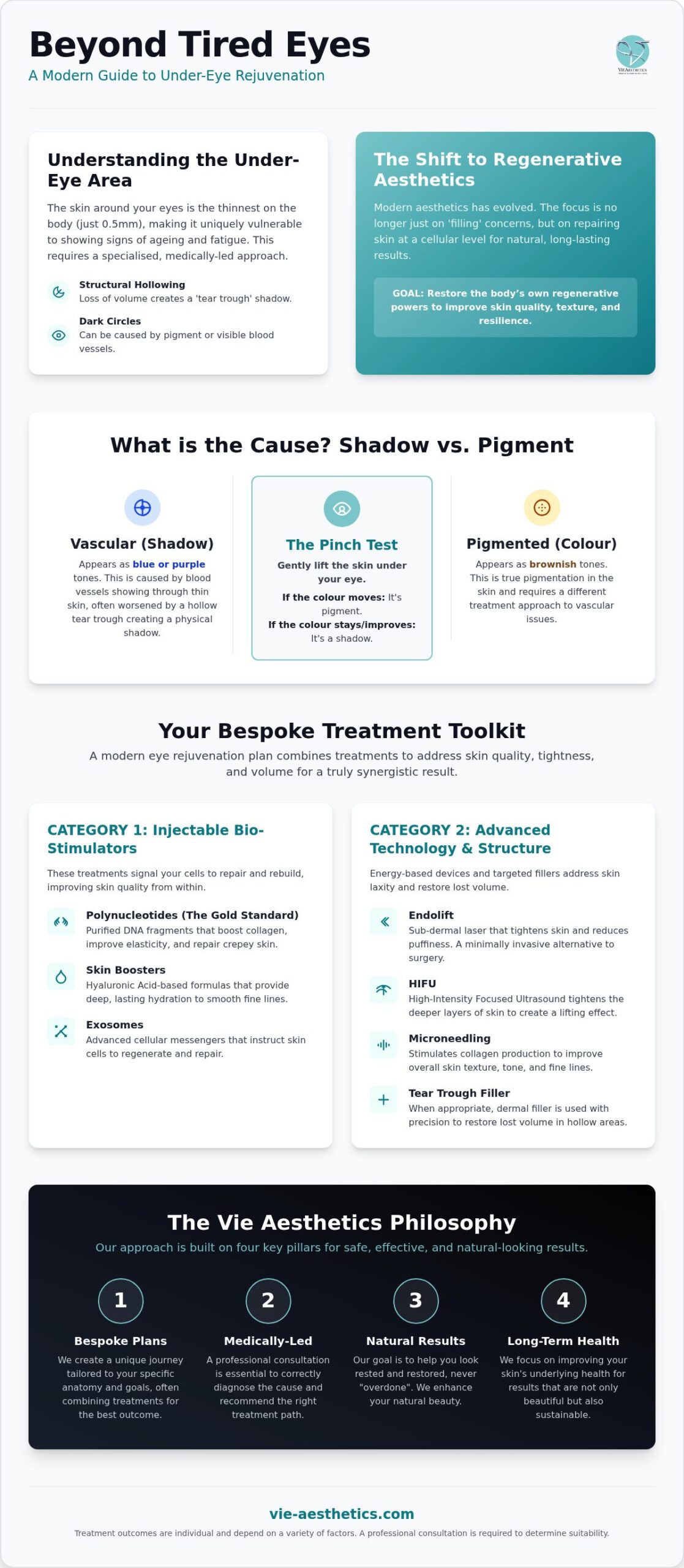
Modern aesthetics offers a tiered approach to eye rejuvenation. We can now combine treatments for the tear trough, dark sircles, polynucleotides, skin boosters, exosomes, microneedling, endolift, HiFu to create a truly bespoke result. This shift from simply “filling” to “regenerating” ensures the delicate under-eye area remains bright and smooth without appearing overdone or puffy.
Polynucleotides are currently considered the gold standard for treating crepey under-eye skin. These injectables consist of purified DNA fragments, typically salmon sperm-derived, which act as biological signals to your cells. Once injected, they tell your fibroblasts to start repairing damaged tissue and producing fresh collagen. This process increases skin thickness and reduces the appearance of tired shadows. Unlike some traditional fillers, they don’t attract water, which significantly lowers the risk of post-treatment swelling. You can find more details on our polynucleotides treatment page.
The latest 2026 innovation in cellular signalling involves exosomes. These are microscopic messengers that facilitate communication between cells, effectively telling older skin cells to behave like younger ones. Whilst skin boosters like Profhilo provide intense hyaluronic acid hydration to smooth fine lines, exosomes focus on deep cellular repair. We often pair exosome therapy with microneedling for skin rejuvenation to ensure these messengers reach the deeper layers of the dermis where they are most effective.
Choosing between these depends on whether your skin needs immediate moisture or a total regenerative reset. The following table highlights the key differences between these injectable options:
| Treatment | Primary Benefit | Typical Downtime |
|---|---|---|
| Polynucleotides | Thickens skin and repairs texture | 24 to 48 hours |
| Skin Boosters | Intense hydration and “glow” | Minimal (under 24 hours) |
| Exosomes | Advanced repair and signalling | Minimal (mild redness) |
Whilst regenerative options are thriving, traditional tear trough fillers remain a vital tool for those with significant structural hollowing. If your concern is primarily a loss of deep fat pads, a targeted hyaluronic acid filler can provide the structural support that biostimulators alone might not achieve. During a bespoke skin assessment, our doctors will help you determine the most effective path for your specific anatomy.
While injectable solutions offer remarkable cellular repair, advanced medical technology allows us to address structural skin laxity and fat deposits that needles alone cannot reach. By integrating these devices into a treatment plan, we provide a comprehensive alternative to traditional surgery. This technological approach is particularly effective for those who experience puffiness or a heavy appearance in the lower eyelid area.
Endolift represents a significant leap in non-surgical eye rejuvenation. This treatment utilises Eufoton laser technology, which involves a microscopic, hair-thin optical fibre inserted just beneath the skin’s surface. It targets the orbital area with extreme precision. The laser energy simultaneously melts small pockets of fat and causes immediate tissue contraction. This dual action tightens the skin and reduces the appearance of prominent eye bags without any incisions or general anaesthesia.
For many patients, this provides a sophisticated middle ground between topical care and a surgical blepharoplasty. You can learn more about the process on our dedicated Endolift treatment page. It’s often featured as a cornerstone in our Non-surgical face lift roundup due to its ability to remodel the face from the inside out.
To achieve a natural lift, we often look to HiFu (High-Intensity Focused Ultrasound). This technology targets the SMAS layer, which is the same deep tissue that surgeons manipulate during a facelift. By delivering focused energy at specific depths, HiFu stimulates a lifting effect in the brow and lower eyelid area. It’s a comfortable, unhurried process that respects your natural anatomy whilst encouraging long-term structural support.
When texture and fine lines are the primary concern, we turn to microneedling. This procedure creates controlled micro-channels in the skin to trigger a healing response. When we pair this with exosomes, the results are amplified. These advanced messengers accelerate repair, leading to smoother, brighter skin. There are various medical treatments for dark circles, and technology plays a critical role in addressing the skin laxity that often causes shadows.
For those seeking to address hooded lids, PlexR Soft Surgery offers a plasma-based alternative to a surgical eyelid lift. It works by contracting the skin through sublimation, providing a refreshed look with significantly less downtime than a theatre-based procedure. Whether you require a combination of treatments for the tear trough, dark sircles, polynucleotides, skin boosters, exosomes, microneedling, endolift, HiFu, our medical team designs a plan just for you.
Dr Ioannis Liakas notes the transformative power of these tools: ‘Technology like Endolift allows us to achieve results that were previously only possible through surgery, but with minimal downtime.’
A refreshed appearance begins with an unhurried, medical-led consultation. We take the time to understand your lifestyle and aesthetic goals before recommending a pathway involving tear trough, dark sircles, polynucleotides, skin boosters, exosomes, microneedling, endolift, HiFu. This diagnostic phase is essential because it allows our doctors to distinguish between simple shadows and structural changes.
Every face is unique, and your plan should reflect that. We prioritise professional integrity by ensuring you feel informed and empowered throughout your journey. Our practitioners listen carefully to your concerns, providing a calm and reassuring environment where your safety is the primary focus.
Safety is the foundation of everything we do. As a CQC-regulated clinic, we ensure that every procedure is performed by qualified doctors or medical practitioners. This commitment to excellence means you can feel confident and supported throughout your transformation.
Preparing for your visit is simple. Think about your health history and what you’d like to achieve, and we’ll handle the rest. You can learn more about our dedicated medical team on our Meet the Team page.
Achieving a refreshed and youthful eye area is no longer about temporary fixes; it’s about investing in the long-term health of your skin. We’ve discussed how a bespoke combination of treatments for the tear trough, dark sircles, polynucleotides, skin boosters, exosomes, microneedling, endolift, HiFu provides a sophisticated alternative to surgery. By prioritising regeneration over simple volume, we ensure your results remain natural and elegant whilst respecting your unique anatomy.
Your care is managed by our expert team in a CQC-regulated clinic where every procedure is doctor-led for your peace of mind. We understand that choosing aesthetic treatments is a significant decision, which is why we provide interest-free finance options to support your journey. This methodical, patient-focused approach ensures you feel informed and empowered at every stage of your transformation.
You don’t have to settle for looking tired when you feel vibrant and energetic. Our team is dedicated to helping you rediscover your confidence through clinical excellence and unhurried, personalised care.
Pricing for the tear trough, dark sircles, polynucleotides, skin boosters, exosomes, microneedling, endolift, HiFu is bespoke and determined during your initial consultation. To make these advanced treatments more accessible, we provide interest-free finance options for procedures costing £280 or more. This allows you to repay the balance in 6, 9, or 10 monthly instalments after a 10% deposit at the clinic. All results are individual and based on your specific goals.
Most patients find these procedures very manageable, describing a sensation of mild warmth or pressure rather than pain. We utilise medical-grade numbing creams and, for technology like Endolift, local anaesthetic to ensure you remain comfortable throughout the procedure. Because all treatments are performed by doctors or qualified medical practitioners, your safety and comfort are prioritised at every stage of the unhurried process.
Polynucleotide results typically peak around 3 to 6 months as your body produces new collagen and elastin at a cellular level. These restorative results generally last between 6 to 12 months, though this varies between individuals based on lifestyle and skin quality. We recommend maintenance sessions every 6 to 9 months to sustain the cellular repair and keep the under-eye area looking bright and refreshed long-term.
Endolift is a soft-surgery option with significantly less downtime than a surgical blepharoplasty. You may experience some mild redness, swelling, or bruising for approximately 3 to 5 days following the procedure as the tissue remodels. Most patients find they can return to their normal social and professional activities within 48 hours. It’s an ideal solution for those seeking effective skin tightening with minimal disruption to their routine.
Yes, our doctors often combine these modalities to address both volume loss and skin laxity simultaneously. A bespoke plan for the tear trough, dark sircles, polynucleotides, skin boosters, exosomes, microneedling, endolift, HiFu ensures that we restore structure whilst repairing the skin’s texture. This holistic approach prevents the puffy look often associated with using too much filler in the delicate eye area, providing a more natural and balanced rejuvenation.
Both exosomes and traditional skin boosters are safe, medical-grade treatments when administered in a CQC-regulated environment. Exosomes act as microscopic messengers that signal your cells to behave more youthfully, whilst skin boosters focus on deep hyaluronic acid hydration. During your skin analysis, our medical team will determine which innovative solution best suits your specific skin thickness and rejuvenation goals to ensure the safest and most effective outcome.