Article by
Vicky Grammatikopoulou, BHons, MA, PGCE
Vicky Grammatikopoulou is the founder and CEO of Vie Aesthetics, a multi-award winning UK-based aesthetics business built on a philosophy of safety, excellence, education, innovation, and empowerment.
Navigating the world of advanced skin treatments can feel overwhelming, especially when weighing a time-tested gold standard against newer innovations. If you are considering a CO2 laser treatment, you want clear, honest information to help you decide if it is the right choice for your skin journey. This guide provides a comprehensive comparison, explaining how a CO2 laser treatment works and how it stands against alternatives like Morpheus8 and Endolift.
CO2 laser treatment is a highly precise method of skin resurfacing that uses focused beams of light from carbon dioxide. For decades, it has been trusted by medical practitioners to achieve transformative results by methodically removing damaged outer layers of skin.
The philosophy behind its use has evolved. We have moved away from the outdated language of ‘fixing flaws’ towards a more empowering approach of ‘enhancing’ skin health and vitality. It remains a clinical favourite because of its unparalleled ability to create significant, lasting improvements in skin texture and tone.
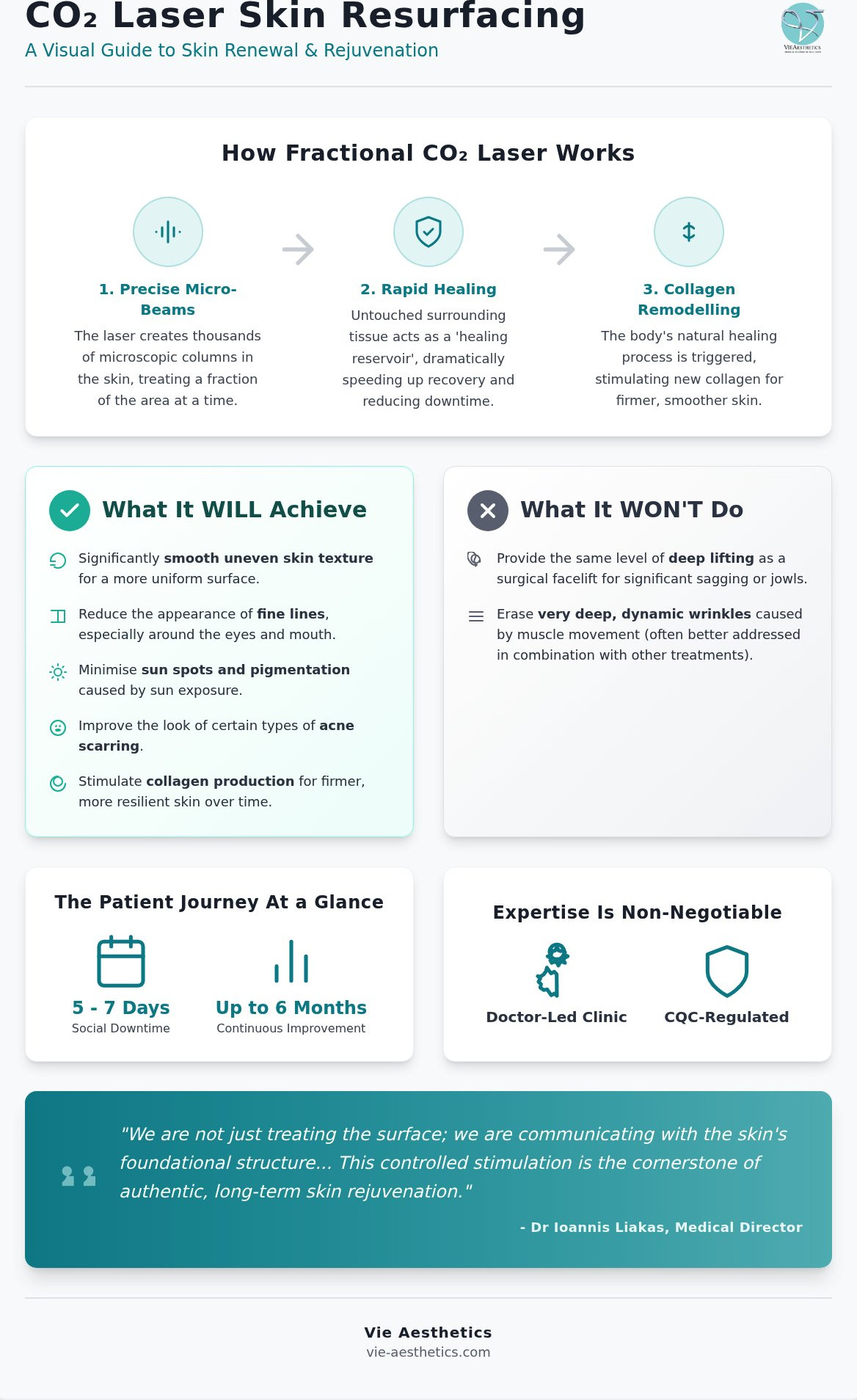
A key innovation that has made this treatment more accessible is fractional technology. Instead of treating the entire surface area, fractional lasers create microscopic columns of treatment, leaving surrounding skin untouched to act as a healing reservoir. This maintains efficacy whilst significantly reducing the recovery period.
The science behind CO2 laser is elegantly simple yet powerful. The laser emits a wavelength of light that is readily absorbed by water in the skin cells. This energy vaporises thin layers of skin in a controlled manner, removing sun-damaged or texturally uneven cells from the surface.
This process also delivers a thermal effect into the deeper dermal layers, which the body interprets as a controlled injury. This triggers a natural healing cascade, flooding the area with growth factors and stimulating the production of new, healthy collagen and elastin—the essential proteins for firm, resilient skin.
The precision of the laser ensures this regenerative process happens without harming the surrounding tissue, leading to a focused and effective renewal.
Early CO2 lasers were ‘fully ablative’, meaning they removed the entire top layer of skin. While effective, this approach came with extensive downtime and a higher risk of side effects. The introduction of fractional technology revolutionised the procedure.
A fractional laser creates a grid-like pattern of micro-injuries, like pixels on a screen. This treats a ‘fraction’ of the skin at a time, promoting much faster healing and making it a more practical choice for modern, busy lifestyles. A doctor-led consultation is essential to determine the correct depth and density for your specific skin needs, ensuring a truly personalised treatment.
The true power of CO2 laser treatment lies in its ability to stimulate deep structural renewal, not just a surface-level glow. By creating thousands of controlled micro-injuries, it kickstarts the body’s innate regenerative capabilities in the deep dermal layers.
“We are not just treating the surface; we are communicating with the skin’s foundational structure. A CO2 laser sends a precise signal to the dermis to rebuild itself stronger and healthier. This controlled stimulation is the cornerstone of authentic, long-term skin rejuvenation.”– Dr Ioannis Liakas, Medical Director at Vie Aesthetics
We prefer to discuss ‘areas of focus’ rather than ‘problem areas’. Whether your focus is on the texture around the mouth (perioral lines) or sun-induced changes on the cheeks, the treatment is tailored to encourage your skin to rebuild in a more organised, youthful way.
One of the most celebrated outcomes of CO2 laser is its ability to create a smoother, more uniform canvas. The laser meticulously vaporises the uneven, damaged cells that contribute to rough texture and blotchy pigmentation from sun exposure.
As the skin heals, new cells form a more uniform surface, and the newly stimulated collagen thickens the dermis. This not only improves the skin’s appearance but also its fundamental health and resilience against future environmental stressors.
The treatment is particularly effective for static fine lines—the ones that are visible when your face is at rest, often found around the eyes and mouth. By resurfacing the top layer and building new collagen beneath, it softens these lines for a naturally refreshed look.
It is important to have realistic expectations. While CO2 laser is brilliant for surface and textural concerns, it is not designed to address significant skin laxity or deep facial sagging. The long-term benefit is healthier, stronger skin that ages more gracefully, an investment in your skin’s future.
In today’s aesthetic landscape, the choice is no longer about which single treatment is ‘best’, but which combination is best for *you*. Understanding how different technologies work is the key to making an empowered decision that aligns with your lifestyle, goals, and anatomy.
At Vie Aesthetics, we use a selection framework that positions CO2 laser as the ‘Gold Standard for Surface’, whilst other modalities target different layers for a comprehensive, 3D approach to rejuvenation. Often, the most natural-looking and satisfying results come from combining treatments.
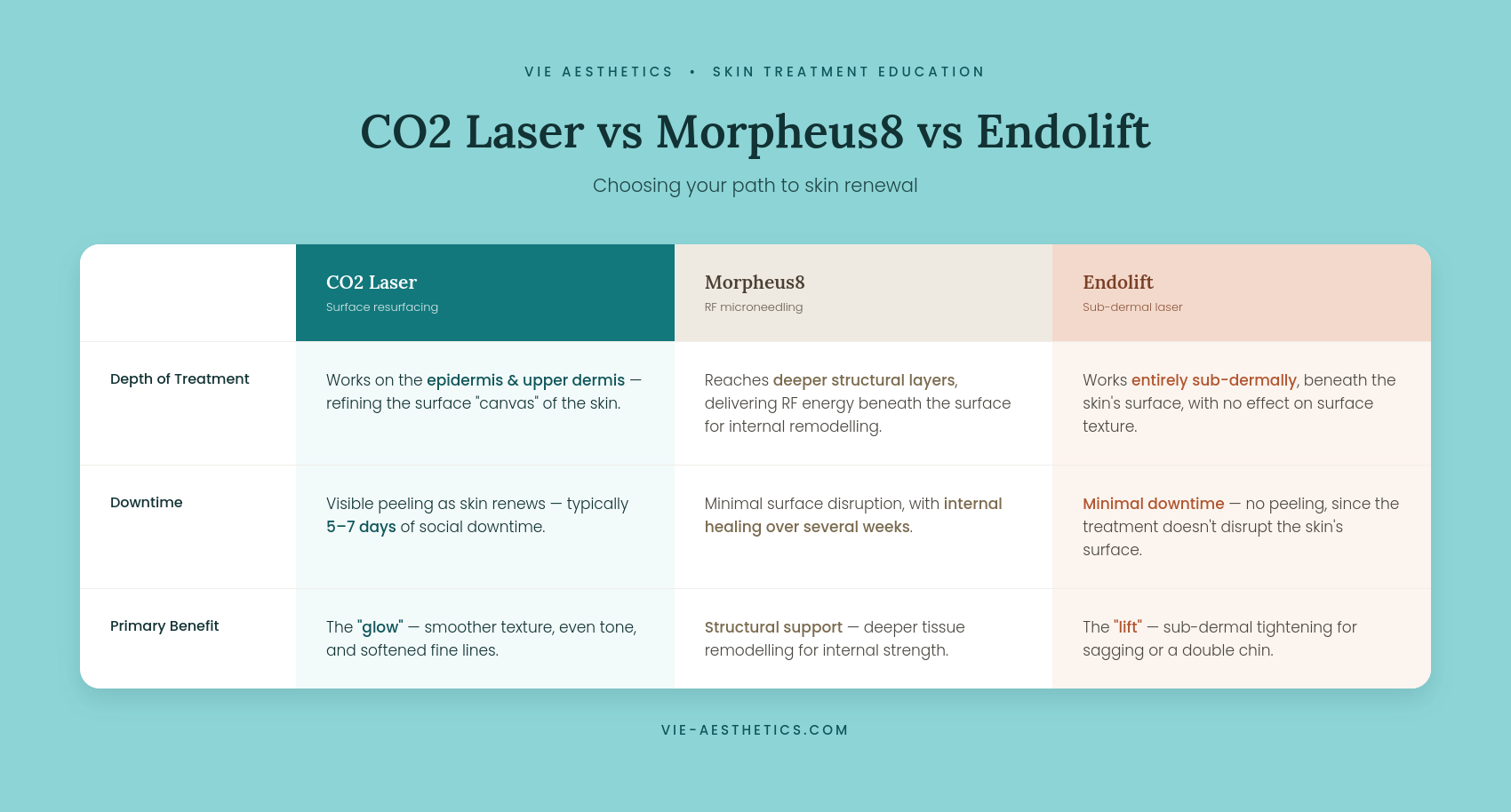
The key difference is depth. CO2 laser excels at refining the epidermis and upper dermis, creating a smooth, even surface. Morpheus8, on the other hand, uses a combination of microneedling and radiofrequency (RF) energy to remodel collagen at a much deeper level.
Think of it as perfecting the paintwork versus strengthening the foundations. If your main concern is sun spots and fine lines, CO2 laser might be your primary choice. If you are looking to address skin laxity and build deep structural support, Morpheus8 could be more suitable. Their downtime also differs; CO2 involves visible peeling, whereas Morpheus8’s recovery is primarily internal with minimal surface disruption.
This comparison highlights the difference between resurfacing and ‘soft surgery’ lifting. While CO2 laser renews the skin’s surface, Endolift works from beneath the skin.
Endolift uses a hair-thin micro-optical fibre inserted under the skin to deliver laser energy that melts fat and tightens the skin’s deep support structures. A patient concerned with a ‘double chin’ or jowl laxity would likely benefit more from Endolift’s lifting capabilities, whereas someone focused on crepey skin texture would be a prime candidate for CO2 laser.
Your journey with us is designed to be unhurried, supportive, and educational. It begins with a detailed consultation where we listen to your aspirations and assess your skin to create a treatment plan that feels right for you.
We believe in full transparency, especially around comfort and recovery. Our commitment to patient safety is reflected in our CQC-regulated environment and our focus on preparing your skin properly with our medical-grade VieDerma skincare range to optimise your results.
“A successful outcome is built long before the laser is ever switched on. It is built on trust, a thorough understanding of the patient’s goals, and meticulous skin preparation. This holistic approach is what defines medical excellence.” – Dr Ioannis Liakas, Medical Director at Vie Aesthetics
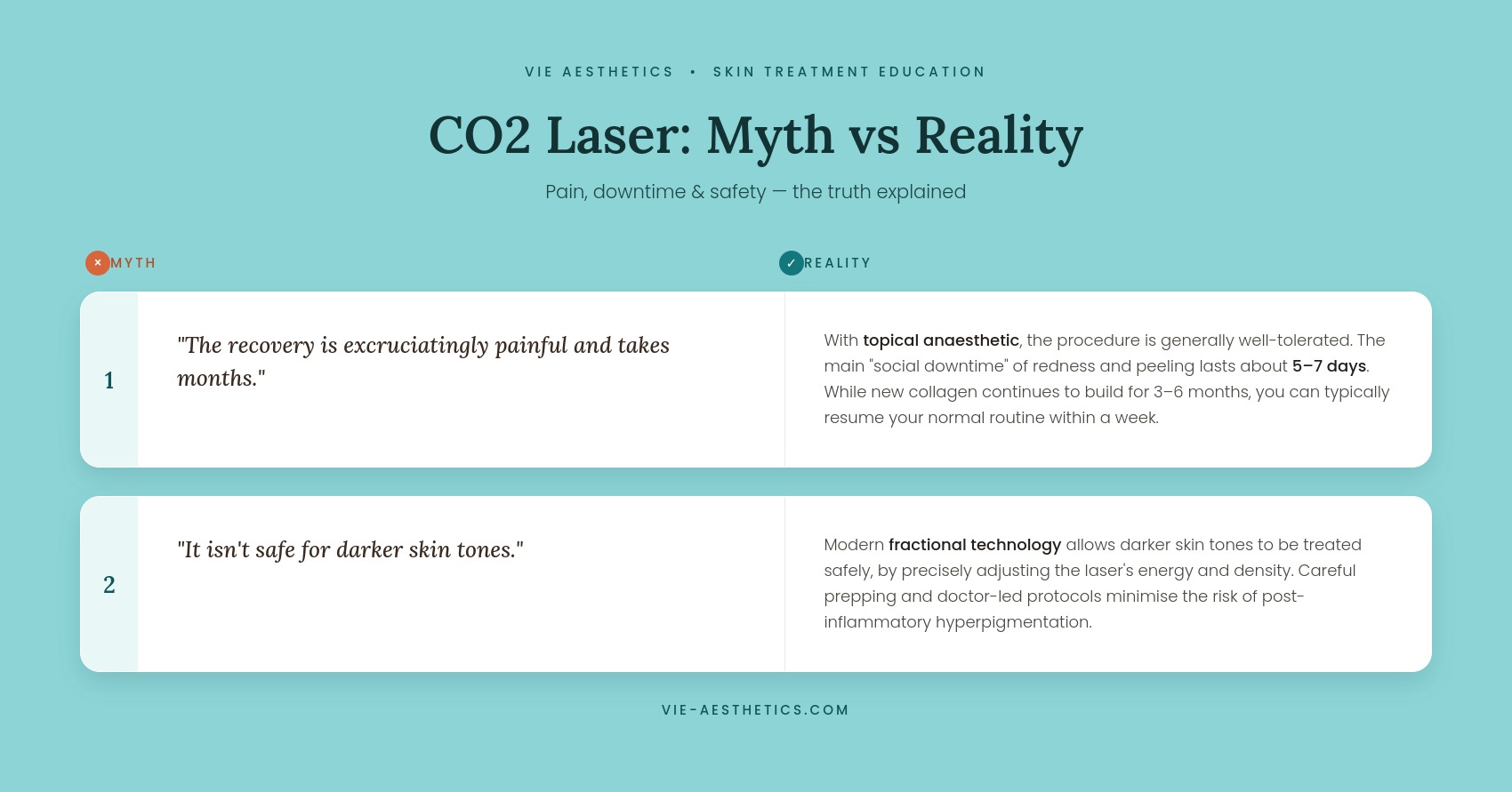
There is a lot of outdated information about CO2 laser online. Let’s separate fact from fiction.
Preparation is a non-negotiable part of the journey. For 2-4 weeks prior to your treatment, you will be advised to follow a specific skincare regimen. This typically involves avoiding direct sun exposure and using active ingredients that strengthen your skin barrier and regulate pigment production.
Using medical-grade skincare, like our VieDerma range, ensures your skin is in the healthiest possible state to receive the treatment and heal efficiently. Education is a key part of this process; we ensure you understand the ‘why’ behind every step.
We are honest about the recovery: for 5-7 days, you will experience what we call ‘social downtime’. Your skin will look and feel like it has a significant sunburn, followed by a period of peeling as the old skin gives way to the new.
We provide actionable, empathetic advice for managing this phase, from cooling techniques to the best ways to keep your skin hydrated. Most importantly, you are never alone. Our clinical team is available to support you with any questions or concerns throughout your healing process.
Choosing a provider for a treatment like CO2 laser is a decision based on trust and expertise. At Vie Aesthetics, we operate on a ‘Doctors Only’ policy for all our advanced aesthetic procedures, ensuring you are in the safest, most qualified hands.
Our commitment to excellence is recognised by over 30 industry awards and reflected in the thousands of 5-star patient reviews we have received. We create bespoke treatment plans because we know that your skin journey is unique. To make our innovations accessible, we also offer interest-free finance options.
Patient safety is our highest priority. Our CQC ‘Outstanding’ ratings are a testament to our rigorous standards and patient-centric care. Being an Investors in People Gold provider highlights our dedication to our team, which translates directly into the quality of care you receive.
We invite you to learn more about the experts who will be guiding your journey. Getting to know our team can help build the rapport and trust that are so vital to a positive experience. You can meet our dedicated clinicians here.
The next step is yours to take, without pressure. A consultation is a chance for you to ask questions, explore your options, and gain the confidence you need to move forward. For those committed to long-term skin health, our Vie Membership scheme offers a structured way to maintain your results.
We are here to help you feel empowered and informed, ready to make the best decision for your personal transformation.
We take every measure to ensure your comfort. A strong topical anaesthetic cream is applied for at least 60 minutes before the procedure, which significantly minimises discomfort. Most patients describe the sensation as a warm, prickling feeling.
For many patients, a single session provides a significant and satisfying improvement. However, for deeper textural concerns or acne scarring, a course of 2-3 treatments spaced at least 6 months apart may be recommended for optimal results.
This requires expert assessment. While traditional CO2 lasers carry a higher risk of post-inflammatory hyperpigmentation (PIH) on darker skin tones (Fitzpatrick types IV-VI), modern fractional devices with adjusted settings can often be used safely. A mandatory 4-week skin preparation protocol with specific skincare is essential to minimise risks.
An ablative laser removes the entire top layer of skin, leading to longer downtime. A fractional laser, which we use, treats the skin in a pixelated pattern, leaving tiny bridges of untreated skin. This allows for much faster healing, typically reducing social downtime to 5-7 days.
The results can be very long-lasting. The collagen you build is your own and can last for several years. However, the ageing process continues, so maintaining results with diligent sun protection and a medical-grade skincare routine is crucial.
You should wait until the initial peeling phase is complete and the surface of your skin has fully re-epithelialised. This typically takes around 7 to 10 days. Using mineral-based makeup is often recommended initially as it is less likely to irritate new skin.
Yes, we offer interest-free finance options to help make our treatments more accessible. You can spread the cost over a period of up to 12 months, allowing you to invest in your skin without financial pressure.
Article by
Vicky Grammatikopoulou, BHons, MA, PGCE
Vicky Grammatikopoulou is the founder and CEO of Vie Aesthetics, a multi-award winning UK-based aesthetics business built on a philosophy of safety, excellence, education, innovation, and empowerment.
Navigating the world of advanced skin treatments can feel overwhelming, especially when weighing a time-tested gold standard against newer innovations. If you are considering a CO2 laser treatment, you want clear, honest information to help you decide if it is the right choice for your skin journey. This guide provides a comprehensive comparison, explaining how a CO2 laser treatment works and how it stands against alternatives like Morpheus8 and Endolift.
CO2 laser treatment is a highly precise method of skin resurfacing that uses focused beams of light from carbon dioxide. For decades, it has been trusted by medical practitioners to achieve transformative results by methodically removing damaged outer layers of skin.
The philosophy behind its use has evolved. We have moved away from the outdated language of ‘fixing flaws’ towards a more empowering approach of ‘enhancing’ skin health and vitality. It remains a clinical favourite because of its unparalleled ability to create significant, lasting improvements in skin texture and tone.
A key innovation that has made this treatment more accessible is fractional technology. Instead of treating the entire surface area, fractional lasers create microscopic columns of treatment, leaving surrounding skin untouched to act as a healing reservoir. This maintains efficacy whilst significantly reducing the recovery period.
The science behind CO2 laser is elegantly simple yet powerful. The laser emits a wavelength of light that is readily absorbed by water in the skin cells. This energy vaporises thin layers of skin in a controlled manner, removing sun-damaged or texturally uneven cells from the surface.
This process also delivers a thermal effect into the deeper dermal layers, which the body interprets as a controlled injury. This triggers a natural healing cascade, flooding the area with growth factors and stimulating the production of new, healthy collagen and elastin—the essential proteins for firm, resilient skin.
The precision of the laser ensures this regenerative process happens without harming the surrounding tissue, leading to a focused and effective renewal.
Early CO2 lasers were ‘fully ablative’, meaning they removed the entire top layer of skin. While effective, this approach came with extensive downtime and a higher risk of side effects. The introduction of fractional technology revolutionised the procedure.
A fractional laser creates a grid-like pattern of micro-injuries, like pixels on a screen. This treats a ‘fraction’ of the skin at a time, promoting much faster healing and making it a more practical choice for modern, busy lifestyles. A doctor-led consultation is essential to determine the correct depth and density for your specific skin needs, ensuring a truly personalised treatment.
The true power of CO2 laser treatment lies in its ability to stimulate deep structural renewal, not just a surface-level glow. By creating thousands of controlled micro-injuries, it kickstarts the body’s innate regenerative capabilities in the deep dermal layers.
“We are not just treating the surface; we are communicating with the skin’s foundational structure. A CO2 laser sends a precise signal to the dermis to rebuild itself stronger and healthier. This controlled stimulation is the cornerstone of authentic, long-term skin rejuvenation.”– Dr Ioannis Liakas, Medical Director at Vie Aesthetics
We prefer to discuss ‘areas of focus’ rather than ‘problem areas’. Whether your focus is on the texture around the mouth (perioral lines) or sun-induced changes on the cheeks, the treatment is tailored to encourage your skin to rebuild in a more organised, youthful way.
One of the most celebrated outcomes of CO2 laser is its ability to create a smoother, more uniform canvas. The laser meticulously vaporises the uneven, damaged cells that contribute to rough texture and blotchy pigmentation from sun exposure.
As the skin heals, new cells form a more uniform surface, and the newly stimulated collagen thickens the dermis. This not only improves the skin’s appearance but also its fundamental health and resilience against future environmental stressors.
The treatment is particularly effective for static fine lines—the ones that are visible when your face is at rest, often found around the eyes and mouth. By resurfacing the top layer and building new collagen beneath, it softens these lines for a naturally refreshed look.
It is important to have realistic expectations. While CO2 laser is brilliant for surface and textural concerns, it is not designed to address significant skin laxity or deep facial sagging. The long-term benefit is healthier, stronger skin that ages more gracefully, an investment in your skin’s future.
In today’s aesthetic landscape, the choice is no longer about which single treatment is ‘best’, but which combination is best for *you*. Understanding how different technologies work is the key to making an empowered decision that aligns with your lifestyle, goals, and anatomy.
At Vie Aesthetics, we use a selection framework that positions CO2 laser as the ‘Gold Standard for Surface’, whilst other modalities target different layers for a comprehensive, 3D approach to rejuvenation. Often, the most natural-looking and satisfying results come from combining treatments.
The key difference is depth. CO2 laser excels at refining the epidermis and upper dermis, creating a smooth, even surface. Morpheus8, on the other hand, uses a combination of microneedling and radiofrequency (RF) energy to remodel collagen at a much deeper level.
Think of it as perfecting the paintwork versus strengthening the foundations. If your main concern is sun spots and fine lines, CO2 laser might be your primary choice. If you are looking to address skin laxity and build deep structural support, Morpheus8 could be more suitable. Their downtime also differs; CO2 involves visible peeling, whereas Morpheus8’s recovery is primarily internal with minimal surface disruption.
This comparison highlights the difference between resurfacing and ‘soft surgery’ lifting. While CO2 laser renews the skin’s surface, Endolift works from beneath the skin.
Endolift uses a hair-thin micro-optical fibre inserted under the skin to deliver laser energy that melts fat and tightens the skin’s deep support structures. A patient concerned with a ‘double chin’ or jowl laxity would likely benefit more from Endolift’s lifting capabilities, whereas someone focused on crepey skin texture would be a prime candidate for CO2 laser.
Your journey with us is designed to be unhurried, supportive, and educational. It begins with a detailed consultation where we listen to your aspirations and assess your skin to create a treatment plan that feels right for you.
We believe in full transparency, especially around comfort and recovery. Our commitment to patient safety is reflected in our CQC-regulated environment and our focus on preparing your skin properly with our medical-grade VieDerma skincare range to optimise your results.
“A successful outcome is built long before the laser is ever switched on. It is built on trust, a thorough understanding of the patient’s goals, and meticulous skin preparation. This holistic approach is what defines medical excellence.” – Dr Ioannis Liakas, Medical Director at Vie Aesthetics
There is a lot of outdated information about CO2 laser online. Let’s separate fact from fiction.
Preparation is a non-negotiable part of the journey. For 2-4 weeks prior to your treatment, you will be advised to follow a specific skincare regimen. This typically involves avoiding direct sun exposure and using active ingredients that strengthen your skin barrier and regulate pigment production.
Using medical-grade skincare, like our VieDerma range, ensures your skin is in the healthiest possible state to receive the treatment and heal efficiently. Education is a key part of this process; we ensure you understand the ‘why’ behind every step.
We are honest about the recovery: for 5-7 days, you will experience what we call ‘social downtime’. Your skin will look and feel like it has a significant sunburn, followed by a period of peeling as the old skin gives way to the new.
We provide actionable, empathetic advice for managing this phase, from cooling techniques to the best ways to keep your skin hydrated. Most importantly, you are never alone. Our clinical team is available to support you with any questions or concerns throughout your healing process.
Choosing a provider for a treatment like CO2 laser is a decision based on trust and expertise. At Vie Aesthetics, we operate on a ‘Doctors Only’ policy for all our advanced aesthetic procedures, ensuring you are in the safest, most qualified hands.
Our commitment to excellence is recognised by over 30 industry awards and reflected in the thousands of 5-star patient reviews we have received. We create bespoke treatment plans because we know that your skin journey is unique. To make our innovations accessible, we also offer interest-free finance options.
Patient safety is our highest priority. Our CQC ‘Outstanding’ ratings are a testament to our rigorous standards and patient-centric care. Being an Investors in People Gold provider highlights our dedication to our team, which translates directly into the quality of care you receive.
We invite you to learn more about the experts who will be guiding your journey. Getting to know our team can help build the rapport and trust that are so vital to a positive experience. You can meet our dedicated clinicians here.
The next step is yours to take, without pressure. A consultation is a chance for you to ask questions, explore your options, and gain the confidence you need to move forward. For those committed to long-term skin health, our Vie Membership scheme offers a structured way to maintain your results.
We are here to help you feel empowered and informed, ready to make the best decision for your personal transformation.
We take every measure to ensure your comfort. A strong topical anaesthetic cream is applied for at least 60 minutes before the procedure, which significantly minimises discomfort. Most patients describe the sensation as a warm, prickling feeling.
For many patients, a single session provides a significant and satisfying improvement. However, for deeper textural concerns or acne scarring, a course of 2-3 treatments spaced at least 6 months apart may be recommended for optimal results.
This requires expert assessment. While traditional CO2 lasers carry a higher risk of post-inflammatory hyperpigmentation (PIH) on darker skin tones (Fitzpatrick types IV-VI), modern fractional devices with adjusted settings can often be used safely. A mandatory 4-week skin preparation protocol with specific skincare is essential to minimise risks.
An ablative laser removes the entire top layer of skin, leading to longer downtime. A fractional laser, which we use, treats the skin in a pixelated pattern, leaving tiny bridges of untreated skin. This allows for much faster healing, typically reducing social downtime to 5-7 days.
The results can be very long-lasting. The collagen you build is your own and can last for several years. However, the ageing process continues, so maintaining results with diligent sun protection and a medical-grade skincare routine is crucial.
You should wait until the initial peeling phase is complete and the surface of your skin has fully re-epithelialised. This typically takes around 7 to 10 days. Using mineral-based makeup is often recommended initially as it is less likely to irritate new skin.
Yes, we offer interest-free finance options to help make our treatments more accessible. You can spread the cost over a period of up to 12 months, allowing you to invest in your skin without financial pressure.